How thick should insulated roof panels be for a heated building?
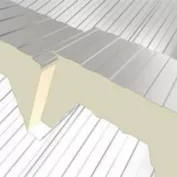
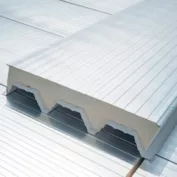
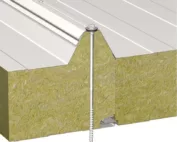
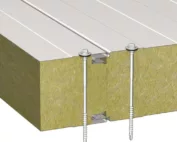
Insulated sandwich panels
The thickness of a sandwich panel roof in a heated building should be selected primarily according to the required U-value for the specific product, not solely from a thermal table. Check the declared Uc, load-bearing capacity and deflection for the given support arrangement, the effect of the facing colour, and the airtightness of joints and service penetrations. PIR allows good performance at a small thickness, but the core alone does not ensure airtightness – the entire installation determines the result. Determine the target U for the building's conditions of use.
What thermal parameter should the roof have?
The target U-value is determined for a specific building and its conditions of use. Continuous heating, a humid process or intermittent use change the assumptions. Thickness should not be selected solely on the basis of hall area. A large and a small roof slope may have the same unit requirements but a different total share of losses.
Check how a given manufacturer declares the U-value of the panel and what the corrected value takes into account. The core is not the only element of the system. Joints and fixings affect the result. Values from different tables should be compared under consistent assumptions. The lambda of the foam alone does not replace the data for the finished roof panel.
What thicknesses do actual data sheets show?
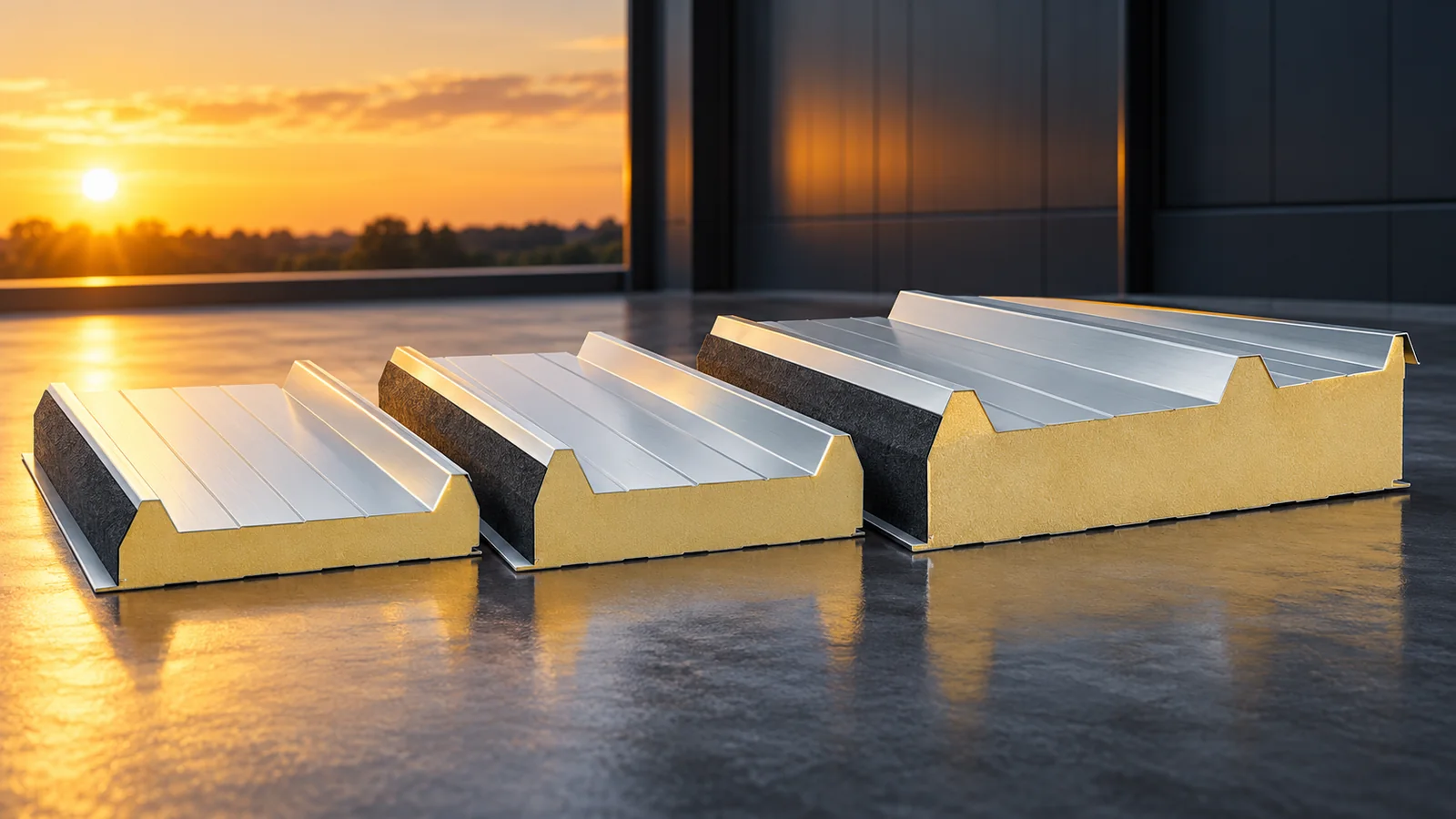
In one datasheet, a 145 mm PIR roof panel achieves Uc = 0.15 W/(m²·K), and 160 mm achieves Uc = 0.14. In another catalogue, the value 0.15 is given for a panel designated 150/195 mm. The first number describes the nominal thickness, the second the total height with the outer profile. These are different products and their parameters should not be mixed.
The examples show that the abbreviation “150 panel” alone can be imprecise. In your enquiry, state the required U-value and the panel type, then check the dimension and the other data. Do not attribute the full trapezoidal height to the core. Such an error overstates the assessment of the amount of insulation in the roof.
Why must the structure be checked?
The roof carries its own weight, snow, wind and other foreseen loads. Panel selection requires tables for the specific facings and support arrangement. Load-bearing capacity and deflection are checked. The required span may determine the panel type regardless of whether a thinner variant would be sufficient thermally.
Take into account equipment and planned photovoltaics. Fixings must not transfer loads in an arbitrary manner. The colour of the outer facing also matters because it affects its heating. Long, dark panels may require different restrictions than light ones. The aesthetic choice is best made before checking the structure and ordering components.

Does a thicker core remove the risk of moisture?
A better thermal parameter helps limit cooling of the building envelope, but airtightness remains essential. Moist air can pass through joints to colder places. The ridge, eaves and wall connection require a continuous insulation and sealing solution.
Ventilation must also be matched to how the building is used. In a hall with a lot of steam, the conditions will be different from those in a dry warehouse. It should not be assumed that metal cladding automatically forms a sealed barrier everywhere. The overall installation decides the outcome, including service penetrations and roof openings.
How does thickness affect detailing and installation?
Changing the panel may require different fasteners, flashings and positioning of components. Check the height at the eaves, ridge, walls and rooflights. The dimensions should match the core and profile of the selected system. Flashings should not be ordered on the basis of an approximate thickness name.
It is worth drawing out the lengths and the division of the roof slope. Continuous panels reduce the number of transverse joints, but they must fall within the permitted lengths and transport capabilities. At longitudinal joints, the requirements for slope and tightness change. Cutting on site should not replace an accurate schedule before production.
When is greater thickness economical?
Compare neighbouring variants in a full cost estimate. Part of the labour, equipment and transport may remain similar, so the surcharge for better thermal insulation need not dominate the budget. However, a specific payback time should not be promised without calculating the building’s losses and the cost of energy.
The choice must take into account fire requirements and the full scope of classification. PIR is not non-combustible, and the roof class depends on the assembly. Where several variants meet all the requirements, the operating cost and the margin of parameters can be compared. A well-chosen thickness brings a benefit when the panel is correctly supported, fixed and tightly connected to the rest of the building.
A simple calculation shows the scale of the difference. With an area of 1000 m² and a temperature difference of 20 K, lowering U from 0.21 to 0.15 W/(m²·K) reduces the calculated loss flux through the surface alone by 1200 W. This is the result of multiplying the difference in U by the area and the temperature difference. It is not an annual energy saving or an amount on the bill. Calculating that requires variable weather conditions, heating time, system efficiency and other losses. Such an example helps to assess the direction of the change without promising something that cannot be justified for a specific building.
7 branches. Materials closer to your project.