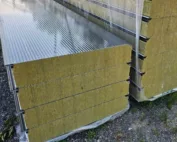
Core conductivity or panel U-value? Checking a quotation for a hall wall
PIR insulation
A hall specification calls for a particular U-value, but the sandwich panel quotation gives only the conductivity of the PIR core. The figures cannot be compared directly. One describes heat transfer through a specified element; the other is a material property. Look up the manufacturer’s U-value for the wall panel model and thickness being offered, then check whether the design requirement applies to the panel or to the complete wall with its junctions. Here is how to put those figures side by side and recognise when the quotation still leaves a question unanswered.
In this guide
Two figures describing different things
The unit is a useful first check: λ is expressed in W/(m·K), whereas U is expressed in W/(m²·K). If the symbols and units on the two sides of your comparison do not match, stop there. A small number is not evidence that the specification is met.
Identify the panel in the quotation first
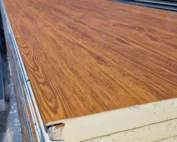
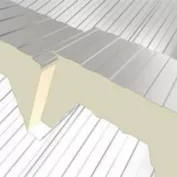
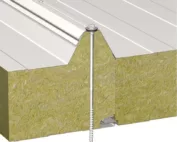
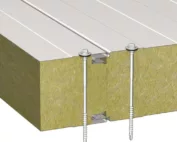
Ask for the full panel designation rather than a shorthand such as “PIR 100”. A product family may include both wall and roof versions. For a hall facade, attach the wall version’s data sheet and identify its joint type.
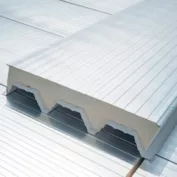
Check what the dimension on the section drawing measures. Core thickness need not be the maximum depth of a profiled element. If a roof schedule gives two dimensions, do not carry either into the wall schedule without checking the drawing key.
Find the matching row in the U-value table
In the selected model’s sheet, read the thermal transmittance from the row for the thickness you will actually order. Record the table number and catalogue edition. If the supplier changes the model in a revised quotation, you can see immediately which lookup must be repeated.
Read the notes beneath the table as well. If the manufacturer explains whether a joint is included or defines the scope of the value, keep the note with the figure. Silence does not establish that every connection in the finished facade is accounted for.
What does the core calculation actually tell us?
For an arithmetic illustration, take a uniform core 0.100 m thick with an assumed conductivity of 0.025 W/(m·K). Dividing thickness by conductivity gives 4.00 m²·K/W. This is the resistance of the modelled core layer, not a test result or a declaration for the panel on offer.
The reciprocal is 0.25 W/(m²·K). The unit now looks like a U-value, but the model still covers the core alone. Do not enter the result under “manufacturer’s panel U-value”; leave that field for the figure documented for the actual product.
Where do the panel data stop?
At the base, at corners and around a vehicle door, the panel meets another element. Mark the boundary between the panel field and those junctions. You can then ask the designer a precise question: which junctions were assessed separately, and in which calculation?
A blanket percentage added for thermal bridges is not a reliable correction to a catalogue figure. Without knowing its scope, you may count some effects twice. Show the panel value in the tender comparison and keep assessment of the designed junctions as a separate item.
Resolve the open points before ordering
One line per option is enough for the comparison: product designation, wall application, thickness, U-value with table reference, and the requirement against which it was checked. Add core conductivity in a separate column if it is needed for further analysis.
If the supplier gives only the foam name and its conductivity, record “U-value for the offered panel not supplied” and request the sheet. That is more informative than rejecting a potentially suitable panel or accepting one on the strength of the wrong property.
7 branches. Materials closer to your project.