How should you cut insulated panels without damaging the facings?
Insulated panels
Insulated panels are cut with tools suited to the metal facings and the core. Edge heating must be limited, the component well supported and swarf removed quickly. An angle grinder with a grinding disc is not the right choice for this task. Before cutting, check the instructions for the chosen system and the finishing detail. A clean cut alone is not enough if the core is left exposed or the sheet’s protection is damaged after the work. The facing is thin sheet protected against corrosion. High temperature and sparks can damage its protective layers. Metal particles left on the surface begin to corrode and leave marks on the paint. They are not always visible immediately after the work is finished.
Why does the cutting method matter?
The facing is thin steel sheet protected against corrosion. High temperature and sparks can damage its protective layers. Metal particles left on the surface begin to corrode and form marks on the paint. They are not always visible immediately after work is finished. Therefore both the tool and the cleaning of the cutting area are important.
The core requires adequate support and preservation of the bond with the facings. Tearing the cut-off fragment can damage the edge. When cutting larger openings, the load-bearing capacity of the panel also comes into play. Not every opening can be made without additional structure. Before work, therefore, not only the cutting line must be determined but also how loads are transferred and how the detail will later be closed.
What tools are used for panels?
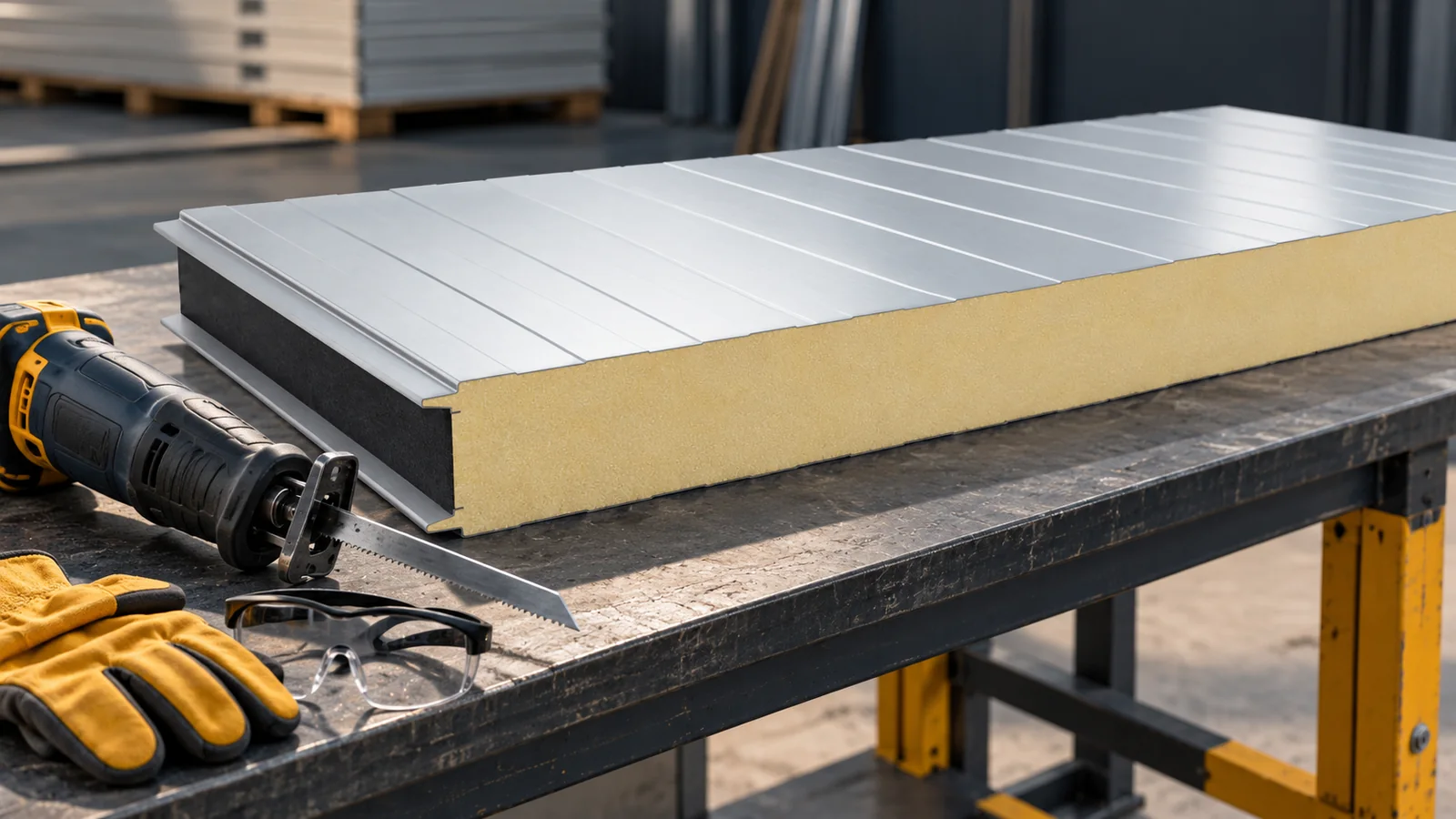
The instructions permit, among other things, suitable circular saws with fine-toothed blades, sabre saws or jigsaws. The choice depends on the material, thickness and type of cut. The accessory should be intended for metal facings and for the given task. Not every toothed blade should be equated with a tool suitable for insulated panels.
Small sheet metal work is often cut with shears. The panel itself must be cut in a way that preserves the geometry of both facings. Angle grinders and other methods causing strong heating are excluded or discouraged in the instructions. The rules for the specific product take precedence over the installer’s habits. This also applies to the recommended speed, guidance and blade selection.
How should the component and the workplace be prepared?
Check the dimensions on the panel and compare them with the wall or roof layout. Mark the side that is to remain. Support the element so that the cut-off part does not break off under its own weight. The support surface should not scratch the paint. Ensure the cables are in a stable position and that the tool can be guided freely.
Before work, inspect the area beneath the panel and remove objects that could be accidentally damaged. Use eye, hand and hearing protection appropriate to the tool. With a mineral wool core, limit contact with dust and fibres in accordance with the rules for working with the material. Do not cut on a loose pack without ensuring that support and access are adequate. A safe workstation also helps maintain accuracy.

How are openings for installations made?
First determine the size and position of the opening relative to the supports, the interlock and the panel edge. A large cut-out may weaken the element or require a structural frame. The principle for a small conduit must not be transferred to a large ventilation duct. On a roof, drainage around the penetration must also be provided for.
The method of forming the opening should come from the design and the system documentation. In a partition with the required fire resistance, an appropriate penetration solution is needed. Not every foam automatically maintains the EI or REI class. The opening should be prepared for a specific penetration, not first cut out as a larger section and then have a sealing method sought for it afterwards.
What should be done immediately after cutting?
Remove swarf and dust from both sides of the component and from the interlocking seams. Use a method that does not scratch the coating and does not rub particles into the paint. Inspect the cut edge and the adjacent surface. If the documentation specifies protection or a touch-up, use the appropriate material. Do not paint everything with a random paint without checking compatibility with the coating.
Protect the exposed core with the required detail. The treatment should protect against water and provide the intended sealing. Do not leave a cut panel in the rain while waiting for further installation. In the case of mineral wool, limiting its moisture absorption is particularly important. Also take care of the cut-off pieces if they are to be used elsewhere. Their interlocking seams and coatings require the same protection.
How can the number of on-site cuts be reduced?
Good measurement and panel layout before production bring the greatest benefit. Agree the lengths with the structure and the position of the openings. For large quantities, it is worth planning the installation sequence and the marking of components. This reduces the risk of cutting the wrong piece. Do not assume, however, that every offcut will fit another section of the wall.
At acceptance, check not only the cut line but also the condition of the coating, the cleanliness of the surface and the completeness of the flashings. A straight component with swarf left on it can still cause a problem. The aim is to preserve the properties of the panel after the dimension has been adjusted. A well-executed cut should end with a finished, protected detail, not merely with the cut-off part set aside.
7 branches. Materials closer to your project.