How can I check the available lengths of insulated roof panels from stock?
Sandwich panels
The available lengths of insulated roof panels must be checked for a specific stock batch. The catalogue states production possibilities, not the current stock level. Roof slope measurements, a support plan and details for the eaves and ridge are needed for selection. Also record the module, sheet thicknesses, overlap direction and edge condition. A well-chosen panel from stock can reduce waiting time, but requires just as precise fitting as a made-to-order product. Ask for the number of pieces in each length, not just the total area. Check the product designation, core, thickness, cover width and both facings. Determine the colour of each side and the reason for any price reduction.
What information should a stock list contain?
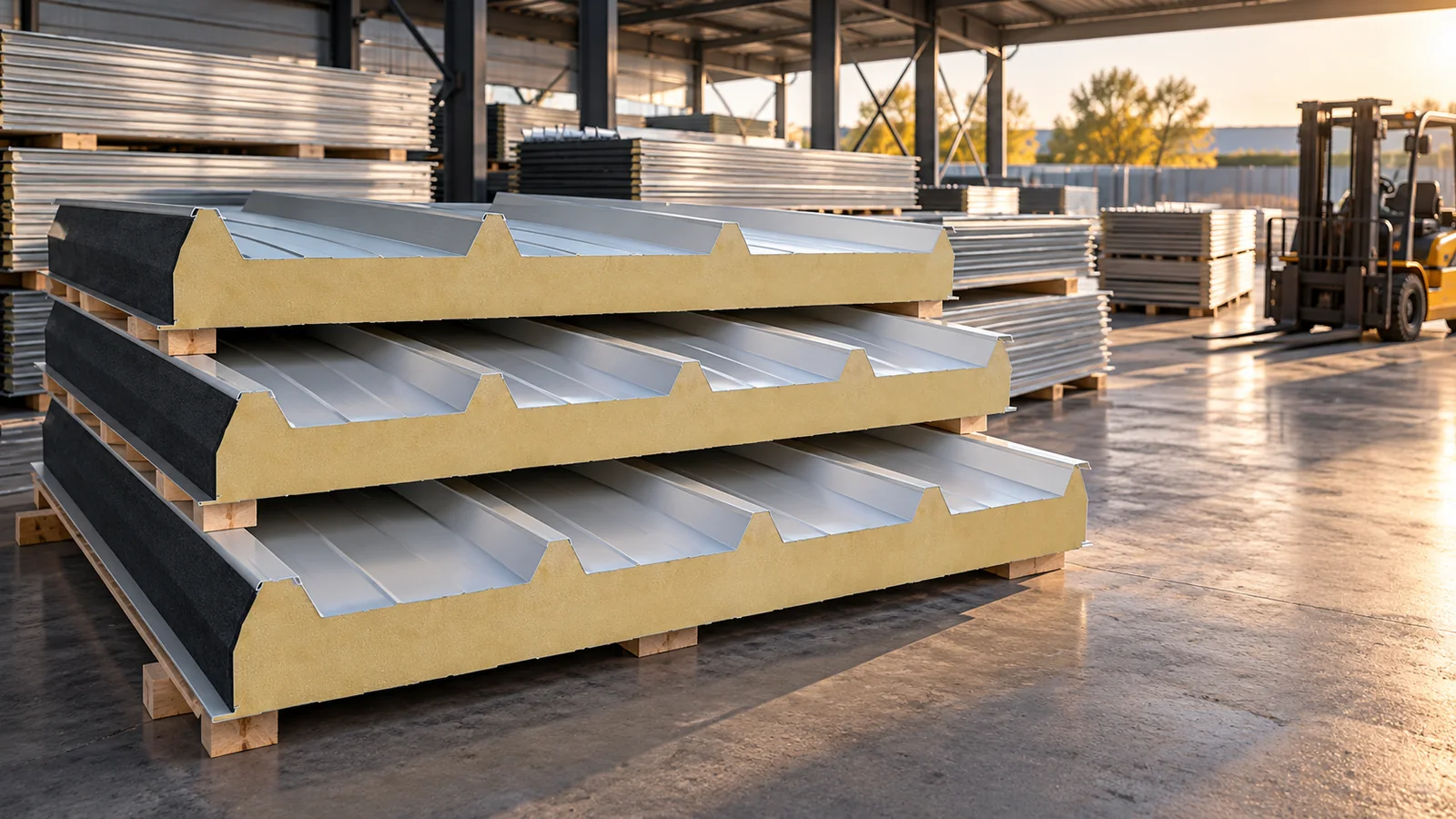
Ask for the number of pieces in each length, not just the total area. Check the product marking, core, thickness, cover width and both facings. Establish the colour of each side and the reason for any reduced price. The date the list was updated is important. Goods on a list from a few days ago may already be reserved.
Confirming a purchase requires identification of the actual components. Photos of the labels and the face of the pack help compare the offer with the data sheet. Do not assume that several panels of the same thickness come from one system. Differences in module or interlock may prevent them being laid together on the roof. Also check whether the order needed for installation can be maintained during unloading.
How do I determine the required panel length?
Measure the length along the slope, in accordance with the roof geometry. The horizontal dimension of the building is not a substitute. Take into account the position of the supports and the termination details. The overhang at the eaves, the junction at the ridge and any trimming of the core must follow from the design and the instructions. Do not add the same arbitrary allowance to every roof.
The panel should have proper bearing on the end supports. A longer section from stock cannot simply be left as an arbitrary cantilever. A shorter one does not become suitable by covering the missing fragment with a wide flashing. Before choosing the length, agree the layout with the installer and the designer. This allows cuts to be limited and avoids ordering components that do not fit the structure.
Does the catalogue length mean the permissible span?
No. The production length indicates what element can be manufactured. The span refers to the distance between supports. A panel several metres long can be supported on several purlins. Its load-bearing capacity depends on the structural scheme, the core, the steel sheets and the loads. It must not be assumed that the availability of a 12 m panel allows such a distance to be covered without additional checks.
Within one family of PIR roof panels the length range is 2–16 m, and for panels with mineral wool 2–10 m. These are the capabilities of specific products, with further restrictions depending on the variant. This is not confirmation that they are in stock. Colour, thickness and transport conditions can also limit the sense of using a very long element. Each delivery must be checked separately.

When can shorter panels be joined lengthwise?
A transverse joint must be provided for in the given system. It requires proper support, overlap and sealing. It may change the minimum roof pitch. Therefore two shorter sections are not a simple replacement for one long panel. The detail drawing and the direction of water drainage must be checked. The joint should not be improvised only during laying.
Determine whether the selected batch has a factory core rebate and on which side. Its orientation should match the planned installation. If on-site modification is required, it must be permitted and precisely executed. Cut-downs affect the amount of usable material. When comparing with a continuous panel, add the cost of the joint, additional seals and labour, not just the sum of the prices of the two sections.
How to check the condition of panels before reservation?
Inspect the roof profile, locks, ends and fixing points. Look for dents, delamination and traces of water in the pack. The coating should not be assessed solely through the protective film. Establish whether it can be checked by partial peeling and the deadline for removal in accordance with the instructions. Long storage requires verification of storage conditions, not automatic rejection or acceptance.
For second grade, request a description of the defects for each group of elements. A panel with a damaged end may need to be shortened, which changes the cutting plan. A damaged lock has a different significance than a minor colour difference. The documents should correspond to the delivered batch and specify the retained properties. Do not choose material for a demanding roof solely on the basis of length and price.
What to confirm in the order and transport?
Record the specific pieces, lengths and accepted defects. Confirm the reservation deadline and collection conditions. Attach a layout drawing to avoid mistakes in the overlap direction or colours. Agree on packaging and the order of elements. This means unloading does not require dismantling the entire delivery to find the first panel for installation.
Check access, storage space and lifting equipment. A long element needs proper support during transport and handling. Saving time only makes sense if logistics do not damage the goods. After delivery, compare labels and dimensions with the order. Stock availability is an advantage, but it does not replace matching the panel to the roof slope, supports and required roof parameters.
7 branches. Materials closer to your project.