When does a roof made of insulated panels need additional insulation?
Sandwich panels
A well-chosen roof made of insulated panels already has an insulating layer in its core and as a rule requires no additional insulation. The need for changes arises during thermal modernisation, a change of use, or when the existing system’s parameters are insufficient. First, the condition of the roof and the source of the problem must be checked. Adding material without assessing moisture, loads and tightness can bring new problems. A cold spot under the roof does not always mean the core is too thin. The cause may be a leaky ridge, an improperly compressed joint, missing insulation at the wall, or moisture from a leak. Each of these problems requires a different repair. Adding insulation over the entire surface may only mask the symptoms.
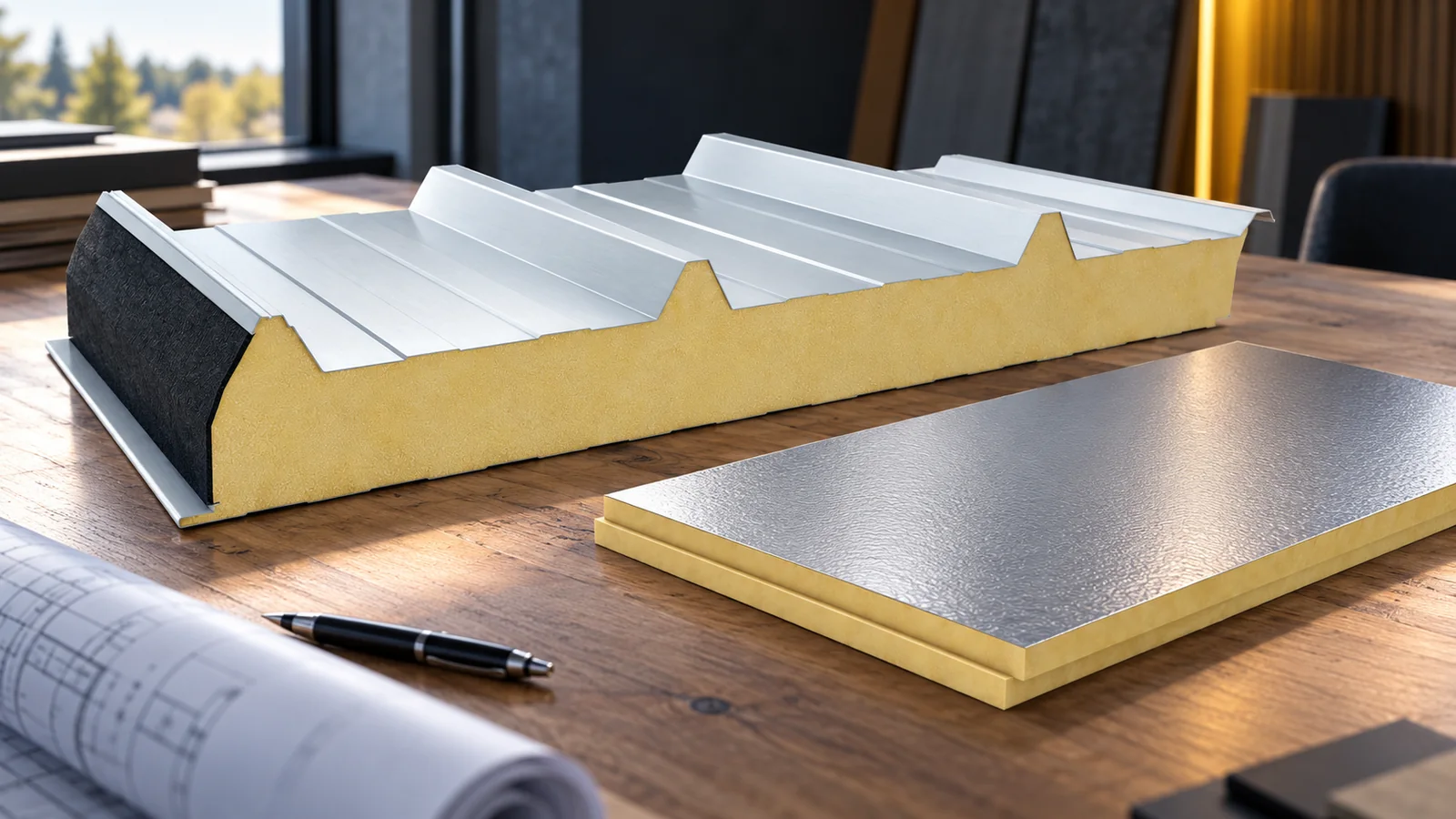
Is the problem due to the panel thickness?
A cold spot under the roof does not always mean the core is too thin. The cause may be a leaking ridge, an improperly tightened joint, missing insulation at the wall or moisture from a leak. Each of these problems requires a different repair. Adding insulation across the entire surface may only conceal the symptoms.
Check the panel documentation, their thickness and type. Assess the coatings, fixings and connections. An inspection under suitable conditions and a thermal survey can be helpful, but the result must be interpreted together with the condition of the building. If the facility changes function from unheated to heated, a new selection of the envelope properties is required.
When is additional insulation justified?
The reason may be a required lower U-value, improved comfort or adapting the building to new conditions of use. The decision should be based on a calculation of the entire system. It is worth comparing additional insulation with replacing the existing panels, especially when they are damaged or have an unknown specification.
In new buildings, the correct core thickness is often a simpler solution than designing a later additional layer. In renovation, the condition of the structure and the possibility of further use of the roof must be assessed. It should not be assumed that every old panel is a suitable substrate for a new system simply because no large dents are visible.
Before comparing variants, establish the time for which the building can remain without full cover. An operating warehouse requires different organisation than an empty garage. The cost of covers, downtime and phasing can be significant. If the old roof requires repair of coatings and replacement of numerous connections, adding insulation alone does not eliminate these expenses. The comparison should therefore include bringing both solutions to a similar technical condition, not just the purchase of new material.
Can the roof be insulated from below?
The possibility of such a change requires thermal and moisture analysis. Metal claddings are of great importance for vapour flow, and the additional layer changes the temperature distribution. A leaking connection may bring moist air to a cooler surface hidden behind the new construction.
Support, airtightness and finishing must be designed. PIR panels with soft facings must not be treated as an arbitrary self-supporting ceiling. The additional cover must meet fire requirements. If an installation space remains, its function and access must be defined. It is not enough to fill the gaps with foam and assume that the system cannot become damp.

What are the requirements for insulation from above?
New layers increase the load and change the roof level at the eaves, parapet and penetrations. The load-bearing capacity of the existing panels and structure must be checked, as must the method of fixing. Fasteners must transfer the relevant actions. Thin external steel sheet is not a universal substrate for every system.
The waterproofing and water drainage also change. New details are needed at rooflights, chimneys and outlets. Materials must be compatible with the adopted solution. If there is moisture beneath the old covering, the approach must be established before it is closed. The new layer should not perpetuate a problem that already exists in the roof.
How should the cost of additional PIR be estimated?
Allow for fixings, separation layers, waterproofing, flashings and labour as well as the insulation itself. The catalogue in force from 27 October 2026 listed one 150 mm PIR roof insulation board at the equivalent of €28.01 excluding VAT or €34.45 including VAT per m². That dated price applies to the specified insulation board. A sandwich panel is a separate product.
Purchase may require full packs and the addition of transport. The covering area is often smaller than the nominal dimension. Simply multiplying the roof area by the rate does not give the renovation price. It is worth asking for a comparison of full insulation upgrade with covering replacement, for the same target thermal effect.
What should be checked before work begins?
Prepare documentation of the existing build-up, a structural assessment and a design for the new layers. Establish how the interior will be protected from water during the renovation. Also check the impact of the changes on warranty conditions and fire classifications. The result for the old roof does not automatically carry over to the rebuilt build-up.
Acceptance should cover the fixing points, continuity of insulation and new flashings. Keep photographs before covering. Additional insulation makes sense when it solves a clearly defined problem and has been matched to the existing structure. If the source of losses is a leak, it must be eliminated first.
7 branches. Materials closer to your project.