Why does water appear on insulated sandwich panels and how can condensation be limited?
Insulated sandwich panels
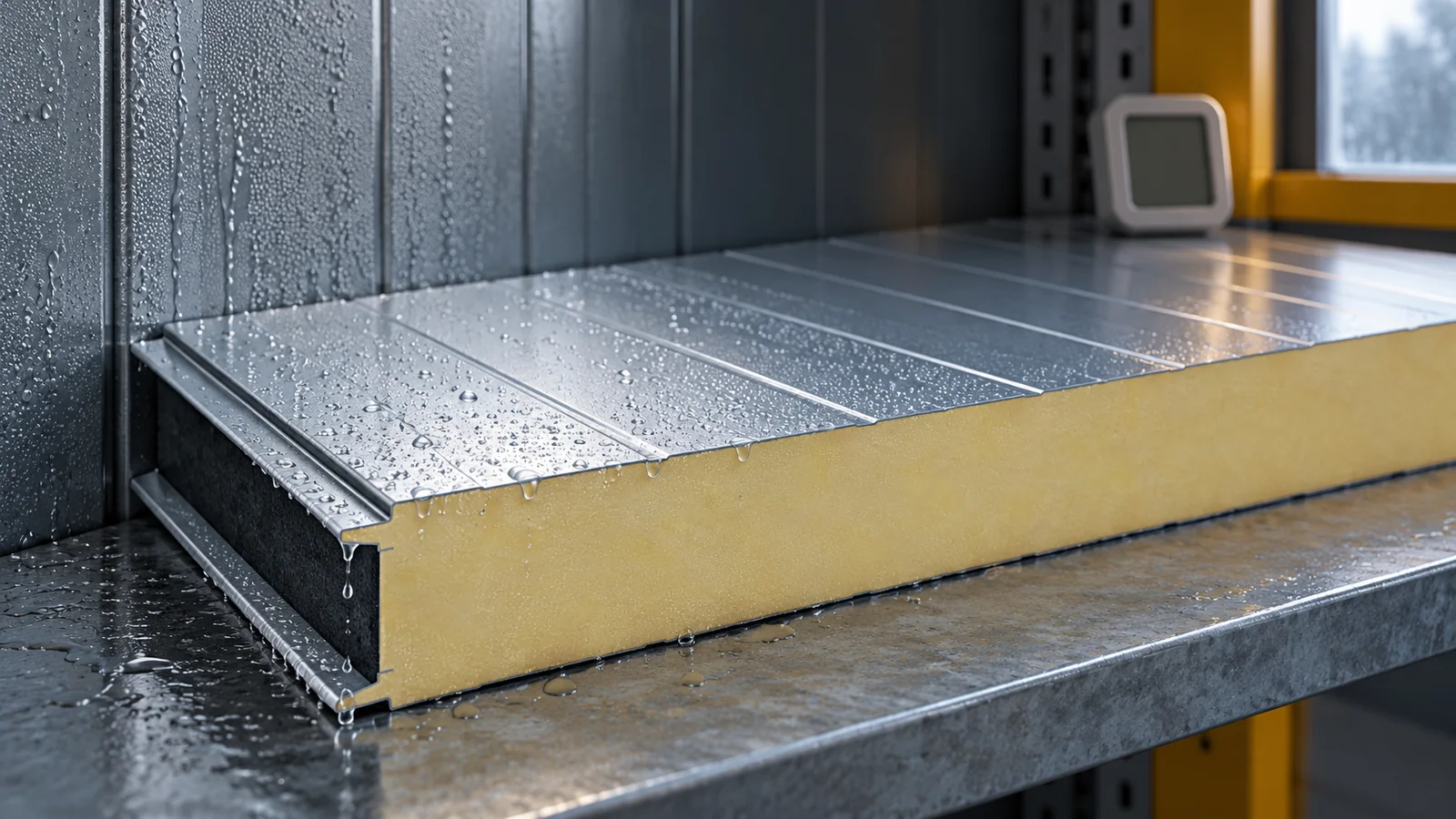
Droplets on an insulated sandwich panel do not necessarily mean a leak. Water can form from the vapour contained in the air when the facing or the detail is sufficiently cold. The cause is sometimes high humidity, a thermal bridge or a non-tight joint. Before you seal the roof or add a membrane, establish the source of the water. Repairing the interlock will not replace ventilation, and intensive ventilation will not remove a wrongly executed roof penetration. Note when the water appears. A leak is usually connected with rain, melting snow or a specific wind direction. Condensation can also occur during dry weather. It often appears when the enclosure cools down and the humidity in the hall is high.
How do you distinguish condensation from a leak?
Note when water appears. A leak is usually linked to rain, melting snow or a specific wind direction. Condensation can also occur during dry weather. It often appears when the enclosure cools down and humidity in the hall is high. This relationship is a clue, not a conclusive test. Both phenomena can occur simultaneously.
Examine the distribution of the traces. Droplets over a larger area suggest a different source than a trickle running out at a single flashing. Water can also travel along structural elements before it becomes visible. Do not assume that the dripping point lies directly beneath the roof damage. Dated photographs and measurements of temperature and humidity are useful.
Why does vapour turn into droplets?
Air contains water vapour. When it meets a surface colder than the dew point temperature, condensation can occur. In practice, this means that even a seemingly warm hall has places where moisture will appear. The more vapour in the air, the easier this problem arises at a given cladding temperature.
Sources of moisture include wet processes, washing, animals, drying goods or fresh building materials. Briefly switching on the heating is not always enough to dry out the building. It is necessary to assess how much moisture is produced and how it is removed. A panel with good U-value reduces surface cooling, but does not itself regulate the amount of vapour. A sealed enclosure still needs properly designed air exchange.
Where should you look for thermal bridges and leaks?
Check plinths, corners, roof junctions, reveals and service penetrations. A discontinuity in the insulation can locally lower the temperature of the internal cladding. Another problem is the flow of humid air through a gap. The vapour then reaches colder parts of the joint and can condense behind the visible surface.
Measurements and inspection of the detail are useful for assessment. An image from a thermal imaging camera requires interpretation and suitable conditions. A cooler strip does not by itself indicate whether the cause is a gap in the core, the structure or air flow. The documentation of the connection and the manner of execution must be checked. Additional sealant on the external surface does not always reach the actual leak.

Does every panel require a separate vapour barrier?
Full metal claddings have a high resistance to vapour diffusion. In an enclosure made of insulated panels, however, the tightness of their joints is of enormous importance. The entire wall cannot be treated as one continuous sheet if the locks, flashings and openings remain untight. The design of the vapour control layer should follow from the specification of the building envelope.
Bonding a membrane to a finished wall is not a universal remedy. It can hinder drying at the point where water has already penetrated. Conditions differ in a cold store, a wet room and an ordinary warehouse. The direction of vapour flow also needs to be assessed. Instead of choosing a layer on the basis of the material name alone, check the whole build-up and the conditions on both sides.
How to fix the cause, not the trace?
If the problem is excess moisture, its removal must be improved and uncontrolled sources limited. If a detail is at fault, a repair suited to the panel build-up is needed. The continuity of the insulation and adequate sealing must be restored. In the case of a leak, flashings, laps, fixings and drainage are checked. Not all of this work can be done with a single type of sealant.
A damp core requires a separate assessment. Do not assume that the disappearance of droplets means the panel has fully dried out. Water trapped in the element can affect insulation performance and the condition of the joints. Extensive damage may require replacement of a section of the cladding. The scope of repair should be determined by the condition of the material, not just the appearance of the coating after wiping it.
What to check after the repair?
Observe the location under the conditions in which the problem previously recurred. Repeat the temperature and humidity measurement. Check the wall after rain and during cool, dry weather. This allows rainwater tightness and the risk of condensation to be assessed separately. A single absence of droplets on a warm day does not yet confirm that the work has been effective.
Keep a description of the repair and photographs. If the use of the hall changes, return to the assessment of humidity, ventilation and coatings. Introducing a wet process into a former warehouse changes the conditions the walls are exposed to. Preventing condensation means combining correct insulation, tight details and moisture control. Each of these elements addresses a different part of the problem.
7 branches. Materials closer to your project.