Planning factory ventilation starts with locating the sources of pollution
Halls and steel structures
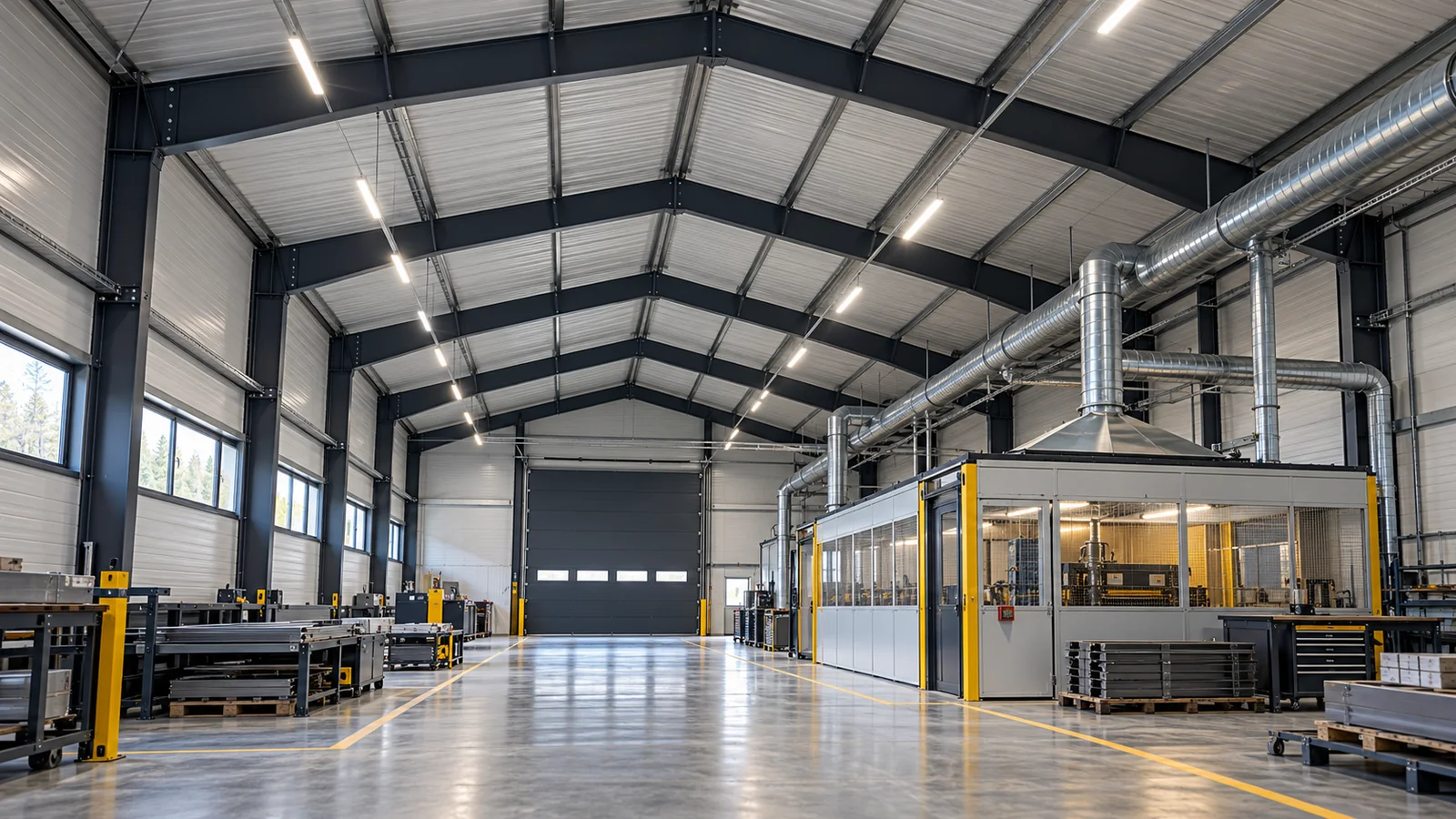
A large fan is not a ready-made solution to the problem of dust, steam or excess heat. First you need to establish what is generated during operation and where it enters the air. A steel hall may have different emission zones, even if it houses a single production line. The ventilation design should follow from this picture, not from the building volume alone. Information is needed on the substances, their quantities and the way they are released. The number of machines in operation and their running time are important. A steel hall with metalworking has different needs from assembly, packing or a wet process. These differences affect the method of capturing contaminants and the selection of the installation.
In this article
Describe the process before you calculate the flow rate
There is no single air change rate suitable for all plants. Performance results from the needs of people, the heat, moisture and emission balance. The steel structure and the layout of workstations should leave space for ducts and equipment. If this is lacking in the design, later routing of services may conflict with transport or machine operation.
Capturing at the source limits spreading
Where justified, local exhaust at the process is used. Its task is to capture the contaminant before it disperses throughout the space. General ventilation alone may not provide the required conditions at the workstation. A steel hall should therefore have a solution adapted to the actual emission point.
The effectiveness of the exhaust depends on shape, position and flow. Moving the machine can change it. It should also not be assumed that the machine guard is merely decorative. Steel structures supporting the installation should allow its designed geometry to be maintained as well as access for adjustment and cleaning.
Extracted air must be replaced
Extraction requires an adequate supply of air. Without it, uncontrolled flows through gates and gaps may occur. In a steel hall, supply air should work together with exhaust systems and heating. At the same time, directing the jet in a way that worsens conditions at the workstation or disturbs contaminant capture must be avoided.
A tight envelope facilitates flow control but does not replace supply air. After sealing an older building, the operation of the installation should be reassessed. A steel hall that previously drew air through numerous leaks may behave differently after replacing panels and gates. Modernisation of the envelope must therefore be coordinated with ventilation.
Ventilation affects heating and cooling
Outdoor air may require heating, cooling or other conditioning. In a steel hall, a large flow has a significant share in the energy balance. This does not mean it can be reduced below process requirements. Savings are sought in correct selection, control and solutions suited to the type of contaminants removed.
Heat recovery is not automatically suitable for every exhaust stream. Contamination, the risk of substance transfer and equipment maintenance requirements must be assessed. The steel structure must account for the weight of air handling units, filters and ducts. Their location also affects the ability to service and replace components.

Plan penetrations through the building envelope before installation
The intake, exhaust and ductwork require suitable openings and sealed detailing. The weight of the unit must not inadvertently load the panel cladding itself. In a steel hall, additional supports are often needed. Large openings should be coordinated with the frames, bracing and the position of doors and windows.
The position of the air supply and extract points is also important. They should not impair each other’s operation. The design takes into account the building’s surroundings and the nature of the emissions. Modular steel structures help to organise the routing of services, but they do not remove the need to verify these relationships for a specific plant.
The enquiry to the designer should also state the planned process changes. A new machine may increase emissions or require a separate extraction system. Space reserved for ductwork is often easy to preserve during construction and difficult to recover once the shelving is in place. This does not mean the entire system has to be oversized. It is about identifying possible changes and establishing which of them are worth preparing for at the first stage. It also helps to avoid clashes.
Acceptance covers operation under normal working conditions
After installation, the flows and settings of the system should be checked under the relevant conditions. Matching the number of fans to the order alone does not confirm effectiveness. A steel hall requires assessment where people are present and contaminants are generated. The interaction of all extraction systems operating simultaneously is also important.
Filters, ducts and units require maintenance appropriate to their purpose. An increase in resistance can change the performance of the system. Any significant process change should therefore lead to a reassessment of the ventilation. A building functions correctly when the system matches current production, and not merely the state on the day of acceptance.
7 branches. Materials closer to your project.