How to compare gutter quotations with different component lists
Roof details
Two gutter quotations can look alike while covering different work. A price per metre says little about outlets, corners, fixings, downpipes or adaptation to the building. A useful comparison starts with a common drawing and parts list, before prices are considered. This guide explains how to prepare an enquiry, identify omissions and distinguish a product substitution from a reduced scope. It also covers transport, installation, removal and items priced after a site visit. It does not propose a universal cost for guttering. It helps establish whether quotations address the same requirement and what would still need to be ordered separately.
In this guide
Give every supplier the same drawing
Prepare a sketch showing run lengths, corners and intended outlets. Give it a date or revision number. Keep any supplier’s proposed route change as a separate option. Otherwise two companies may price different arrangements under the same heading of “house gutters”.
Include the eaves arrangement and finished façade in the enquiry. Mark existing parts intended to remain. Do not expect a supplier to infer downpipe lengths from a house photograph. An unknown dimension should be flagged for measurement, rather than entered as zero in the estimate.
Separate the component groups
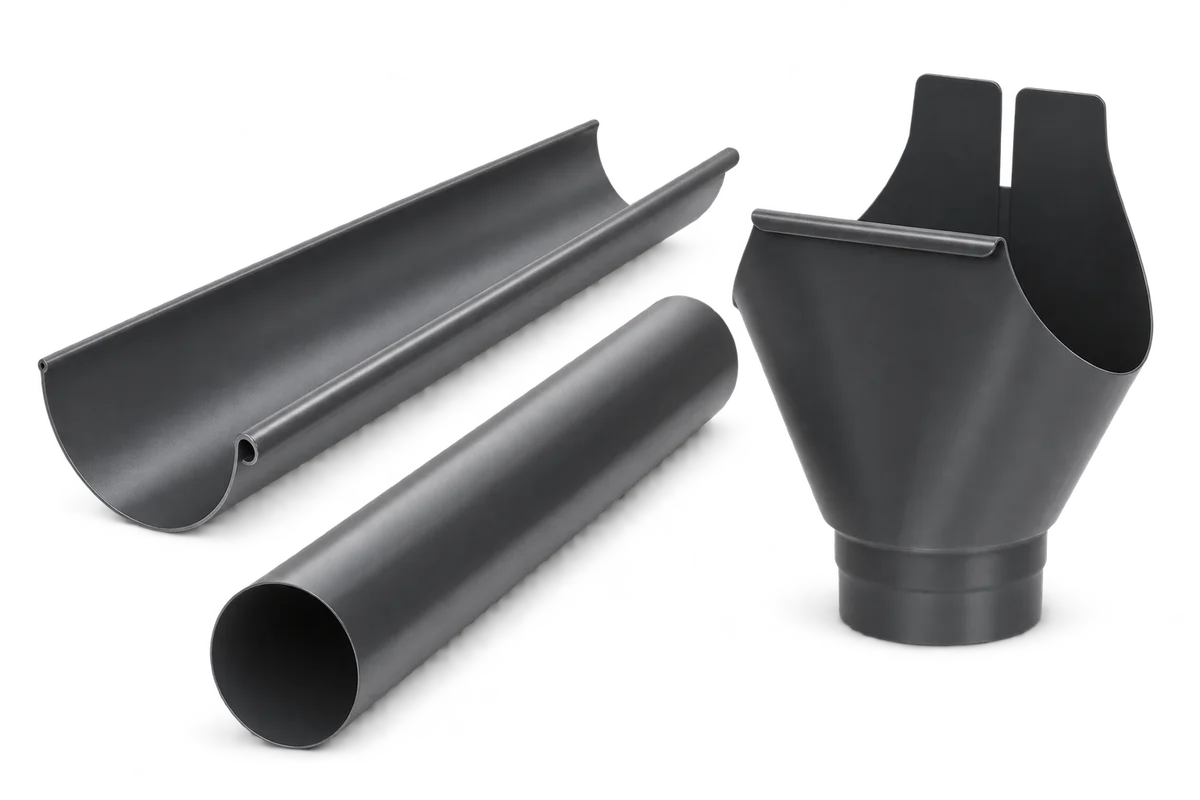
Separate the gutter runs, downpipes and final discharge components. Check fittings and fixings in each group, not only long lengths. This makes an offer ending at the gutter outlet easier to spot. The purchase list should cover the agreed route from roof to receiving point.
Do not add a bracket quantity from a random online diagram. Number and positions depend on the selected system and supporting construction. Ask each quotation to identify its assumed arrangement. Different fixing quantities require explanation rather than automatically representing a saving.
Compare units and quantities
Check whether a price is per metre, item or pack. A stock gutter length may exceed the required section, and a listed component is not necessarily a complete kit. Separate ordered quantities from installed lengths. Compare what is delivered, not just the numbers in the price column.
Use the same price basis across options: excluding or including tax. Record the quotation date and validity conditions. A promotion on one component does not price the rest of the system. Keep provisional amounts visibly separate from confirmed items.
Separate goods from services
Make goods, delivery, installation and removal identifiable in the scope. Clarify access equipment, clearing leftover material and transport of long components. An absent line does not mean the contractor will include it at no extra charge. Resolve it before comparing totals.
For replacement work, agree who assesses the fascia or other support once exposed. Describe an unknown repair as conditional and agree how its scope and price will be presented before it proceeds. An arbitrary allowance for an unseen condition does not make a quotation reliably complete.
Clarify substitutions and omissions
A substitution should identify the product, material, size and associated fittings. Changing one item may require changing others. Request a coherent alternative system instead of combining the cheapest lines from several quotations. Matching colour does not establish compatibility.
Send a list of omissions for clarification before choosing. Distinguish “not applicable”, “excluded” and “to be determined after measurement”. These are different cases. Compare current documents after replies arrive, rather than one supplier’s old total with another’s revised one.
Approve the complete order scope
Before ordering, confirm the final parts list and its corresponding drawing. Check handed components, such as corners, where the chosen system distinguishes them. Include agreed extras. A single approved revision reduces the risk of delivery against earlier assumptions.
Check delivered parts against the order before installation starts. Report shortages with references, quantities and label photographs. A quotation is useful when it can be matched to the actual kit. The lowest total is not comparable if its scope remains unclear.
7 branches. Materials closer to your project.