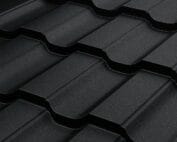
When to specify made-to-length tile-effect roofing
Tile-effect metal roofing
Made-to-length tile-effect sheets can suit a simple roof slope where the layout produces few offcuts. Ask for a cutting plan for the entire roof, including valleys and dormers, before settling on a sheet length. Consider the route from the delivery vehicle to the roof. Where access for lifting is restricted, shorter sheets can be easier to handle even with the extra lap. To work out the quantity required, use the effective cover width and the lengths permitted for the particular profile.
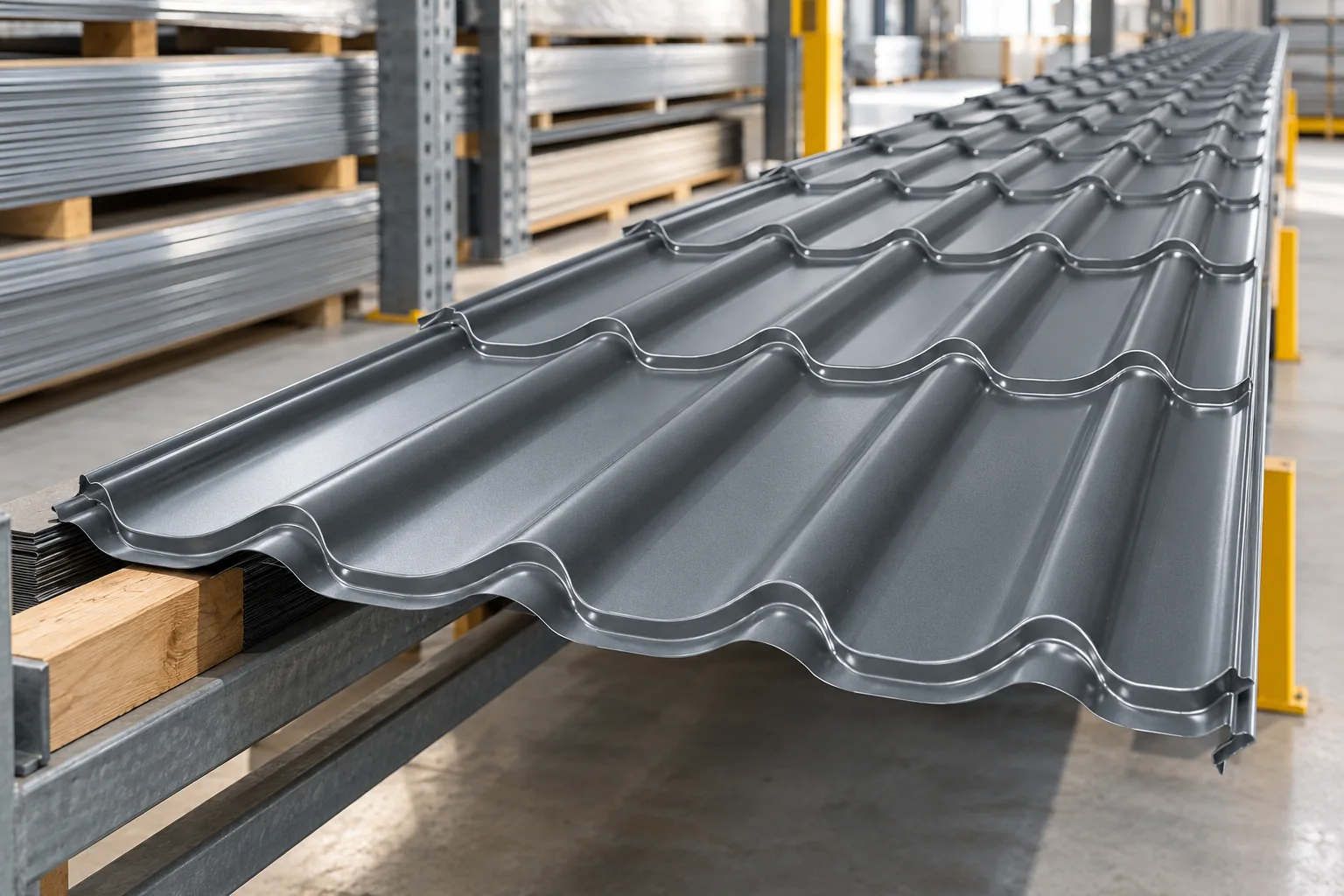
What does cutting to size mean?
Sheets are produced in lengths specified for the order, within the range provided by the manufacturer. This does not mean any shape or unlimited length. The profile has its own rhythm of pressings and rules for finishing. Order dimensions must therefore be matched to the documentation, not just to a tape measure.
Before purchase, it must be established whether the roof slope will be covered with a single lengthwise section or with a transverse joint. Each variant has specific requirements. A well-detailed order shows the length and number of sheets for the individual roof sections. It also allows checking where cuts will occur.
Why does a simple roof slope favour this format?
On a regular roof, sheets can be matched to repeatable lengths. This facilitates planning the covering and may reduce the number of transverse joints. The benefit depends on the permissible product dimensions and installation options. The absence of valleys alone does not mean that measurement can be done approximately.
The evenness of the eaves and the line of the ridge should also be checked. Roofs that appear symmetrical may have dimensional differences. These should be clarified before sheet production. Material ordered on the basis of an incorrect assumption may require additional cutting or may not provide the correct termination of the roof slope.
How does the effective width affect the quantity?
The overall width also includes the part intended for the side overlap. The effective width is needed for checking the covering. In an example model, it is 1100 mm with an overall width of 1170 mm. These are dimensions of a specific product, not a common standard for all cut-to-size tile-effect metal roofing sheets.
When calculating the order, the intended arrangement of the edge sheets and flashings must be taken into account. The roof area should not simply be divided by the total area of one element. A material layout plan provides more information. It also helps to understand the difference between the price per overall metre and the price per covered metre.
When does a long sheet become a hindrance?
A large element requires space for the vehicle, unloading and moving close to the roof. A lifting method must also be prepared that avoids excessive bending. On a plot with narrow access or next to a building surrounded by trees, this can determine the length split. It is worth assessing the conditions before placing an order.
Do not choose the largest format solely to avoid every joint. A correctly designed lap can be more practical than difficult transport. A small modular format, in turn, offers different organisational possibilities. The comparison should cover material, handling and the crew’s work.

What should be checked on a roof with valleys and dormers?
With many slopes, the cutting plan must be analysed for each roof slope. The direction of the pattern and laps limits the reuse of cut-off pieces. Not every apparently large offcut will be useful elsewhere. Therefore the amount of waste should result from the plan, not from a single percentage adopted for all roofs.
It is worth comparing the cut-to-size variant with the modular one for an identical scope of flashings and installation. It happens that the benefit of long sheets on a larger roof slope remains significant despite a few difficult places. At other times, a finer split will be more practical. The decision should be explained by the numbers and the construction conditions.
Which parameters remain important beyond the format?
The cut-to-size length says nothing about the coating, thickness or permissible pitch. These features must be determined separately. Also check the material grade, support requirements and fixing instructions. The profile’s appearance should suit the house, but it cannot replace compliance with the design.
Correct ventilation and the layers beneath the covering are still required. Tile-effect metal roofing alone does not insulate the loft. During installation, the surface must be protected, the correct tools used and swarf removed. A well-fitted sheet length will not compensate for errors at the chimney, eaves or junction with a window.
How can an order be prepared without ambiguities?
Record the exact profile, coating, colour, thickness and set of lengths. Attach the layout drawing and the scope of flashings. Establish the price unit, delivery conditions and unloading method. It is also worth agreeing the date so that the sheets do not wait long in conditions inconsistent with the storage instructions.
Before production, confirm the measurement and completion of structural repairs. Cut-to-size tile-effect metal roofing is a good choice when the format matches the actual roof slope and the execution possibilities. Its main advantage is matching the order to the design. It is best used through careful preparation, not by ordering the longest available sheets.
7 branches. Materials closer to your project.