Tile-effect metal roofing or clay tiles? How to compare cost and durability
Metal sheets and roofs
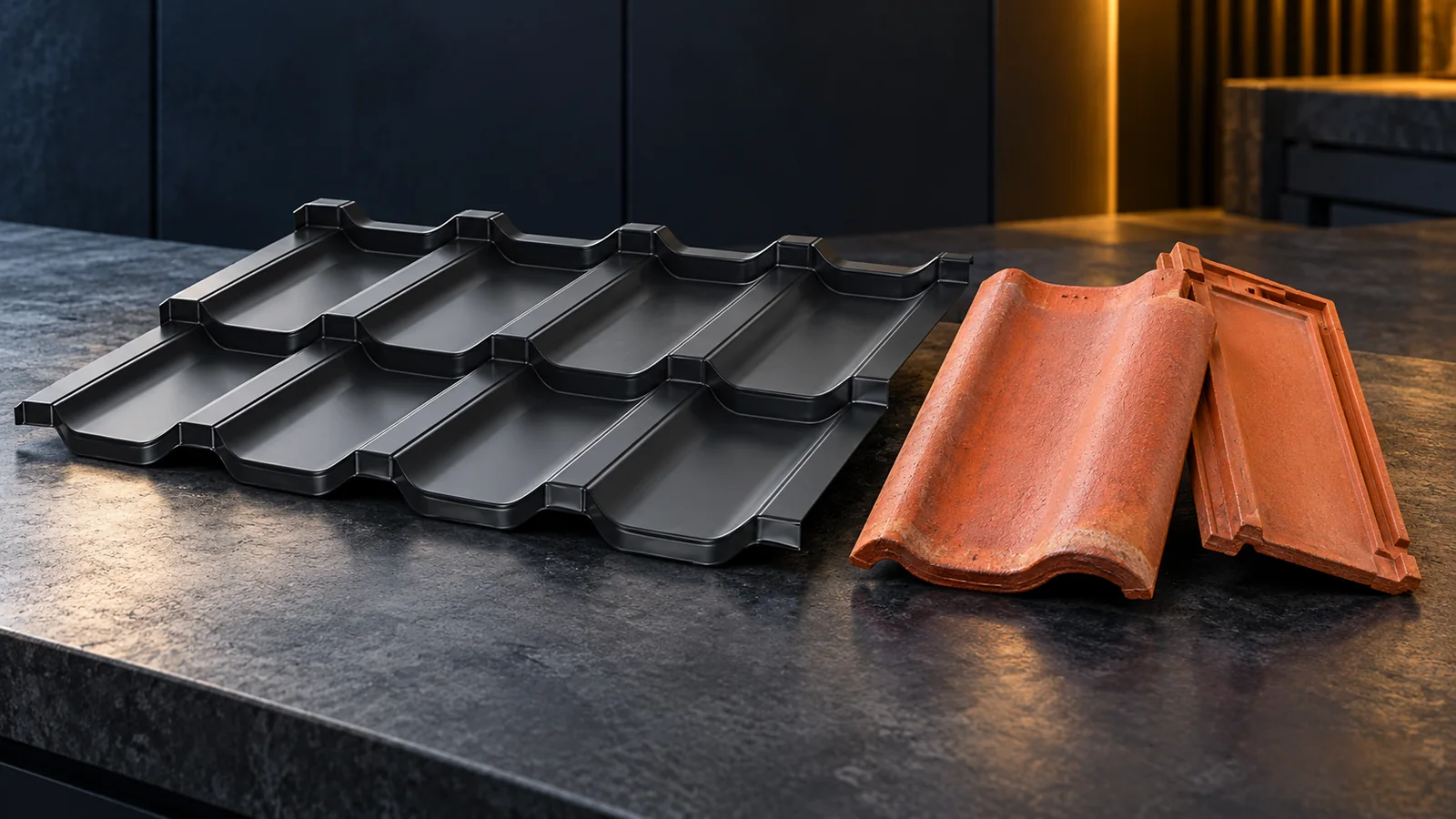
Tile-effect metal roofing and clay tiles can both form a durable roof, but they require a different approach to structure, installation and cost. Metal sheet is considerably lighter. Clay consists of small, separate elements. A reliable comparison should cover the whole roof, not just a square metre of covering. The condition of the roof truss, the shape of the roof slopes, the accessories required and the requirements for appearance and use of the loft all matter. When replacing an old roof, the weight of the new material is one of the first parameters to check. Tile-effect metal roofing usually places less load on the truss than clay tiles. This does not mean, however, that every old structure is suitable for metal sheet. Rotten timber, weakened connections and excessive deflection require assessment regardless of the covering chosen.
When does the weight of the covering matter most?
When replacing an old roof, the weight of the new material is one of the first parameters to check. Tile-effect metal roofing usually places less load on the roof structure than ceramic tiles. This does not mean, however, that every old structure is suitable for metal sheeting. Rotten timber, weakened connections and excessive deflection require assessment regardless of the choice of covering.
In a new building, the structure is designed for the entire layer build-up and loads. Changing to a heavier material after the roof structure has been built requires checking the design. A lightweight covering also needs correct anchoring. Wind can act on it with a pull-out force. Low mass therefore does not exempt you from calculating the fixings and securing the roof edges.
How to compare the cost of the whole roof?
Request two quotes for the same plan and scope of work. The comparison should include the following items:
| Item | What to compare |
|---|---|
| Covering | Quantity purchased after allowing for cutting |
| Substrate | Battens, counter-battens, any sheathing |
| Details | Ridges, edges, roof valleys and penetrations |
| Works | Removal, installation, flashings and protection |
| Logistics | Delivery, unloading, transport to the roof |
A cheaper metre of material may stop being cheaper once waste or structural alterations are added. Do not compare an amount including accessories with a quote limited to the covering alone.
Which material is better suited to the shape of the roof slopes?
On a simple gable roof, long sheets of cut-to-size tile-effect metal roofing allow large areas to be covered efficiently. A small number of roof valleys and corners simplifies cutting. On a complex roof, shorter modules can make handling easier and reduce some waste. However, a fixed percentage saving should not be promised. The result depends on the actual sheet layout.
Small ceramic tiles are easier to adapt to many local changes in geometry, but roof valleys and edges still require cutting. System components and the method of fixing them are also important. For both materials, the permissible pitch must be checked. It is not selected solely on the basis of the category name. Different models have different interlocking systems and requirements for the layer beneath the covering.

Are clay tiles quieter than metal sheet?
Rain may be more clearly audible on a lightweight, uninsulated metal covering. However, this does not mean that every house with tile-effect metal roofing will be noisy. The sound reaching the room depends on the entire building envelope. Insulation, loft conversion, joint tightness and vibration transmission through the structure all matter.
Comparing the material sheets alone does not describe comfort in the finished bedroom. If acoustics are important, ask for a whole-roof solution. The same applies to heat build-up in summer. The colour and surface of the covering affect its temperature, but insulation, ventilation and window shading also determine the conditions in the loft. Choosing ceramic alone does not replace proper thermal insulation.
What determines durability and repairs?
In steel sheet, the grade and thickness of the steel, the metallic protection and the organic coating are important. The method of cutting, removal of swarf and periodic inspection are also important. In ceramic, the characteristics of the specific product, its condition and the conformity of installation are assessed. On both roofs, flashings, fixings and service penetrations can prove to be weak points.
Do not equate the length of the warranty with a certain service life. The warranty conditions may distinguish between watertightness, perforation and appearance. A damaged tile can often be replaced individually. Repairing a sheet may be more extensive, although a short module makes handling a small area easier. A stock of the same product helps with both solutions. It must be stored in accordance with the material requirements.
How do you decide for a specific house?
Start with the structure and the pitch. Then compare the full cost and the appearance on a similar building form. Check samples in daylight. A matt-surfaced steel sheet will look different from a smooth gloss in the same shade. With tiles, texture, shape and type of finish also matter, not just the colour name.
With the limited load-bearing capacity of an old roof structure, lightweight tile-effect metal roofing may be a sensible direction after assessing the structure. For a project designed for ceramic and with an appropriate budget, the heavier covering can be retained. Neither choice justifies saving on flashings and ventilation. It is precisely these elements that often determine whether the roof will cause problems.
Also take into account access for inspections and the planned roof equipment. Steps, walkways or snow guards require fixing compatible with the chosen covering. Their cost and method of installation should be included in both compared options.
7 branches. Materials closer to your project.