What thickness of trapezoidal steel sheet should I choose for a roof?
Steel sheets and roofs
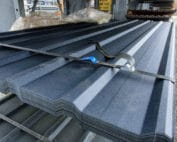
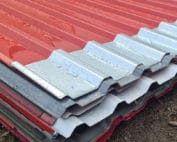
The thickness of trapezoidal steel sheet for a roof is selected to suit the specific profile, loads and support spacing. There is no single value suitable for every garage, house or hall. T18 and T35 come in various versions, and thickness alone does not describe the full load-bearing capacity. The steel grade, geometry and the relevant tables must be checked. The protective coating is a separate parameter and does not replace the required thickness of the steel core. Two sheets of the same thickness can have different rib heights and widths. This changes the stiffness and the way they perform. The steel grade also matters. It should not be assumed that every product described as T18 or T35 has an identical cross-section.
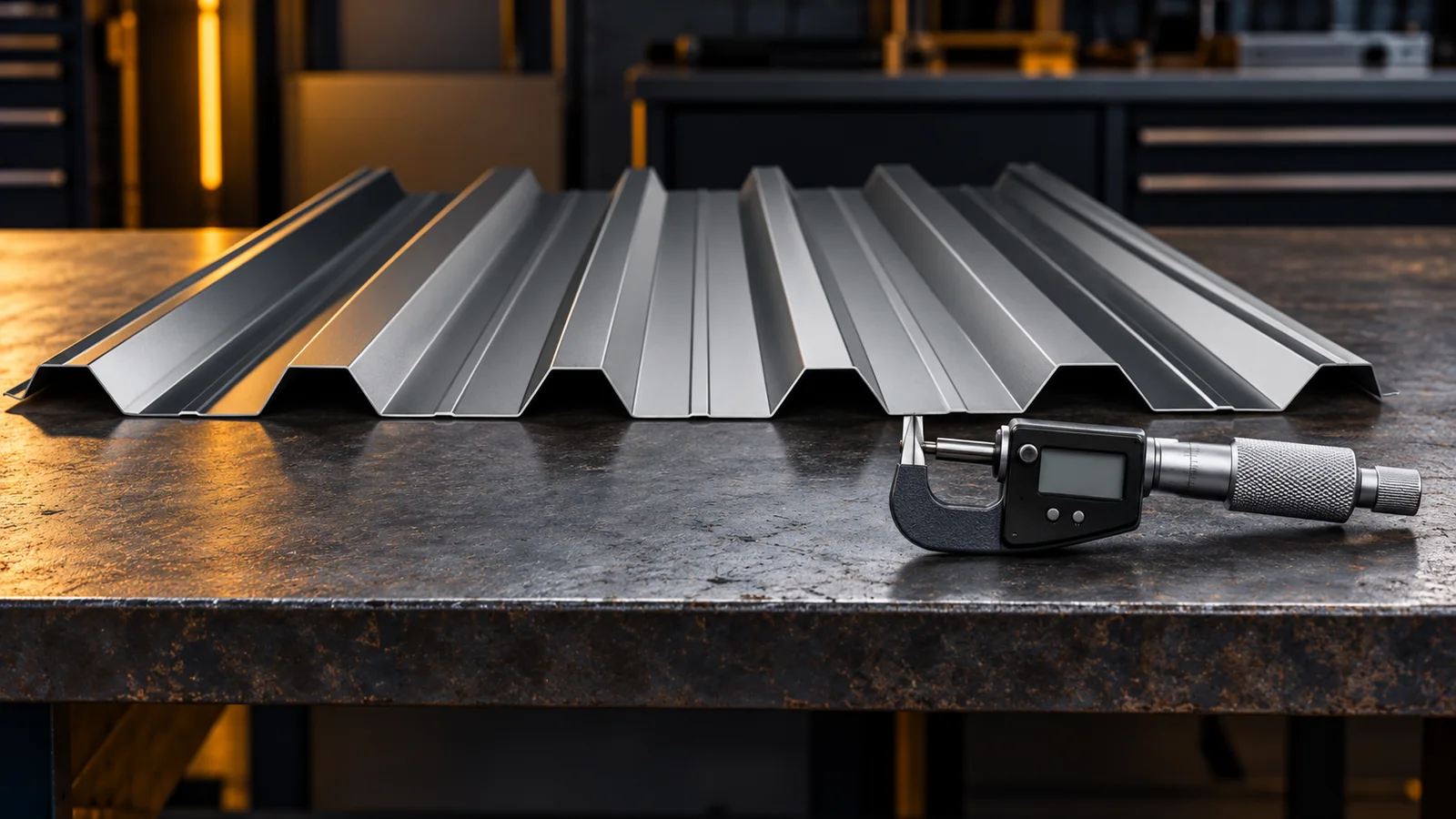
Why is it not enough to ask for 0.5 or 0.7 mm?
Two sheets of the same thickness can have different rib heights and widths. This changes stiffness and structural behaviour. The steel grade also matters. It should not be assumed that every product described as T18 or T35 has an identical cross-section. The full model designation is needed both for comparing prices and for load-bearing capacity.
The span between supports has a major influence on the result. The same sheet may be suitable with closely spaced supports and insufficient at a greater purlin spacing. The spacing must not be increased simply because the sheet feels rigid when handled. Deflection under distributed load is assessed differently from manually bending a single sample.
What thicknesses are available in the offer?
For many cladding sheets, variants of 0.50, 0.60 and 0.70 mm are found. Some profiles have a wider range. Structural sheets may be available in significantly greater thicknesses, depending on the model. Availability does not, however, mean a recommendation for a specific building. The design determines which variant may be used.
When comparing offers, establish how the nominal thickness is stated and which tolerances apply. Record coating parameters separately. Paint and metallic protection do not perform the same function as the steel. Their designations should not be accidentally added together and the resulting number treated as structural thickness. Doubts are best clarified on the basis of the material documentation rather than the commercial description alone.
What does the designer check in the load table?
First select the correct profile and thickness. Then take into account the number of spans, the width of supports and the side on which the sheet is laid. Loads include the weight of the covering and layers, snow, wind and items provided for on the roof. It must be established whether self-weight is included in the table or requires separate addition.
Load-bearing capacity and deflection are both checked. The first condition does not replace the second. A sheet may carry the load without loss of strength while deforming excessively. This matters for drainage and other layers. If the roof has installations or unusual openings, a standard table for uniformly distributed load may not be sufficient. An assessment of the actual case is needed.

Will a thicker sheet always be the better purchase?
Greater thickness with a comparable cross-section usually increases stiffness and load-bearing capacity. However, mass and cost also increase. Additional steel does not replace a suitable coating in an aggressive environment. Nor will it remedy drainage errors or leaky laps.
If both options meet the design requirements, the cost of the whole solution and the installation requirements can be compared. Sometimes changing the profile or the supports gives a more favourable result than simply increasing the thickness. Such a change must, however, be calculated. The specified sheet should not be replaced with a thinner one on your own initiative just because the roof area is small. Snow load and wind action do not disappear on a small garage.
How does thickness affect installation?
Sheets must be lifted and supported so that the profile is not deformed. A very long element may require a suitable number of people or equipment, also at greater thickness. The cutting method should protect the coating from overheating. Swarf must be removed from the surface after drilling and cutting.
Fasteners are selected for the sheet and the type of substrate. Length, drilling capacity and the sealing washer matter. A screw suitable for wood is not automatically suitable for every steel purlin. A thicker sheet does not justify fewer fixings. Edge and corner zones may require a different layout than the central roof area.
What to check when buying and on delivery?
In the order, record the specific profile, nominal thickness, steel grade and coating. Attach the lengths and the requirements from the design. On delivery, check that the labels and batch documents match. If a measurement raises doubts, a proper method and interpretation of tolerances are needed, not just a single reading from a random location.
Do not buy material for a load-bearing application whose parameters cannot be determined. This applies in particular to stock remnants and second-grade material. The absence of visible damage does not confirm the thickness or the steel. A correct choice makes it possible to state why a given sheet suits the roof. The mere opinion that it is “thick and solid” is not sufficient justification.
When checking thickness, do not choose a location on a bent or damaged edge. The measuring method should correspond to the parameter you want to confirm and take into account the requirements of the documentation.
7 branches. Materials closer to your project.