Single- or double-module roofing sheets: what difference does the format make?
Tile-effect metal roofing
The number of modules in a metal roofing tile determines how many repeating pattern rows an individual sheet contains, not the number of corrugations across its width. Before choosing a format, compare the effective coverage area rather than the external dimensions, and analyse the cutting layout for the specific roof geometry. Also check whether offcuts can be reused and how installation costs compare. It is worth comparing two cutting plans, the number of pieces and the required flashings. The final choice depends on the roof layout and work organisation, so leave detailed technical decisions to the designer.
What exactly are we comparing?
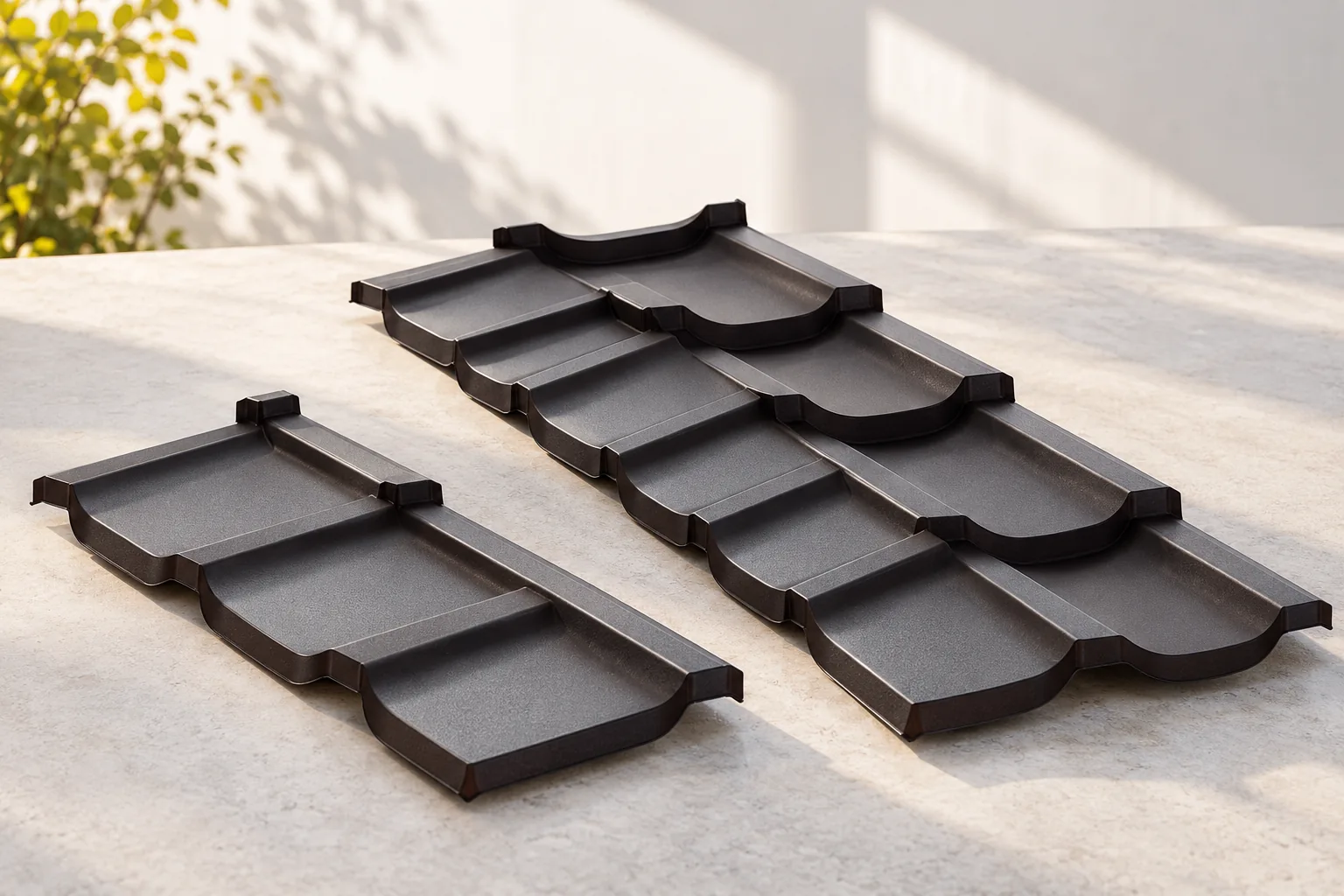
The number of modules refers to the repeating rows running down the slope. It does not describe the number of corrugations across the sheet. Two models may have the same one- or two-module layout and still differ in width and coverage area. Always check the dimensions in the product data sheet.
It is worth distinguishing between the overall length and the effective length. The part of the sheet that forms the overlap does not increase the coverage of the next row. That is why twice the external dimension does not necessarily give exactly twice the effective area. Ordering requires a layout specific to the chosen geometry.
How does the format affect material handling?
A shorter sheet is easier to turn in a confined space and to carry between obstacles. A larger sheet covers a larger section of the roof slope in a single laying operation. However, convenience depends not only on the dimensions but also on roof access and the preparation of the working area. There is no single most convenient format on every site.
Both variants require protection of the coating and careful handling of the edges. The packs must be stored in accordance with the instructions. A small sheet must not be dragged over other pieces either. The method of transport and unloading should be established in advance, particularly on a tight plot or with a high eaves.
What to choose for roof valleys and dormers?
On short and irregular sections, the small format may make cut planning easier. However, you must check whether the cut-off part can be reused. The direction of the overlap and the pattern of the profiling limit the freedom of laying. The mere existence of a spare piece of material does not mean that it fits in another place.
For a complex roof, ask for two cutting layouts. Compare the ordered area, the number of pieces and the required flashings. Do not assume a fixed advantage of one format based on a photo of the roof. The exact geometry may make the result different from what is expected.

Is a larger sheet better on a simple slope?
On a wide roof slope without numerous obstacles, a larger format may reduce the number of elements to lay. This is a potential organisational benefit that the installer should assess. At the same time, the accuracy of the batten grid and the ease of handling the material must be taken into account. The pace of work does not depend solely on the area of a single piece.
A smaller number of sheets should not automatically be equated with a smaller number of all fastenings. Their layout results from the instructions, the loads and the roof zone. Likewise, the number of required battens does not necessarily change in proportion to the sheet size. The substructure must still correspond to the covering module.
How do you compare the joints and the appearance of the roof?
Weathertightness is determined by the overlap design, the pitch and correct installation. A well-designed joint of a small element can perform correctly. A larger sheet also requires precise fitting. The number of modules does not replace the assessment of edges, flashings and fastener locations.
When viewing samples, compare a larger section composed of several pieces. Pay attention to the consistency of the lines and the visibility of the joints in side light. A small sample will not show the full rhythm of the roof slope. Stylistic differences often result from the profile and the height of the profiling, not from the delivery format itself.
How do you calculate the actual price difference?
Divide the price of the sheet by its effective area. Then take into account the cutting layout for the specific roof. In this way you compare the cost of the covering, not an attractive price per single piece. Add fastenings, flashings and all accessories required for both variants.
Ask the installer for a quote for an identical scope. If one format requires a different solution for the eaves or ridge, note this in the comparison. Also check the delivery conditions and the required allowance. A small difference in material price may matter less than the organisation of work on a roof with difficult access.
How do you decide for a new roof or a renovation?
In a new building, the entire batten grid and detail layout can be adapted in advance. In a renovation, it is necessary to assess which parts of the existing substrate can be reused. The old batten spacing should not determine the choice of an arbitrary covering. If it does not match the instructions, an appropriate change is required.
Choose the format after combining three pieces of information: the cutting layout, the installation documentation and the full offer. Also check whether compatible elements can be purchased later. The decision then results from your own roof, not from a general belief that one or two modules are always the better solution.
7 branches. Materials closer to your project.