Tile-effect metal roofing cut to size or modular? How to choose the format
Sheets and roofs
Tile-effect metal roofing cut to size is particularly suitable for simple roof slopes and a good cutting plan. Modular roofing facilitates transport, handling of the material and fitting short elements. However, no format always delivers a lower cost. The choice should be based on the roof geometry, installation conditions and a full material schedule. The coating and steel parameters are compared independently of the sheet size. The manufacturer prepares the sheet length according to the agreed order. This does not mean that every profile can be shifted freely. Tile-effect metal roofing has a repeating module, and the edges and overlaps require specific finishing. Lengths must be agreed with the geometry of the specific model. The roof slope dimensions are the starting point for the cutting plan, not a ready-made production list.
What does cutting to size mean?
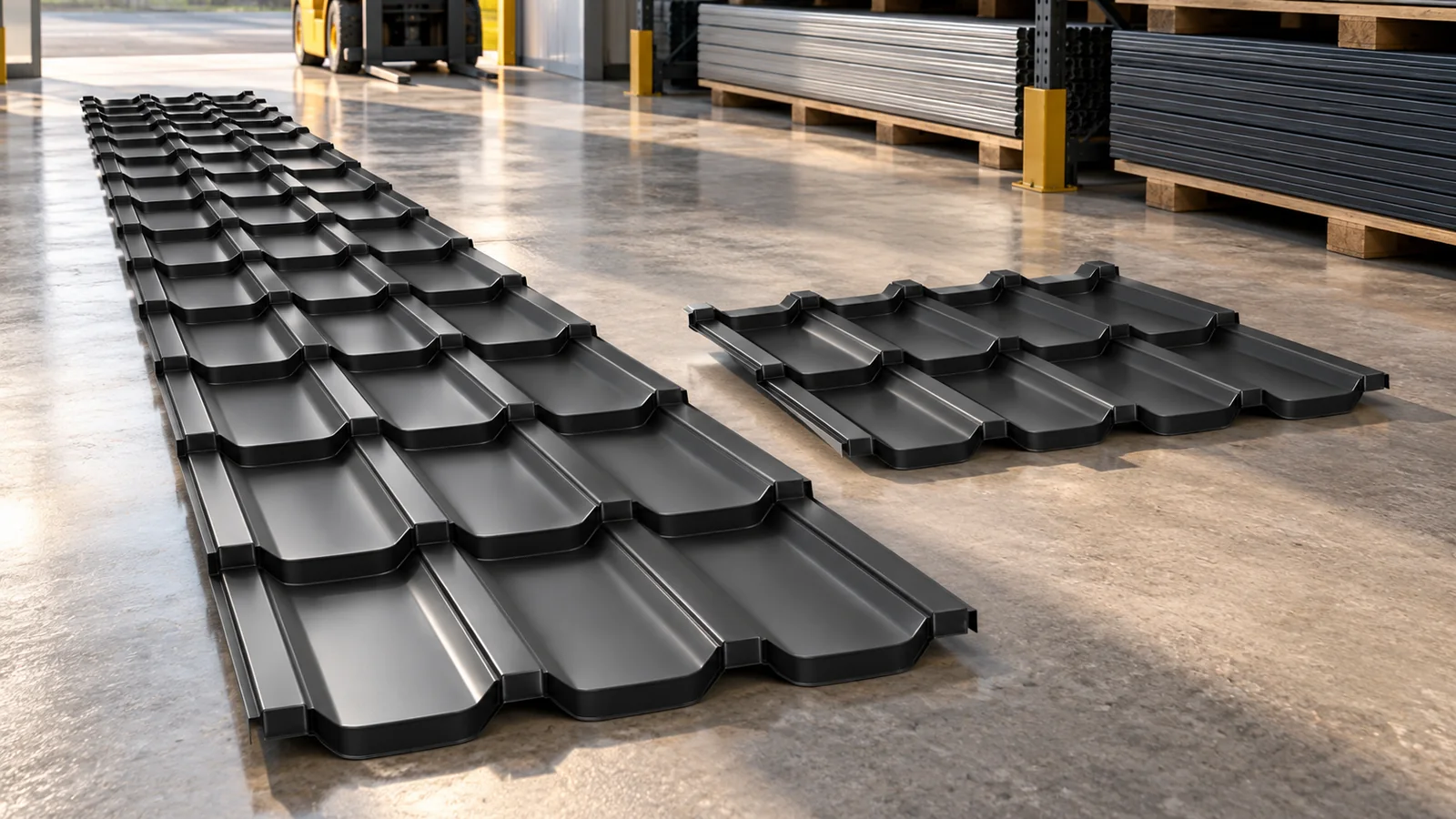
The manufacturer prepares sheet lengths according to the agreed order. This does not mean that every profile can be shifted freely. Tile-effect metal roofing has a repeating module, and the edges and overlaps require specific finishing. Lengths must be agreed with the geometry of the specific model. Roof slope dimensions are the starting point for cutting, not a ready-made production list.
A long sheet can cover a large part of the roof slope from the eaves towards the ridge. This limits the number of transverse joints. At the same time, it requires careful handling. It should not be dragged over other sheets or gripped in a way that stretches the profile. Damage to a large element may mean replacing a significant part of the material.
How does a module differ?
A short panel has defined dimensions and coverage area. Repeatability makes it easier to count pieces and organise work. However, the module does not have to correspond to a single row of imitated tiles. Depending on the pattern, it may cover more than one length module. A distinction must be made between the geometric dimension of the profile and the unit sold in a pack.
One real example has a total length of 740 mm and an effective length of 700 mm. With a coverage width of 1140 mm, this gives 0.798 m² per piece. These are the data for a specific model. Another panel may have different dimensions and a different joining method. The same number of pieces in two offers does not have to mean the same area of the finished roof.
Which format will reduce waste?
On a rectangular roof slope, sheets cut to size can utilise the material very well. The problem grows where strips cross roof valleys or diagonal edges. The cut-off part does not always fit elsewhere. The direction of the profiles, the side of the overlap and the pattern layout matter. It cannot be assumed that every triangular offcut will be used on the adjacent corner.
Short modules give greater freedom in organising the cutting layout. However, they do not eliminate waste. For a roof with many small roof slopes, a compilation of pieces and cuts is needed. Ask for two plans for the same roof. Compare the area of material purchased and the number of remaining offcuts. A percentage added in advance to the metreage does not replace such an analysis.

How does the format affect installation and delivery?
Modules fit on a compact pallet and are easier to deliver in batches. This matters on a narrow plot, where there is no storage space or difficult access to the building. Long sheets require a suitable vehicle, unloading space and an appropriate number of people or equipment. These conditions must be established before delivery, not after the transport arrives.
A smaller element does not mean any laying pattern is acceptable. The installation and fixing sequence is determined by the system. Some models permit specific staggered layouts, while others have their own rules. The battens must also match the module. The first spacing at the eaves may differ from the subsequent repeat spacing. The installer should know the instructions before preparing the substrate.
Also check the unpacking area. Modules can be supplied from one compact zone, while long sheets require more free space. Gusty wind makes handling both formats more difficult. The work plan should allow for safe lifting and temporary storage of the material. It is not worth choosing the length solely on the basis of the number of joints.
Is a short panel less durable?
Durability is not determined by the format alone. The steel, coatings, edge quality and execution of the joints are important. A long sheet has fewer transverse joints but is more easily deformed during incorrect lifting. A module has more joints, but these have been accounted for in its construction. A correctly assembled system should perform in accordance with the documentation.
Do not assume one warranty applies to all versions. Depending on the coating and conditions of use, the scope of protection may vary. In both formats, swarf must be removed, damage checked and drainage kept clear. For repairs, a short module can facilitate local replacement. However, a matching model and shade are required, not just a similar pattern from later production.
How to choose without guessing?
Base the comparison on four data:
- the quantity of material resulting from the cutting layout for the same roof;
- the steel and coating specification with comparable parameters;
- the cost of delivery, unloading and installation;
- the full set of flashings and fixings.
For a simple roof slope and straightforward logistics, cut-to-size sheets can be a good choice. With many hips or difficult access, modules can make the work easier. The final outcome follows from the design and the quote. It is not worth paying extra purely for the word “modular”, nor rejecting long sheets without checking the cutting plan.
7 branches. Materials closer to your project.