Planning a fence with metal pickets
Façades and fences
A boundary fence can have open spaces between its pickets. Screening a garden from view calls for a closer arrangement, which also affects the supports. Check how the fence looks both from the side and straight on, ideally using a sample panel, and plan the panels, gate and side entrance together with the slope of the ground. A denser infill reduces visibility but increases wind load, so leave the choice of posts and rails to the designer.
What level of privacy do you want to achieve?
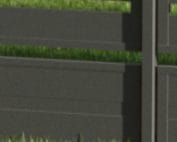
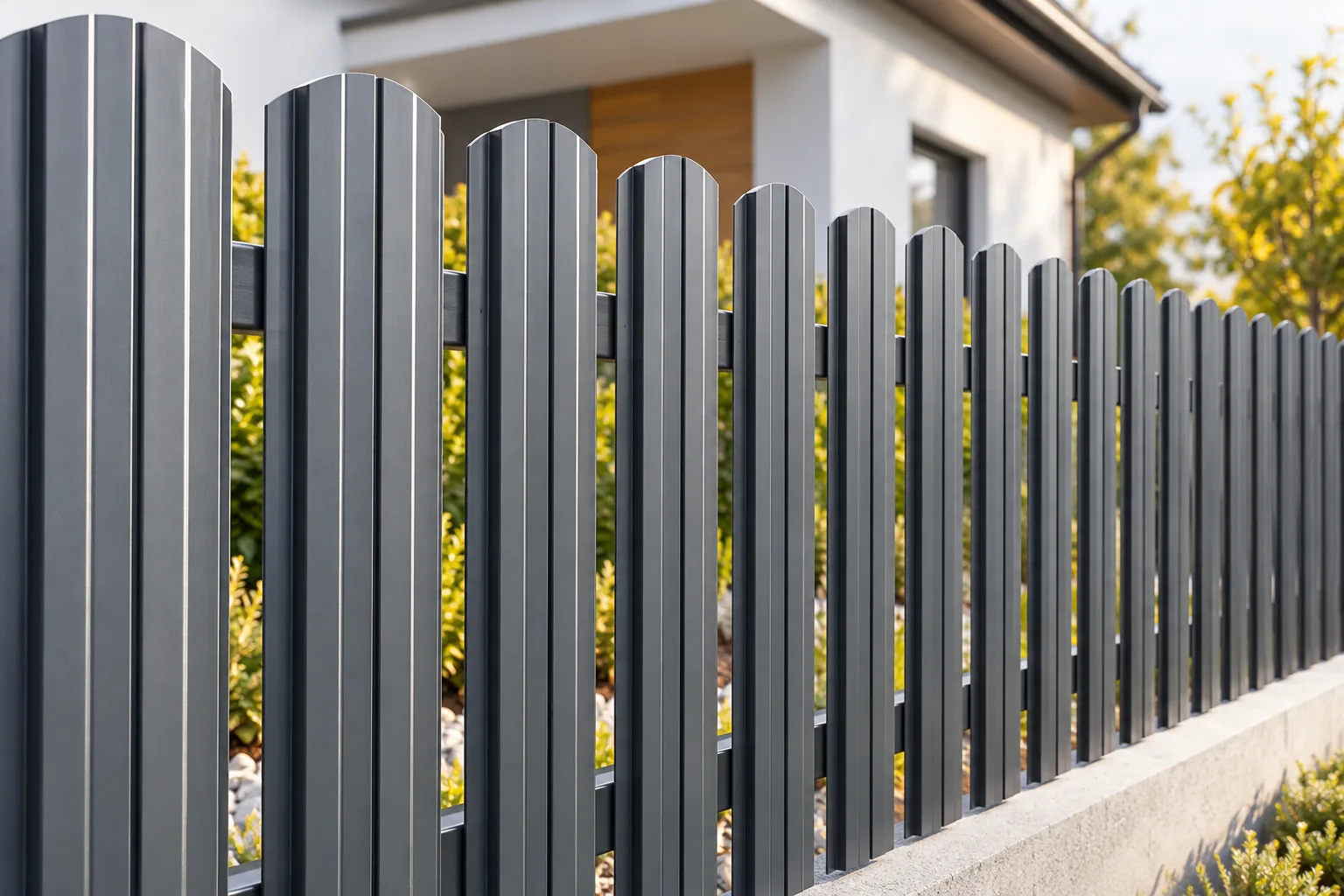
First decide whether the fence is mainly to mark the boundary or to screen the garden. A single layer of pickets with gaps creates a visually light screen. Smaller gaps reduce visibility but do not always eliminate it entirely. The side view differs from the front view, which is worth checking on a sample bay.
A double-sided arrangement can screen the plot more strongly. However, it requires more components and appropriately designed rails. Do not promise yourself full privacy based on the front drawing alone. Take into account the difference in ground levels, the viewing angle and the position of the terrace relative to the road.
How to lay out the bays and the entrance?
Measure the length of the fence and the points where the direction changes. Determine the clear width of the gate and the pedestrian gate separately. The division into panels should take into account the position of the posts, the slope of the terrain and vehicle access. Leaving a very narrow last section often spoils the appearance. It is better to distribute the dimensional difference earlier.
On sloping terrain, a stepped or slope-following arrangement can be considered if the system allows it. The height of the components is then measured relative to a defined line. Pay attention to the clearance under the fence. An uneven gap can look accidental and makes it easier for small animals to pass through.
How many pickets are needed for one bay?
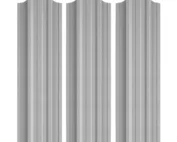
Start the calculation from the usable bay width. If the picket has width b and the gap g, the repeating module is b plus g. Both gaps at the posts must also be taken into account. Therefore a simple division of the length by the module is the beginning of planning, not always the final number of components.
For example, ten pickets of 10 cm occupy 100 cm of the sheet alone. Nine gaps of 2 cm add 18 cm. Edge clearances come on top of this. This simple record allows an even division without accidentally compressing the last components. In a double-sided arrangement, both layers are calculated separately.

What to check in the picket profile?
The width, depth of the pressing and the way the edges are finished all matter. The profile affects rigidity, but it cannot be judged on appearance alone. Check the material thickness and the intended spacing of the rails. A long picket on too few supports may vibrate, despite careful screwing.
Also inspect the top and bottom finish. Folded edges should be even and free of burrs. The colour on the garden side may differ from the front if a single-sided finish has been chosen. Confirm this when ordering. Only a sample viewed from both sides shows the full effect of the finished fence.
How to choose posts, rails and fixings?
The pickets are the infill, while the substructure carries the loads. Its selection depends on height, bay length and wind conditions. Fuller screening is not merely an aesthetic change. A larger wind-catching surface may require stronger posts, foundations and connections.
The fasteners should match the rail material and the corrosion protection. Holes are not made at random close to the edge. Tightening should stabilise the element without crushing the profile. At the gate, loads from the movement of the leaf are added. Do not therefore transfer the layout from a fixed bay to a wide gate without checking.
How to match the coating and colour?
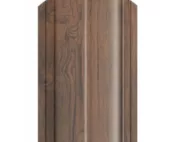
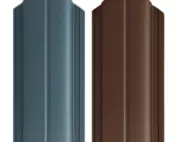
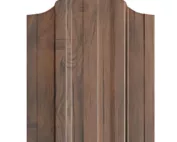
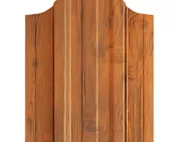
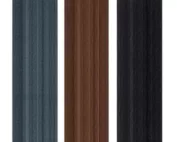
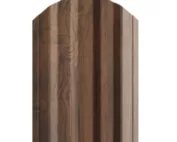
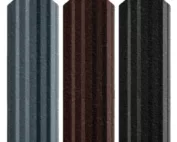
Graphite, black and brown are easy to combine with many roofs, but the shade must be viewed in daylight. The wood-effect finish also has a direction of pattern. State in the order whether the garden side is to look identical. Not every variant gives the same decoration on both surfaces.
Durability depends on the coating and the conditions at ground level. Road salt, soil and constant moisture can stress the lower sections more than the rest of the fence. After cutting, remove filings and apply the protection method intended for the product. Do not position the sheet so that its lower end constantly sits in wet soil.
How to prepare the order and installation?
Prepare a schedule of the bays with their width, height and number of pickets. Mark the gate and pedestrian gate elements. Add posts, rails, fastenings and finishes. Determine the sequence of work on the foundations and the required time before loading the structure. Do not speed up installation at the expense of support stability.
Before repeating the whole layout, it is worth assembling one control section. Check the spacings, the vertical alignment and the appearance of both sides. Keep a small number of matching elements for future repairs if the project justifies it. A well-planned fence is easier to order, install evenly and maintain without makeshift alterations.
7 branches. Materials closer to your project.