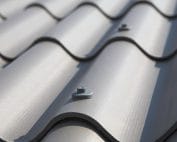
Fibre cement roofing and summer heat inside the building
Fibre cement roofing
On a hot day, room temperature is determined by more than the type of outer sheet. Sun, insulation, windows, air exchange and how the building is used all matter. Fibre cement sheets can be part of a well-designed envelope, but they do not guarantee lower temperatures. Asbestos-free fibre cement also heats up in the sun. A sensible choice of roofing requires looking at the path of heat through the whole roof and the other parts of the building. Radiation falls on the roof, and some of the energy is absorbed by the material. The amount depends among other things on the properties of the surface, the angle of incidence and the ambient conditions. A dark colour is often associated with greater absorption of radiation than a light one, but it does not replace data for a specific coating.
In this article
The sun first heats the surface
Surface temperature is not the same as room temperature. Between them there may be a ventilated cavity, insulation and other layers. Comparing two heated sheets in a yard does not yet show how complete roofs will perform. You need to check where the energy reaches the interior and what limits its flow.
A thin sheet is not a thick layer of insulation
Fibre cement sheets differ from metal sheets in composition and thermal properties. This does not mean, however, that they alone will provide the required roof resistance. The thickness of the covering is small compared with a typical insulation layer. The claim of lower heating should therefore not be used as a reason to omit insulation. In a heated or cooled building, the parameters of the whole assembly are selected. Joints and gaps in the insulation are also assessed. Even a good insulating material will not do the job if uncontrolled thermal bridges remain along steel elements. The covering is an important component, but not the only regulator of comfort.
Ventilation beneath the covering has a specific role
Flow in the intended cavity can influence conditions beneath a heated roof and support drying. It must, however, have a clear inlet and outlet. Fibre cement sheets do not create effective ventilation simply through the corrugations visible from outside. The length of the slope, obstructions and the construction of the layers matter. This space should not be equated with room ventilation. Air beneath the covering may flow correctly while the interior still overheats through large glazing. When assessing the effect, these paths need to be separated. Then it is clear whether to improve the roof assembly, window shading or the way air is exchanged inside.
An open shelter and a closed building react differently
In a well-ventilated shelter, comfort depends strongly on shade and air movement. In a closed workshop, gains from equipment, people and lighting are added. Asbestos-free fibre cement over these structures will be part of different operating conditions. The impression of coolness beneath a shelter cannot be transferred to a temperature forecast for a hall without ventilation. Likewise, assessing an empty building does not describe the operation of a facility full of machines. Before choosing a covering, it is worth recording operating hours, heat sources and the expected comfort. This way the design does not focus solely on the roof if the main problem comes from another part of the building.
Roof colour is both a practical and an aesthetic decision
Fibre cement sheets may have natural or factory-painted surfaces. The choice should take into account the surroundings, the appearance of the building and the parameters of the specific version. Not every palette is available in every format. When assessing summer heating, it is worth asking about coating data if the manufacturer declares it, rather than relying on the colour name alone. Nor should it be assumed that any later repainting is permitted. The coating and the way it is renewed may be subject to separate conditions. A light-coloured roof can be beneficial under certain conditions, but it will not fix missing insulation or permanently closed ventilation.
Comfort has to be assessed over time
A short temperature measurement at one hour does not describe the whole day. What matters is the rate of heating, the evening release of heat and the possibility of night-time ventilation. Fibre cement sheets interact here with the mass and layers of the whole building. It is not worth promising a single temperature difference without comparing similar structures under the same conditions. For an existing roof, it helps to record internal temperatures, weather and equipment operation. This allows you to check when overheating begins. If the maximum occurs after intensive machine operation, changing the covering alone may have less effect than improving heat removal from the process.
Start choosing a solution with the largest source of gains
In a house, this may be a sunlit glazed area, while in a hall it may be a technological process. The roof still matters, but its modernisation is worth comparing with other measures. Fibre cement sheets should be assessed as a complete system with insulation and ventilation. A good design makes it possible to establish what effect can be achieved and what the limitations are. It is not about assigning one temperature to a material name. What matters is that the building maintains the required conditions during actual use. Only then can the cost of the covering, additional layers and the subsequent energy needed to maintain comfort be reliably compared.
When considering asbestos-free fibre cement, state the building’s pattern of use and expectations for summer. Selecting the entire roof provides a better basis for a decision than a promise of coolness from the sheet alone.
7 branches. Materials closer to your project.