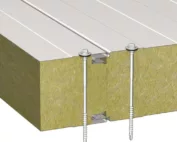
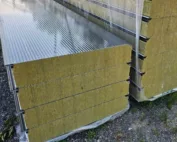
What do lambda and U mean for insulated wall panels with a mineral wool core?
Insulated wall panels
Lambda describes heat conduction through the core material. The U-value indicates how heat penetrates through the panel or the entire building element under specified conditions. These are different quantities with different units. A low lambda is not sufficient to assess a wall. Thickness, joints, fixings and details also matter. Quotes are best compared on the basis of U-values for an identically defined solution. Lambda, written as λ, defines the thermal conductivity of a material. Its unit is W/(m·K). At the same thickness, a lower value means greater thermal resistance of the layer. However, it does not describe the complete wall with connections and structure. It applies to the material under the conditions adopted when determining the properties.
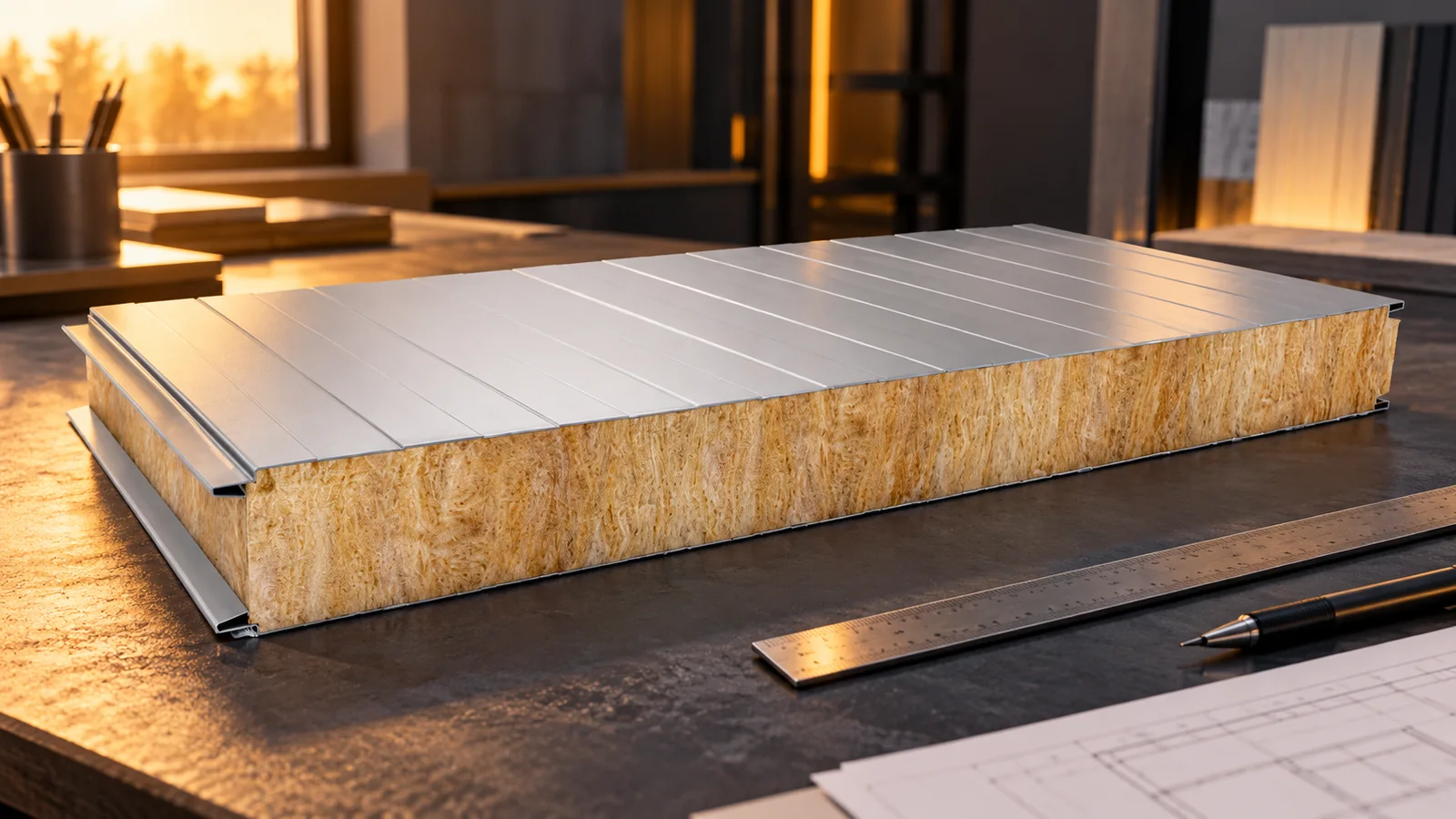
What does the lambda value tell us?
Lambda, written as λ, defines the thermal conductivity of a material. Its unit is W/(m·K). At the same thickness, a lower value means greater thermal resistance of the layer. However, it does not describe a complete wall with joints and structure. It applies to the material under the conditions adopted when determining the properties.
Various values can be found in the data sheets for panels with mineral wool. An example core has a λ of around 0.039 W/(m·K), other solutions declare 0.040 or 0.044. These are not contradictory figures if they refer to different products. It is not permissible to take the lowest lambda from one data sheet and combine it with the weight or price of another panel. That would create a product that nobody offers.
What is U and why does it have different units?
The thermal transmittance coefficient U is given in W/(m²·K). It allows an estimate of the heat flow through a unit area at a given temperature difference. The lower the value, the smaller the flow under the same conditions. In the data sheet, it should be checked whether it refers to a section of the panel, a value with a correction for the joint, or a parameter that also takes fixings into account.
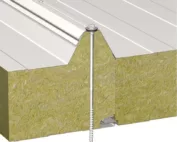
The designations U and Uc should not be compared without reading the explanations. Individual documents may take a different range of influences into account. In one catalogue, the linear thermal bridge at the joint and the point thermal bridges from the fasteners were explicitly included. This is important information. The entire façade still has corners, plinths and openings whose influence cannot be replaced by a single value from the table.
How does thickness affect insulation performance?
The resistance of a homogeneous layer alone can be roughly calculated by dividing its thickness in metres by lambda. For 0.10 m of mineral wool and λ 0.040, the result is 2.5 m²·K/W. At 0.20 m, it is 5.0 m²·K/W. This is a calculation for the core, without surface resistances and details. Its reciprocal should not be equated with the finished U-value of the entire wall.
Practical values are read from the data sheet of the selected panel. In an example wall system, 100 mm has a Uc of 0.39, 150 mm 0.27, and 200 mm 0.20 W/(m²·K). This shows the direction of change. However, it does not create a universal table, because a different joint geometry and a different core can produce different results. The designer selects the product to meet the requirement, not the other way round.

How much heat can flow through a wall?
A simple example shows the significance of the difference in U. Assume 100 m² of homogeneous wall and a constant temperature difference of 20 K. At a U of 0.40 W/(m²·K), the flow is approximately 800 W. At a U of 0.20, it is 400 W. The calculation multiplies U by the area and the temperature difference. It does not include losses through doors, ventilation or thermal bridges not included in U.
This example is not a forecast of the heating bill. The annual cost depends on the weather, operating hours, heat source and how the hall is used. In a warehouse with a frequently opened door, a large share of the losses may come from air exchange. A good panel helps, but it does not eliminate all paths of heat loss. It is therefore worth linking the decision on thickness to the balance of the whole building.
Does PIR allow a thinner panel to be used?
PIR cores generally have a lower lambda than the mineral wool used in insulated panels. This means a good resistance can be achieved with a smaller thickness. For example wall panels, PIR 120 mm achieves Uc 0.18, while mineral wool 200 mm achieves Uc 0.20 W/(m²·K). This is a comparison of specific products and does not replace checking their other parameters.
A thinner wall can make it easier to form flashings and reveals. Mineral wool, in turn, may be the right choice because of fire requirements. There is no basis for considering a material the best solely on the basis of lambda. The fire resistance of the system, load-bearing capacity, acoustics and operating conditions are also assessed. Thermal parameters are an important part of the comparison, but not the only one.
How to read a quote without mistakes?
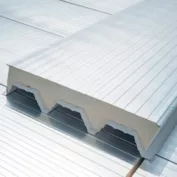
Ask for the data sheet for exactly the panel that has been quoted. Check the core thickness, the joint variant, the facings and the U-value. For roofs, distinguish the nominal insulation thickness from the overall height including the rib. A designation with two numbers may describe both these dimensions. A higher profile does not mean that the insulation is equally thick over the entire surface.
Next, check how the design accounts for the connections to the structure and adjacent building elements. Avoid descriptions such as ‘meets all standards’ without stating the conditions. A material may be correctly tested but insufficient in a given building. A good quote contains a specific parameter and its range. This allows the thickness to be selected consciously and later verified at acceptance.
7 branches. Materials closer to your project.