Combining a dark solar roof with timber, brick and pale render
Roof and energy
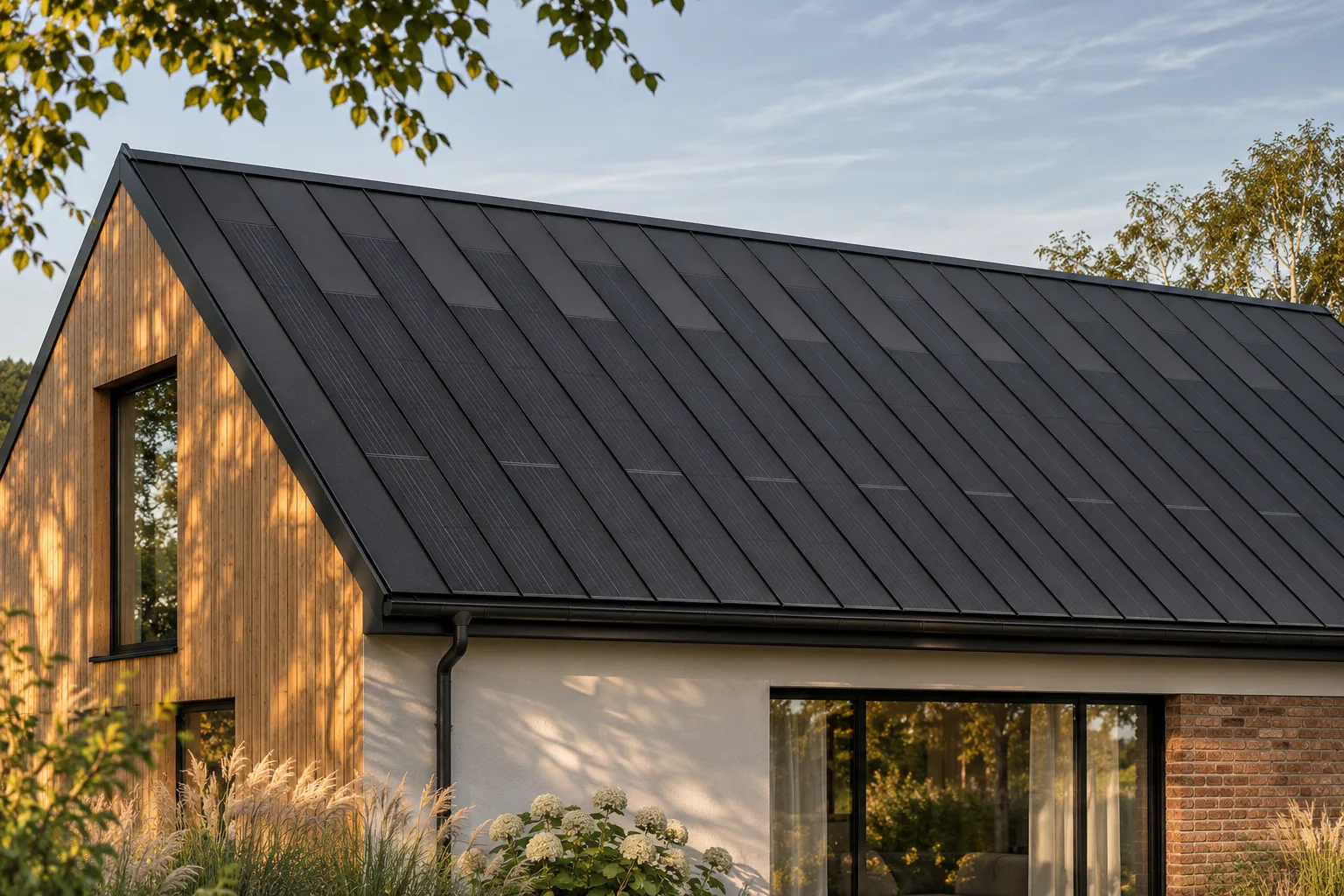
A dark photovoltaic roof can work well with light render, wood and brick. A coherent effect depends more on proportions and the number of materials than on perfectly matching all colours. Integrated steel roofing helps to organise the upper part of the house, because it does not add a separate plane of panels. It is worth treating it as a fixed element of the palette and only then selecting the façade, flashings and small accents to suit it. It is best to start with the elements that are large and difficult to change later. The roof occupies a considerable area, and its material has a specific appearance. The active part should not be treated as a freely coloured decoration. The choice of façade colour usually gives more freedom than changing the character of the cells and the system construction.
In this article
Which material should the composition start with?
A set of real samples will be useful. Alongside the roofing, it is worth laying out the render, a piece of wood and the flashing material. Seen together in natural light, they show relationships better than separate photos on a screen. A BIPV roof can provide a calm backdrop for the façade if the other decisions do not compete with each other without a clear plan.
The samples are best checked in shade as well. Materials viewed only in strong sunlight can make a different impression on the north side of the house or on a cloudy day.
How does the combination with light render work?
A light wall and a dark roof create a clear contrast. This helps emphasise the simple volume and the eaves line. It is worth assessing the shade of the render, however, and not just its general description. Cool white, warm white and slightly grey white can look different with the same roofing. Light and the surrounding greenery also matter.
If the roof has a regular division of active and passive fields, the façade can remain restrained. There is no need to repeat every seam with additional lines on the wall. A calm surface allows the roofing material to come into its own. It is worth refining the windows and gutters, however, because against a light background their random selection will be clearly visible.
What does wood contribute?
Wood can warm the perception of a dark roof and give the façade a more natural character. It works well as a clearly defined section, for example at the entrance or terrace. It does not have to cover the entire wall. It is important that its direction and divisions harmonise with the volume instead of creating an additional, competing pattern.
The way the chosen material ages and is maintained must be taken into account. The colour immediately after installation will not always be the colour a few years later. The palette design should therefore tolerate natural changes in shade. The integrated roof surface provides a good reference point for this, since its geometry remains regular despite changes in the appearance of the façade.
How to choose brick or mineral cladding?
Brick has its own rhythm and surface variation. A dark, orderly roof can balance this texture. It is worth comparing the shade of the mortar joint and the proportion of brick in the façade. Too many strong accents on a small volume can weaken the clarity of the form. Not every part of the house has to be decorative at the same time.
With cladding, a distinction must be made between appearance and the technical wall construction. The roof does not determine how the façade is fixed or its layers. Materials can form a coherent composition, but each must be properly designed. The choice of palette should not lead to flashings and correct junctions at the interfaces between different parts of the building being overlooked.
Should all metal details be black?
There is no such obligation. Gutters, window sills and flashings can harmonise with the roof or with another architectural element. What matters is that the choice is limited and consistent. Sometimes graphite or dark grey gives a better effect than various random shades of black. Samples should be viewed together, because colour names do not describe the whole impression.
Gloss also matters. An active surface may reflect light differently from a matt flashing. This difference does not have to be eliminated at all costs. It can be taken into account in the design while keeping a similar colour direction. However, the technical compatibility of materials remains more important than mere similarity in a photograph.
How can the combination be checked before construction?
It is worth preparing several calm views of the house in ordinary daylight. The actual active and passive areas and the flashings should be shown. A uniform black texture across the entire roof may hide important differences. It is good to supplement the visualisation with a photograph of a similar covering realised in a real setting.
A BIPV roof gives architecture the benefit of a compact, planned energy-producing roof slope. Wood, brick and render can complement it in many ways. It is best to choose a limited palette that also works after years of use. Coherence comes from proportion and material, not from multiplying striking details.
Manufacturers and brands of solar roofs include ML System, Tesla, MDM NT (MyRoof), Solarstone, Megasol Energie, SolRoof, SunRoof, Wienerberger Wevolt, Electrotile and Autarq.
7 branches. Materials closer to your project.

- SEROCK — Dzierżenin 34 E
- BŁONIE — ul. Sochaczewska 138A
- RADOM — ul. Grobickiego 8
- ŁÓDŹ — Natolin 8
- OLSZTYN — Barczewo, ul. Prosta 9
- WROCŁAW — ul. Jerzmanowska 10C
- GORZÓW WLKP. — ul. Zielona 33/34