Does asbestos-free fibre cement roofing provide thermal insulation?
Fibre cement roof coverings
A roof can be rain-tight and yet still fail to protect adequately against heat loss. These tasks belong to different parts of the building envelope. Fibre cement sheets are primarily a covering or cladding specified within a given system. Asbestos-free fibre cement does not replace a suitably selected thermal insulation. When choosing a material, it is worth separating the functions of the layers. That makes it easier to assess what a heated house, a workshop or an unheated warehouse needs. Materials differ in their ability to conduct heat, but their thickness matters too. A thin sheet may conduct heat less readily than metal and still have too low a thermal resistance to serve as proper building insulation.
In this article
Lower conductivity does not mean ready-made insulation
The comparison of two raw materials should therefore not be transferred to an assessment of the whole roof. Insulation performance is determined by the sum of the layers, the junctions and thermal bridges. The actual method of installation also matters. If there is a ventilated space beneath the covering, its role is taken into account in the calculations appropriate to that build-up. The marketing term “warm material” does not replace the parameters of the building envelope.
The covering must keep precipitation where it belongs
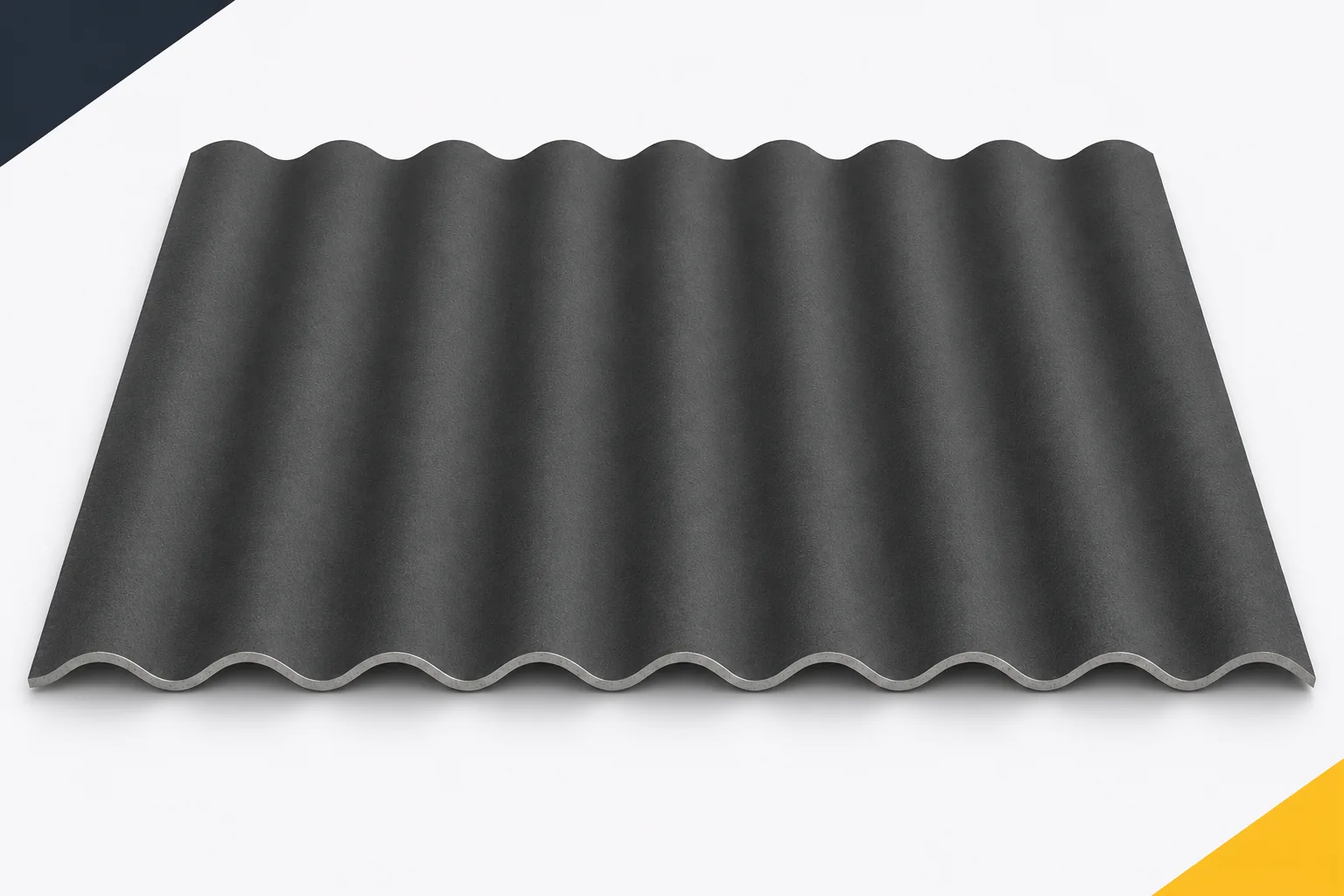
Corrugated fibre cement sheets protect the roof from external conditions when they are correctly selected and installed. The laps, flashings and fixings form the water-shedding layer. This does not automatically mean airtightness. In many solutions a ventilation path is deliberately left beneath the covering. The perceptible draught in the room therefore need not indicate a hole in the sheet itself. It must be established where the airtight boundary should run. This is usually a separate task in the design of an insulated roof. Sealing all the corrugations from the outside can worsen ventilation without remedying the actual cause of the losses.
Insulation is selected to suit the building’s requirements
A heated room requires a different build-up than an open shelter. The expected temperature, humidity and mode of use must be established. Corrugated fibre cement sheets can be used above an insulated roof, but the thickness and type of thermal insulation must be selected for the entire building envelope. Fire, acoustic and structural conditions also matter. There is no basis for recommending a single thickness for every building. The design should take account of the areas at the rafters, walls and openings. Correct insulation in the middle of the field alone does not ensure a good result if continuous gaps or exposed heat-conducting elements are left at the junctions.
Air can bypass even good insulation
The insulation layer performs as intended when it is properly laid and protected against uncontrolled air flow. Leaks at ducts, the roof hatch and the wall can change conditions throughout the roof. Asbestos-free fibre cement on the outside will not remedy these junctions. A continuous airtight layer is needed on the side specified in the design. Its function can be performed by a suitably executed material or system, not necessarily by any membrane. The laps, bonding and penetration details matter. The assessment is worth carrying out before the interior finish is closed, when any corrections do not require dismantling a finished ceiling.
Moisture affects the durability of the layer build-up
Insulation and vapour control must be coordinated with each other. Moist air should not reach the cooler parts of the building envelope in an uncontrolled way. Corrugated fibre cement sheets can limit the effects of periodic moisture under certain conditions, but they are not a remedy for permanently damp insulation. The design should specify the drying potential and the required flow beneath the covering. Adding an airtight layer during renovation without analysis can be risky. Moisture can become trapped in the existing structure. Before insulating, it is therefore worth checking the condition of the roof, removing leaks and identifying the materials already present in the building envelope.
Summer comfort involves yet another set of factors
On a hot day, solar exposure, surface colour, insulation, ventilation and heat gains through windows all matter. Corrugated fibre cement sheets do not guarantee a constant reduction of the indoor temperature by a specific number of degrees. The material may have favourable properties in a particular solution, but the effect must be assessed at building level. In a room with large glazing, overheating may dominate regardless of the covering. An uninsulated hall, in turn, will remain sensitive to external conditions. Comparing roofs makes sense when it takes account of a similar function and a complete layer build-up. Simply changing the sheets need not deliver the expected comfort.
How to compare two solutions without oversimplifying
It is worth comparing complete assemblies with the same function, not just the prices of surface materials. Insulation, the substructure, airtightness, ventilation and details must be taken into account. Corrugated fibre cement sheets can then be assessed as part of a deliberately designed roof. A comparison requires the thermal parameters of the whole system and its installation requirements. The cost of new construction must be separated from the cost of adapting an existing structure. Sometimes it is more cost-effective to retain a good covering and improve the layers beneath it. In another building, the condition of the roof justifies a full rebuild. The decision should be driven by the problem that actually needs solving.
If you are planning asbestos-free fibre cement over a heated interior, state the building’s thermal requirements. This will allow the covering to be selected as part of a complete assembly, together with appropriate insulation.
7 branches. Materials closer to your project.