Fence picket spacing: balancing an open appearance and privacy
Fence pickets and metal fences
The gaps between pickets are just as important as the profiles themselves. They reveal glimpses of the garden, change how the colour is perceived and affect how well the property is screened. Metal fence pickets set closely together can look like a solid surface. The same elements spaced more openly create a more open rhythm. However, there is no single gap that suits every house. The choice should follow from where the fence will be viewed, the need for privacy and the actual layout of the structure. It is worth checking several variants before ordering material. Ask what should be visible through the fence. At the entrance, contact with a visitor may matter. By the terrace, limiting visibility may be more important. Along a side boundary, a calm view of greenery is sometimes needed. These needs do not always lead to identical spacing across the whole property. Sections can be varied while keeping a common profile and colour.
In this article
Start with function, not a ready-made number
It is not worth choosing a gap simply because that is how the pickets were set in a photo. A photograph shows one angle and distance. It may have a different background and fence height. Metal fence pickets need to be assessed under conditions close to reality. A short test section set up where the property boundary will be is helpful.
The gap works together with the profile width
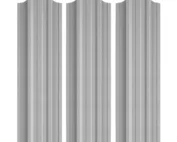
The same gap with a narrow and a wide picket gives different proportions. Therefore, gaps should not be compared in isolation from the material. It is worth seeing several repetitions of the entire module. A dense rhythm of small elements can look different from calm, wider fields. The impression also depends on the colour and depth of the embossing.
When changing the profile, the number of pickets must be recalculated. The width of the input is not the correct value here. What counts is the finished dimension of the element in the bay. In addition, there are gaps at the posts, which may require a different distribution than the internal gaps. A well-planned layout maintains order also at the ends, not only in the middle of the field.
Look diagonally and from different heights
A three-dimensional profile changes the view during movement. Head-on, the widths of the face and the gaps dominate. At an angle, the side surfaces of the pickets and their mutual screening are added. Therefore, the fence may look more open or more closed depending on the viewing position. Assessing privacy requires several views, not one photo.
Also check the view from a seated and a standing position. This is particularly important when there are differences in ground level. Fence pickets do not provide full screening merely by reaching a certain height. If an effect is needed in a specific direction, the test should be carried out from that very position. This allows the layout to be chosen without unnecessarily densifying the entire boundary.

Do not equate density with every protective function
Smaller gaps restrict some views, but they do not confirm acoustic protection or resistance to burglary. A standard picket bay has a defined purpose. If a specialised function is required, appropriate data and a design are needed. These should not be replaced by a mere impression of solidity. A dense surface still consists of separate elements and connections.
Densification also changes the wind conditions acting on the fence. The structure should correspond to the intended infill. It cannot be assumed that every existing frame will accept any change in spacing or an additional row. Fence pickets must work together with the posts and rails. This relationship is part of the choice, even if aesthetics was the starting point.
Ensure even distribution along the entire length
The most attractive trial spacing can lose its point if a random wide gap appears at the end of each bay. That is why spacings must be calculated together with the number of pickets and the edges. Where field widths vary, choose a consistent rule for adjustment. Sometimes a small change to the internal gaps gives a calmer effect than maintaining them at all costs.
During installation, repeatable spacers and checking successive elements are helpful if this corresponds to the instructions. It is not worth checking only the first gap. A small deviation can accumulate across the entire width. Fence pickets should retain their cross-section and vertical alignment. Their sides should not be deformed as a way of hiding a spacing error.
Choose the level of screening you can comfortably live with
Before the final decision, look at the sample from the street and from the house side. Check how much background the gaps reveal and what the structure behind them looks like. Think about future plants and access for cleaning. A denser layout may require more attention when inspecting the space between elements. It should still allow the material to be maintained in accordance with the instructions.
Well-chosen gaps give the fence the right character without accidental promises. Fence pickets can form an open boundary or a more sheltered section, depending on the design. It is important that the effect is checked in a real view and combined with a suitable structure. Then lightness and privacy are conscious parts of the choice, not a surprise after installation is complete.
7 branches. Materials closer to your project.