Why increasing EPS thickness from 10 to 20 cm does not halve heating bills
Polystyrene and thermal insulation
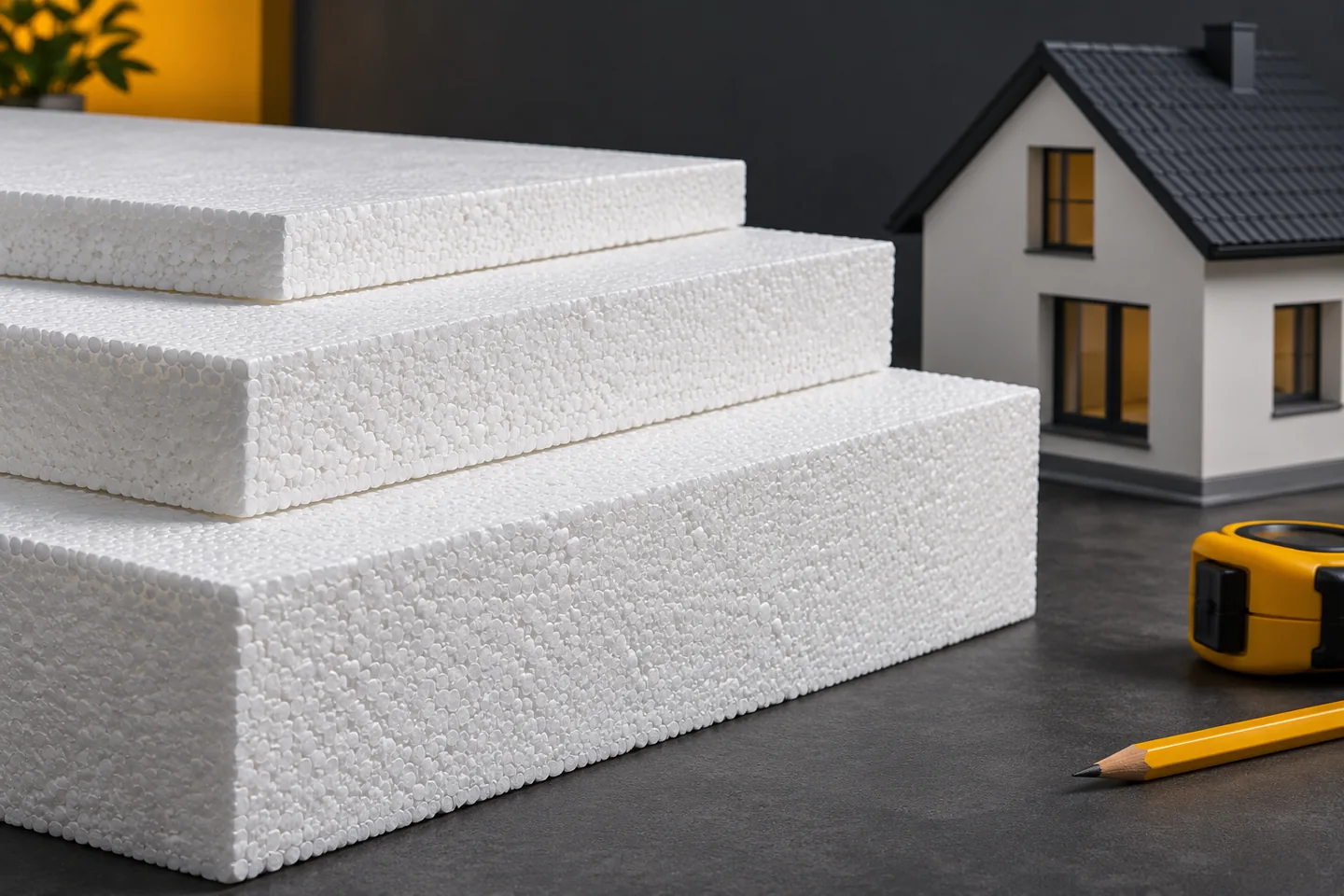
Doubling the thickness of EPS doubles the thermal resistance of the insulation itself, but does not automatically halve the heat losses of the whole wall or the heating bill. A wall also has other layers, and a building loses heat through the roof, windows and ventilation. It is worth separating the U-value calculation from the balance of the whole house. Only then can the real value of each additional centimetre be assessed. For the same lambda, the thermal resistance of a layer is R = d/λ. If the thickness increases from 10 to 20 cm, the thermal resistance of the EPS doubles. This is a simple relationship concerning the material. However, the U-value of a wall is the reciprocal of the sum of the thermal resistances. It covers the masonry, the finish and the relevant surface resistances, and in a full assessment also the appropriate corrections.
In this article
What actually doubles when EPS is added?
So you cannot jump from a statement about doubled R of polystyrene to a promise of a bill that is twice as low. These are different levels of calculation. First, the change in U of the specific building component must be established, then its share in the building’s balance. Finally, the operation of the heating system and the way energy is billed come into play. Each stage contributes different data.
Let us calculate an example for one wall
Let us assume that the resistance of all components other than EPS totals 1.0 m²K/W. Let us take the λ of the expanded polystyrene as 0.040 W/(m·K). For 10 cm the insulation resistance is 2.5, so the total is 3.5 m²K/W. We obtain a U-value of approximately 0.286 W/(m²·K). At 20 cm EPS the total rises to 6.0, and the U-value falls to approximately 0.167 W/(m²·K).
In this example the drop in the U-value is approximately 42%, not 50%. The difference results from the resistance of the remaining elements, which did not double along with the insulation. The figures are indicative and omit corrections and thermal bridges. For a different wall the percentage will be different. This is precisely why answering the question about savings requires knowledge of the existing building element, and not only of the planned board thickness.
Why do additional centimetres yield a smaller increase in benefit?
Keeping to the same assumptions, 30 cm EPS gives a total resistance of 8.5 m²K/W and a U-value of approximately 0.118. The change from 10 to 20 cm lowers the U-value by approximately 0.119. The move from 20 to 30 cm lowers it by approximately 0.049 W/(m²·K). Each additional 10 cm adds the same resistance, but reduces an ever smaller remaining heat flow.
It does not follow from this that a greater thickness is worthless. The cost, the project requirements and the effects over the entire service life must be compared. On a new façade, part of the cost is incurred regardless of a few additional centimetres. A very large thickness, in turn, can affect the reveals, the flashings and the fixings. An assessment of cost-effectiveness should cover these actual changes.
Walls are only part of a building’s losses
Let us imagine a simplified balance in which the walls analysed account for 40% of the losses, while the rest remains unchanged. If we reduce their losses by 42%, the total decrease will be about 17%. This is the multiplication of the share by the improvement of that part. It is not a forecast for any arbitrary house. It merely shows why a good result for one building envelope component does not translate directly into the whole building.
In the real balance there are the roof, the floor, windows, doors, thermal bridges and air exchange. There are also gains from the sun, people and appliances. Their share changes with the weather and with use. Insulating the walls does not automatically reduce losses through an open gate or a leaky hatch. It is worth identifying the other weak points before all the resources are devoted to one element.
There is still a step between the heat demand and the bill
The calculation depends on the efficiency or effectiveness of the heat source, the controls, the energy carrier and the charges. It may also include domestic hot water preparation, which insulating the walls does not change in the same way. In a before-and-after comparison of a renovation, the weather and the temperature maintained indoors must be taken into account. Two different winters do not provide a simple measurement of the effect of the EPS alone.
The behaviour of the occupants may also change. If they raise the temperature after the renovation, they will use part of the potential saving for greater comfort. This does not prove that the insulation is not working. It only means that different conditions are being compared. A reliable forecast should separate the technical effect from the usage assumptions and state clearly what the calculated percentages refer to.
How should the decision on thickness be made?
First, compare the U-value of the whole building element for several variants. Then check the effect on the building’s energy balance and on the details. It is worth taking into account the durability of the modernisation and the possibility of later access to the thermal insulation. Finally, compare the cost of the complete solution with the forecast savings. A single number describing the lambda value is not enough to assess a renovation, just as the cost of a single pack is not enough on its own.
EPS is produced by, among others, Termo Organika, Austrotherm, Genderka and Paneltech. Their specific boards can be compared at different thicknesses and with the same function. More insulation usually reduces heat flow through a correctly installed layer. However, the size of the benefit must be calculated for the actual building, without promising that doubling the centimetres will always halve the costs.
7 branches. Materials closer to your project.