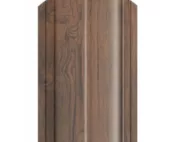
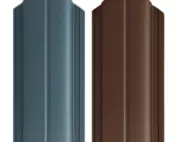
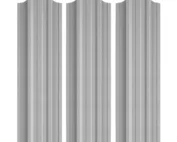
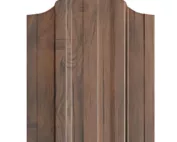
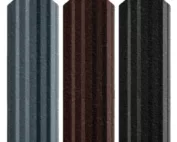
A double row of metal fence pickets: planning depth and views through the fence
Metal fence pickets and fences
Two rows of pickets create a spatial arrangement that cannot be assessed from a flat front view alone. Offsetting the elements affects what can be seen through the gaps. A second layer of shadows and a more pronounced depth of the bay are also added. Metal fence pickets can thus screen a selected part of the property more effectively. However, this is not automatically a full wall. The design should cover the geometry of both rows, the structure and the view from several directions. Before choosing the spacing, mark the observation points. This may be the pavement by the street, the neighbouring garden or the entrance area. Also check the position of people sitting on the terrace. A two-row arrangement is worth designing for specific viewing directions. Simply adding another layer of material does not guarantee the same effect from every side.

In this article
First establish which view is to be limited
Metal pickets have their own width and section depth. Together with the gap between the rows, they affect how much is screened. A sample section is particularly useful here. It can be walked around to see how the view varies. If one direction remains too open, the geometry needs to be analysed. Further random tightening of the elements is not always the right answer.
Treat the offset as part of the design
In many layouts, the centre of a picket in one row falls opposite the gap in the other. This is a starting point that must be adapted to the system. The edge elements at the posts also matter. The rows do not have to end in an identical way. The number of pickets and their arrangement should therefore be worked out separately rather than automatically doubling the result from a simple single bay.
Show a top view on the sketch, with short sections and gaps. It does not have to be a complicated drawing. It helps to understand where both planes are located. It is worth marking the street side and the garden side. This allows those carrying out the installation to read the orientation of the elements as intended, including where the front and back have different finishes.
Ensure a clear finish at the posts
The post governs the thickness of the entire bay. With two rows, the relationship of the infill to its surface may look different than with one. Some systems specify a particular setting for the crossbar and the first row. It is worth knowing these rules before choosing the appearance of the corners. Necessary space should not be removed just to achieve an accidentally flatter image.
At the pedestrian gate and driveway gate, the transition to two layers requires separate checking. The moving leaf has its own construction and hardware. Additional metal fence pickets change the mass and the degree of enclosure. They should not be added without assessing the whole solution. Visual consistency can also be achieved through colour and rhythm, without mechanically copying every detail of the fixed bays.

Colour should support depth, not create chaos
A uniform colour for both rows gives calm transitions of light and shadow. Contrasting colours may reveal the rear layer more strongly. This effect should be checked on a sample, because the proportion of the colours will change from different angles. It is not worth assuming that the second row will always remain invisible. Particularly against a light background, its surfaces may be clearly visible.
The finish on both sides of the picket must be specified separately from the number of rows. A decorative double-sided coating does not mean two layers of construction. In a two-row layout, visible parts of the rear surface of the profile may also appear. Metal pickets should therefore be inspected from the front, from the back and at an angle. A description of one representative side alone leaves too many unknowns.
Match the construction to the intended development
A larger amount of material and altered airflow affect the working conditions of the fence. Posts, rails and fixings must suit the intended layout. Do not assume that a structure designed for an open single row will be equally suitable once further pickets are added. The assessment should take account of the installation location and the system requirements.
Do not attribute unconfirmed noise protection to such a bay. A double row of ordinary pickets is not automatically an acoustic screen. The same applies to a specific resistance to burglary or impact. If such a function is required, the relevant data for the solution must be checked. The impression of a closed fence does not replace confirmed performance characteristics.
Allow for cleaning and inspection
The space between the rows should be accessible to the extent needed to maintain the material. It is not worth immediately screening it with dense greenery and additional decorations. Leaves, deposits and minor damage are easier to spot when the structure remains clear. The cleaning method must suit the coating. Aggressive agents do not become appropriate simply because the location is difficult to access.
Double-row metal pickets can create an interesting, three-dimensional front and screen off some unwanted views. Their advantage stems from a well-tested geometry. A sample, a plan view and the right structure help predict the result. This makes the depth of the fence a planned architectural element rather than the effect of adding further pickets without a clear purpose.
7 branches. Materials closer to your project.