Using environmental product declarations to compare EPS
Polystyrene and thermal insulation
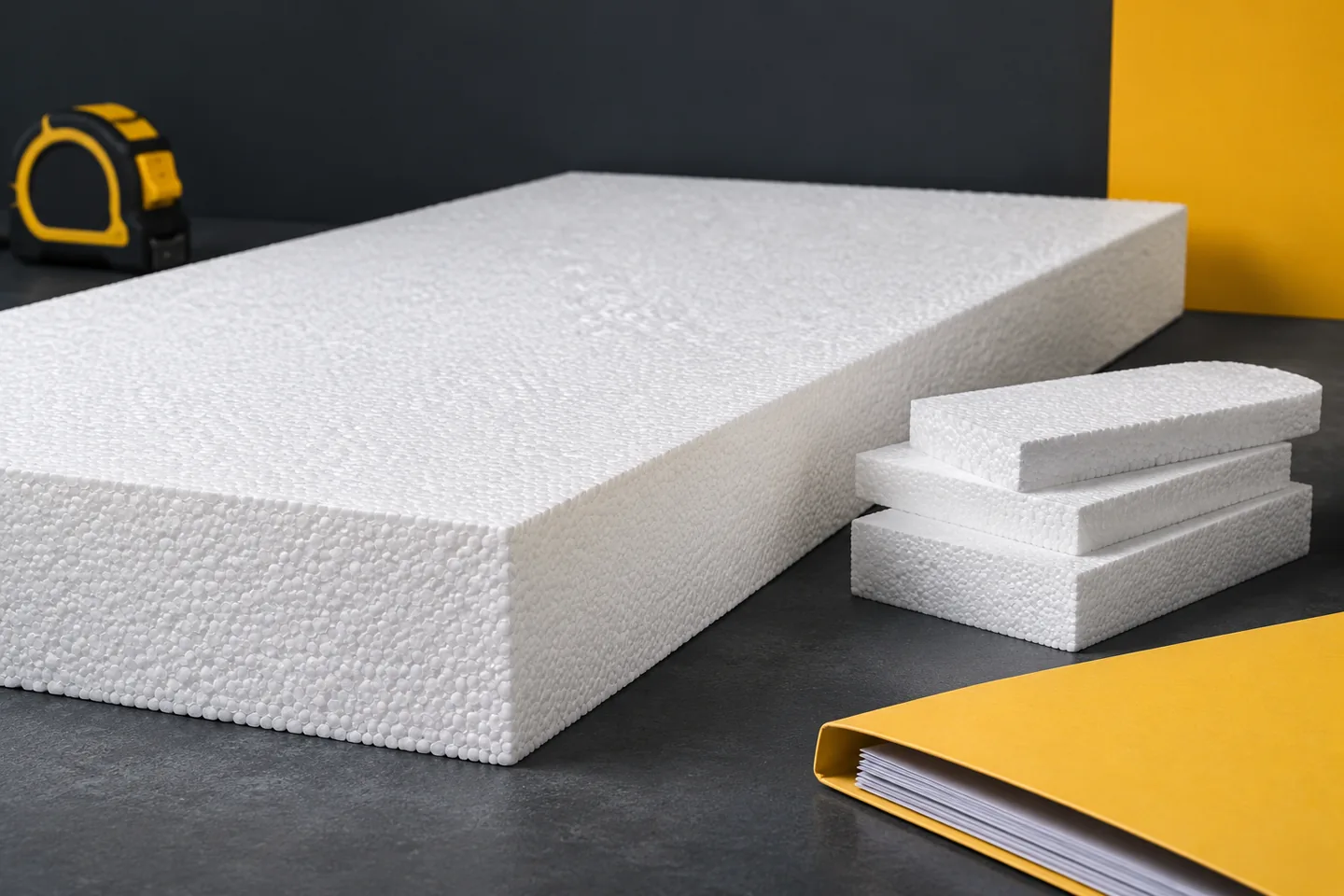
An EPD environmental declaration helps to compare the environmental impact of insulation, but it requires careful reading. What counts is the reference unit, the scope of the life-cycle stages and the actual function of the material. A kilogram or a cubic metre of two boards does not necessarily give the same thermal insulation performance. An EPD also does not replace the technical data needed to use EPS in a building. A type III EPD contains structured data on the environmental impact of the product. It is produced according to specific rules and is subject to verification. It shows indicators and the assumptions of the life-cycle analysis. It is not a simple good-or-bad assessment. The mere fact of having the document does not mean that the product has the smallest impact in every category and in every application.
In this article
How does an EPD differ from the word ecological?
A distinction must also be made between an EPD and a declaration of performance. The latter is used to read properties such as lambda or compressive stress. An EPD concerns a different set of information. Both documents may be needed to select a material, but they are not interchangeable. A board with a favourable environmental indicator must still meet the technical requirements of a specific wall, floor or roof.
Check whom and what the data cover
The declaration may cover a single product, a product family or a group of manufacturers. The scope, representativeness and the method used to derive the values must be read. Aggregated data do not necessarily describe every board supplied. The period over which information was collected, the production location and the document’s expiry date are also important. The declaration number makes it easier to link an offer to the correct version.
Tables should not be compared without checking the normative basis and the product category rules. Different editions of the rules may change the way reporting is done. In the case of an aggregated document, it must be established whether it covers the given product and manufacturer. Merely attaching the EPD mark to an offer does not clarify this point. It is worth keeping the full document, not just a cut-out table of a single indicator.
It is the function that must be standardised, not just the unit
One cubic metre of insulation does not always provide the same thermal effect. Materials may have different lambda values and require a different thickness. For a comparison in a building, it is worth assuming the same area and the required R-value, together with the other functions. Under a loaded floor, the mechanical parameters must also be maintained. A comparison with a façade board would then be inadequate.
If the data refer to 1 m³, then 1 m² of a layer 15 cm thick contains 0.15 m³ of material. The conversion is useful when the document permits such a scaling basis and corresponds to the selected product. With equal R, the thickness is d = R × λ. The quantity of material required must therefore be determined first, and only then should the environmental impact attributed to it be calculated.
Compare the same life-cycle stages
Modules A1–A3 cover raw material extraction, transport to production and manufacturing. A4 and A5 relate to delivery to the construction site and installation. Modules C describe the end-of-life stage. Module D shows the benefits and loads beyond the adopted system boundary, associated with specific scenarios. These scopes should not be mixed in a single comparison without explanation.
A lower result for production alone does not automatically determine the whole life cycle. Transport, installation losses and the approach taken after demolition can influence the result. Data for future recycling are a scenario, not proof that every board will actually be recovered. Module D should not be subtracted from production according to any arbitrary shortcut of one’s own. The rules of the adopted analysis must be retained.
Do not limit the assessment to a single figure
The GWP indicator describes the potential impact on climate change and is given as CO₂ equivalent. The EPD also contains other categories, including those related to resources, water, emissions and waste. Selecting only the most favourable value can distort the comparison. The purpose of the assessment must be defined and the same scope retained for the solutions considered.
The benefits of reduced energy consumption in the building require a separate usage model. They do not follow automatically from the EPD’s production table. They depend on the building component, climate, heat source and operating time. An identical emission saving should not be attributed to every additional board. The actual thermal effect must first be calculated and then combined with the assumptions of the building analysis.
How can an EPD be used when ordering EPS?
It is worth asking for the current declaration covering the proposed product and clearly stating the required data. The comparison should include the lambda value, the selected thickness, the quantity and the intended use. When comparing offers, the same functions and modules must be retained. If data are missing, this gap should be flagged. The absence of an EPD does not automatically mean a greater impact, but it makes a reliable comparison more difficult.
EPS is produced by, among others, Austrotherm, Swisspor, Paneltech and Arsanit. The range of available documents should be checked for the specific boards. An EPD is useful when it helps to calculate the solution actually envisaged in the project. A reliable assessment combines the quantity of material, its function, the conditions of use and transparent scenarios, instead of basing the choice on the word ecological alone.
7 branches. Materials closer to your project.