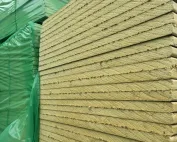
IKO enertherm ALU: documenting properties and fire classifications
PIR insulation
The requirement for ALU should distinguish between the reaction of the product itself and the result of a specific end use. A more favourable class must not be transferred without the test conditions. The specification must relate it to the actual substrate and assembly. This is particularly important when assessing proposals to substitute the material. The IKO enertherm ALU specification should identify the function that the building envelope assembly with aluminium-faced PIR boards is to perform. An element requiring an unambiguous description is the penetration of services through the continuous insulation layer. The input data should include the thickness of the layer and the position of the elements penetrating the insulation, and not only the area intended for insulation. The coordinating document remains the cross-section with the full ALU designation and the required protective layers.
In this article
Input data for the specification
It should be recorded who confirms that the task can be carried out: use the thermal resistance of the board without omitting the conditions of application of the entire system. In this respect, the person responsible should be the designer of the building envelope with the specific ALU variant, in accordance with the division of design work.
The correct product and the scope of its data
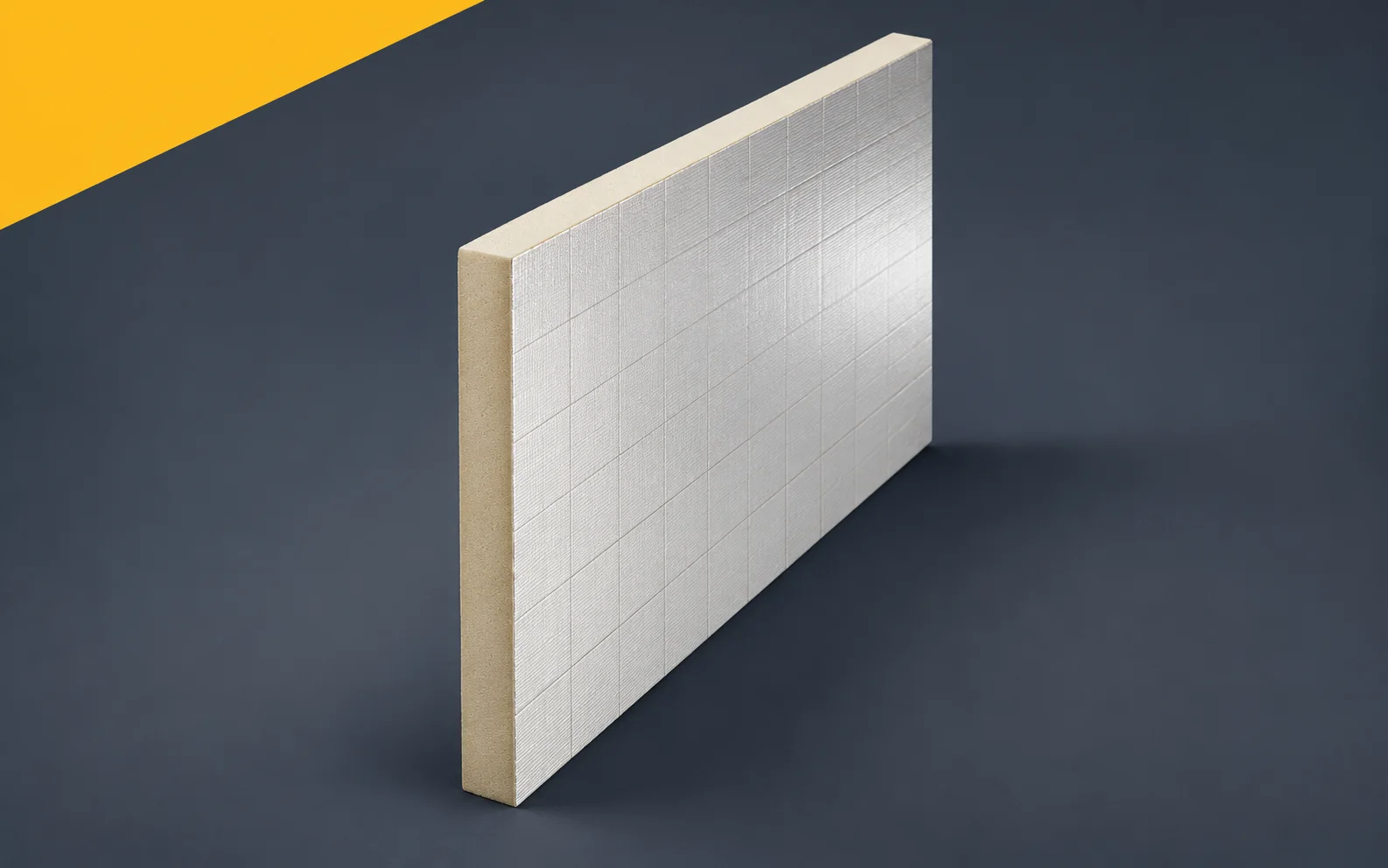
IKO enertherm ALU is described as a board whose PIR core has more than 95% closed cells and both sides consist of aluminium facing. The documentation records λD = 0.022 W/(m·K) and compression of at least 175 kPa at 10% deformation. The reaction to fire of the product itself is recorded as class F, whereas B-s2,d0 refers to the specified end use on a steel substrate — the two classifications must not be entered interchangeably. The scope of the assessment is determined by the building envelope system with aluminium-faced PIR boards: the PIR-type core is one layer, and the properties of the complete board also result from the facings. The installation of factory-made boards in a specific layer system is therefore what this article calls polyurethane insulation.
What the presented calculation covers
Combine the IKO enertherm ALU entry in the specification with a description of the protective layers and documentation of the end use. An example 100 mm board with a lambda of 0.022 W/(m·K) gives, from the calculation 0.10/λ, approximately 4.55 m²K/W. This is a calculated resistance that must be distinguished from the RD declared in the product documents. When qualifying a delivery, the ALU designation and its conditions of application are just as necessary as the thickness; lambda conformity alone does not confirm the entire solution.
For IKO enertherm ALU, the distinction between the product data and the result of the entire solution must be maintained. The analysis uses the characteristic: lambda 0.022 W/(m·K) with a specific product construction. The assessment must take into account the limitation: the condition that the facing and edges are compatible with the adopted building envelope. Before approving the variant, the data of the board itself must be separated from the results for the specified end use and the result recorded in the documentation. Reproducing the assumptions is made possible by a section drawing identifying the exact ALU variant and showing the necessary layers that protect it. This ensures that a later comparison with another offer does not omit the element described as a service penetration through the continuous insulation layer.
Conditions for assessing the variant
In the project, the performance described as selecting the thickness in the confirmed ALU system can be compared with the solution of changing the product variant together with a reassessment of the joints. The criterion should follow from the need to use the thermal resistance of the board without omitting the conditions of use of the entire system. For IKO enertherm ALU, retaining a single figure from the data sheet does not mean that the entire build-up is equivalent. The requirements must also take into account a joint suitable for the ordered ALU version. Transferring the classification from the test on a steel substrate to any building envelope component must be excluded, because this changes the meaning of the recorded parameter. The decision should be presented by the designer of the building envelope with a specific ALU variant, together with the scope of changes for adjacent materials. The adopted variant must be linked to a schedule: an unambiguous list of the variant, thickness and scope of application.
Description of the execution of the valid joint
The drawing should unambiguously indicate the penetration of a service through the continuous thermal insulation layer. In the case of IKO enertherm ALU, the surface of the material formed by the multi-layer gas-tight aluminium facing must also be described. The preparation must provide a substrate that bears the load in the selected application. The required point of inspection occurs before the stage described as the finish provided for in the design of the building envelope. The basis for acceptance is the record of the variant label together with the documentation of its end use, assigned to the drawing and the place of execution. Such a description limits discretionary decisions by the crew at a point that will not be visible later.
Delivery and acceptance documents
The delivery of IKO enertherm ALU should be assignable to a single specification item. This item is expanded by an unambiguous list of the variant, thickness and scope of application; every described characteristic should have a reference to the design. A record of the variant label together with the documentation of its end use is needed, allowing the variant and the manner of its use to be confirmed. If conditions change, the condition of conformity of the facing and edges with the adopted building envelope must be reconsidered. The update should be agreed by the designer of the building envelope with a specific ALU variant before the next layer conceals the discrepancy. In this way, the polyurethane insulation is linked to the executed scope, which is the building envelope assembly with aluminium-faced PIR boards.
A record that can be verified later
The final description of IKO enertherm ALU should allow the adopted decision to be reproduced without guessing its purpose. In this case, the purpose can be defined as using the board’s thermal resistance while accounting for the application conditions of the complete assembly. The description should be accompanied by a cross-section identifying ALU in full and specifying the protective layers needed for the chosen application. The penetration of a service through the continuous thermal insulation layer should be indicated separately where its solution differs from the main field. The record should cover the entire required scope. When proposing a substitute, the data of the board itself must again be separated from the results for the specified end use, instead of basing the assessment solely on the name PIR. Polyurethane boards are then compared according to verifiable characteristics and the effects on the specific build-up.
7 branches. Materials closer to your project.