What do the properties of termPIR MAX 19 AL actually tell you?
PIR insulation
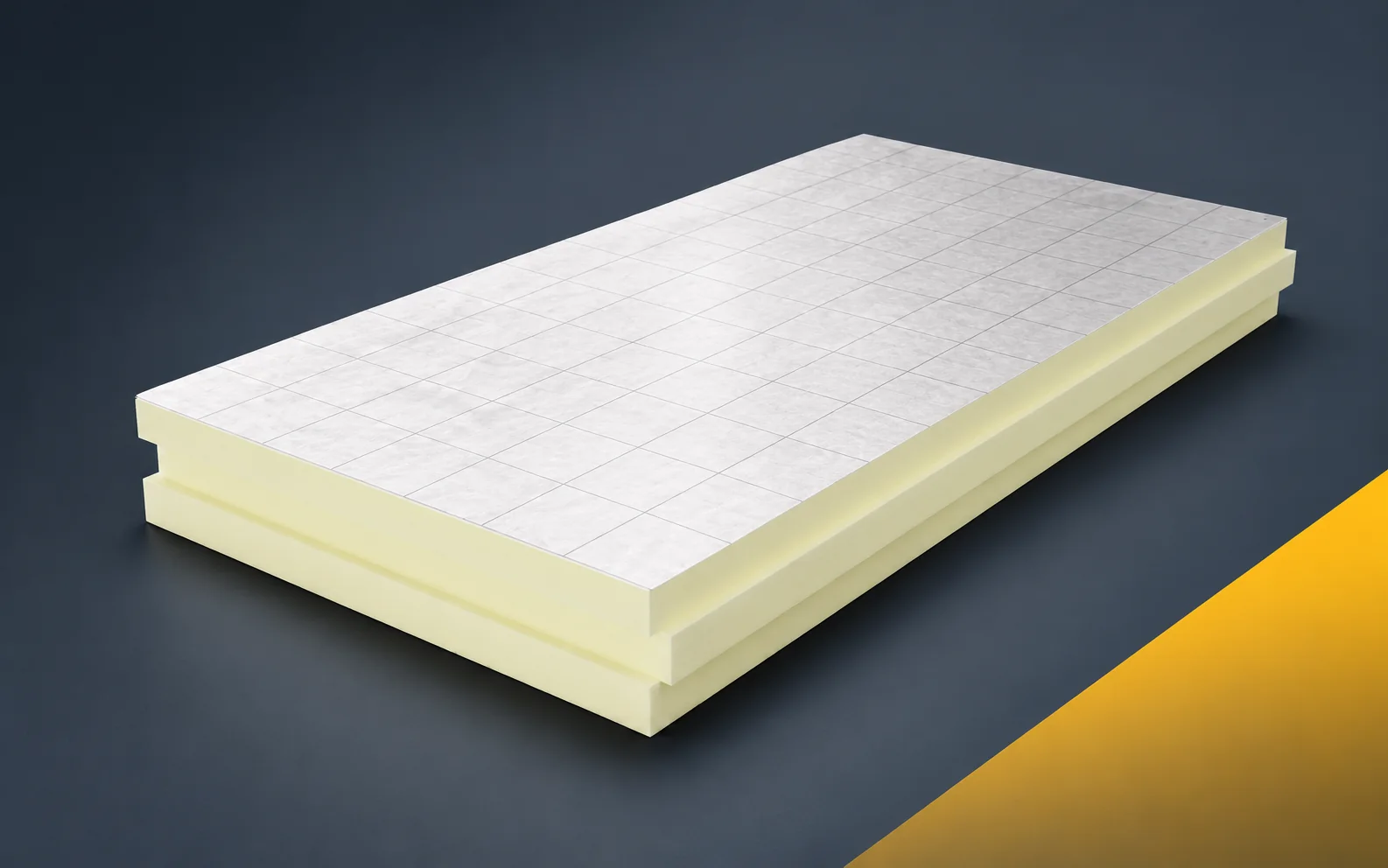
The name MAX 19 draws attention to the thermal properties. However, the documentation for termPIR MAX 19 AL also contains mechanical data and reaction-to-fire conditions. Product selection requires reading them together, without assuming an automatic advantage in every category. termPIR MAX 19 AL is a board made of rigid PIR foam, protected on both sides with a gas-tight laminate of aluminium, paper and polyethylene. Its primary distinguishing feature is its level of thermal conduction. In the specification for the application described as PIR boards, clearly indicate the place where little space remains for insulation under the existing flashing. The cross-section at the existing flashing must be checked before using the advantage of the low lambda value, and the adopted variant must be clearly marked in the documentation.
In this article
Scope of the data in the specification
An abbreviated record of the name alone is not sufficient, because a very low lambda does not remove the restrictions relating to the substrate and adjacent layers. The functional assumptions are intended to allow the advantage of the thickness to be used where it actually permits the detail to be simplified. In the design documentation, include the available cross-sectional height and the scope of work required to increase it, together with a reference to the relevant cross-section.
The basis for a correct comparison
In the calculation of the building component, use the lambda of 0.019 W/(m·K) declared for termPIR MAX 19 AL, valid for thicknesses of 80–220 mm. With an unchanged required thermal resistance, this value leads to a thinner insulation layer, and the result must be related to the specific thickness within this range.
When comparing polyurethane boards in the calculations, describe separately the layers compared at the assumed resistance of 5.0 m²K/W in the calculation example. The calculated thickness of termPIR MAX 19 AL must be matched to the variant available in the actual delivery so that each value can be linked to the correct version of the calculation. The parameter must remain linked to the declared range, since the product of R and lambda gives a theoretical thickness that does not necessarily occur in the delivery. Verification of the design should allow the nearest suitable thickness to be selected without promising a U-value result on the basis of the foam alone. In the calculations, retain the result of the layer calculation and the re-checking of the entire building component after product selection, so that any subsequent change of material can be traced.
Interpretation of the mechanical and fire properties
For termPIR MAX 19 AL, the declaration states CS(10/Y)100 and reaction-to-fire class E. In the specification and at acceptance, refer to these values for this board; do not transfer them from another product with a similar facing.
In the table of mechanical and fire requirements, distinguish the CS(10/Y)100 declaration belonging to termPIR MAX 19 AL, and not to a similar board. The CS100 declaration must be checked independently of the benefit resulting from the lambda of 0.019, so that the product document does not replace the required assessment of the application. Evidence for one case cannot be extended arbitrarily, because better thermal insulation does not automatically mean greater resistance to load. The product and application documents must allow the performance requirements to be checked independently of the expected reduction in thickness. When approving the material, compare the conformity of CS and class E with the documentation for precisely the ordered product with the actual configuration of the building component.
When approving termPIR MAX 19 AL, the declaration specific to that name must be read. CS100 cannot be replaced by a value taken from another board with an aluminium facing. This rule also applies to the variant proposed as a substitute. The comparison must state the thickness, thermal resistance and mechanical requirements. The shared PIR designation is not a sufficient basis for equivalence.
Moisture through the full cross-section
The termPIR MAX 19 AL board requires protection during storage and installation. The gas-tight laminate limits vapour flow through the surface, but does not in itself seal the joints — continuity of the layer must be ensured in the detail of the connections.
The analysis of moisture conditions should include the point where installations emerge at the perimeter of the layer with the gas-tight facing. The perimeter of the laminate must be connected to the intended sealing of the wall or installation penetration in accordance with the thermal and moisture conditions adopted for the building envelope. The description “polyurethane foam” does not conclude the analysis, because even a very good thermal parameter does not compensate for an open path of air flow. The adopted layers and their connections must allow the critical perimeter to be closed without relying solely on the metallised surface of the board. In the specification, explain the continuity of the sealing and the protection of the material during the interval between work stages, as well as the boundaries of responsibility of the individual layers.
Geometry and joint design
For termPIR MAX 19 AL, the FIT variant has a straight edge, LAP – an overlap, and TAG – a tongue and groove. On the execution drawing, indicate the joint of the boards with the groove in the case of slight unevenness of the substrate: the TAG profile does not level the structure or close every inaccurate connection, so the support and inspection of the gap at the joint should be decided in the design, not on site.
In the construction drawing, describe precisely the joint between the grooved boards at the point where the substrate shows a slight unevenness. The profiled edges must be fitted without forcing the boards to lie over an uneven substrate, and the method of checking must be shown on the construction drawing. This cannot be left solely to the installer’s decision, since the TAG profile itself neither levels the structure nor closes every imprecise joint. The adopted geometry should allow a flat support to be prepared before assessing the tightness of the laid thermal insulation. The designed polyurethane insulation requires specifying how the condition of the edges, the support under the joint and the actual width of any gap are to be checked during acceptance.
Conditions for purchasing and checking a substitute
TermPIR MAX 19 AL is available in formats 600 × 1200 and 1200 × 2400 mm, with a coverage correction for the groove. In the offer comparison, first balance the thermal effect, and only then compare the other features.
When checking the item “polyurethane insulation” in the bill of quantities, analyse the cost difference between thinner insulation and rebuilding the surrounding elements. The two cost variants should provide the same thermal effect and the same functional performance, and the agreed criteria must remain clear during the assessment of the substitute. Agreement of a single feature is not enough when a more expensive square metre of board can be justified only by a specific benefit in the whole task. The material procedure should allow the material price to be separated from the cost of changes to geometry, fixing and finishing. Enter two complete calculations in the conformity report, together with the cutting plan and the effects of the adopted layer thickness, so that the decision is not based solely on the commercial description.
7 branches. Materials closer to your project.