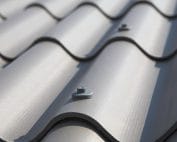
Air humidity and cold roof surfaces: why roofing alone is not enough
Fibre cement coverings
The building owner often looks for the cause of moisture solely in the covering. Meanwhile, the conditions under the roof can change once a wet load is introduced, the heating is switched on or the gates are closed. Corrugated fibre cement sheets react to their surroundings just like the other materials of the building envelope. Asbestos-free fibre cement does not regulate the interior humidity on its own. To limit water on the cold roof slope, its sources and the way air is exchanged must be identified. A percentage humidity reading is not straightforward information about the amount of water in the entire room. A change in temperature also changes this indicator. That is why two measurements taken at different times require context. Merely heating the air can lower its relative humidity without removing moisture from the building.
In this article
Relative humidity depends on temperature
If the air cools later, the conditions change again. In practice, it is worth recording the temperature together with the humidity and the activities carried out in the building. Such a record makes it possible to see whether the problem is linked to an operating cycle rather than only to the weather. A single reading taken after opening the gate can be misleading.
A wet load can change the conditions throughout the entire hall
Machines after rain, fresh wood or damp materials release water into the surroundings. If the building has been closed, the moisture remains inside. Fibre cement sheets above a dry warehouse and above an identical warehouse full of wet goods perform under different conditions. It is worth determining where the water comes from and how long its inflow lasts. Brief ventilation at the time of delivery is not always sufficient. A permanent method of air exchange matched to the storage may be needed. Gaps allowing flow around the stored items must also be maintained. Blocking existing openings can change the situation even though the roof is unchanged.
A cool surface does not necessarily mean a material defect
An uninsulated roof covering remains strongly linked to external conditions. When warmer, humid air comes into contact with a sufficiently cool surface, condensation can form. Fibre cement sheets are no exception to this phenomenon. Their ability to buffer moisture temporarily depends on the product and on the drying conditions. It does not provide unlimited protection. If the building is to operate at a different temperature than before, the need for insulation and for the entire layer build-up must be assessed. Replacing only the covering without changing the internal conditions may not eliminate dripping. It is important to establish whether the roof is to be only a shield or also a thermal barrier.
Short heating periods require conscious organisation
In some buildings, the air is heated only during working hours. The structure and the stored items warm up more slowly. Asbestos-free fibre cement may then remain cool even though the perceived temperature inside has already risen. It is worth tracing the entire cycle, including after the heating is switched off and the building is closed. The problem should not be solved solely by raising the temperature. If the moisture is not removed, it will return as the building cools. The heating method must be coordinated with ventilation and with processes that generate water. The selection of equipment and its use should match the function of the room, not only the available output.
Air exchange must include the areas under the roof
In a large room there may be areas with weaker airflow. Obstacles, platforms and stored goods affect the path of the air. Fibre cement sheets may be dry in one area and damp in another. This does not immediately mean a difference in the quality of the sheets. The local conditions and whether the intended openings are unobstructed must be checked. Ventilation should remove moisture from the building without directing it into closed roof layers. An opening made accidentally in the ceiling can make the situation worse. The air exchange design must also take account of the winter period, when the user most often restricts ventilation because of the cold.
Keep observations that will allow you to make a decision
An orderly record of the date, weather, temperature, humidity and work carried out is enough. It is worth marking the places where water appears on a simple floor plan of the building. Fibre cement sheets are inspected from safe positions, without walking directly on the roof slope. It should be checked whether the symptoms occur during rainfall, after night-time cooling or after delivery of a wet load. Such material is useful to the designer or contractor. It helps to separate a leak from condensation and to assess whether both phenomena occur simultaneously. It is not worth removing all traces without documenting them, because information needed to determine the cause may be lost.
A change in use may require a change of solution
A building previously used as an open-sided shelter may need a different method of ventilation after its walls have been enclosed. The subsequent addition of heating creates a further change. Fibre cement sheets do not have to be defective for the original roof to cease to suit the new conditions. The structure, thermal protection and moisture control must be assessed for the intended function. Measures may include organising storage, removing moisture at source or rebuilding the layers. The right order begins with diagnosis. Only then are the costs of the changes compared. As a result, the investment addresses the actual cause and not the material on which the water is most visible.
When choosing asbestos-free fibre cement, also describe the pattern of use and the sources of moisture. This information helps to match the roof to the way it is used, instead of expecting the covering to control the climate on its own.
7 branches. Materials closer to your project.