What does the protective coating on a steel roofing sheet do?
Covering selection
The protective layer on steel roof sheeting limits the environment’s impact on the steel core, but it does not replace the required amount of steel. When choosing a covering, two decisions must therefore be kept separate: the profile and its resulting geometry, and the protection system on both sides of the sheet. It is worth checking which metallic and organic coatings are used, how their mass is declared, and whether the underside protection suits the building’s conditions. Colour or coating name alone does not determine durability – continuity of the surface and how the roof is used are what count.
The core serves a different purpose than the coating
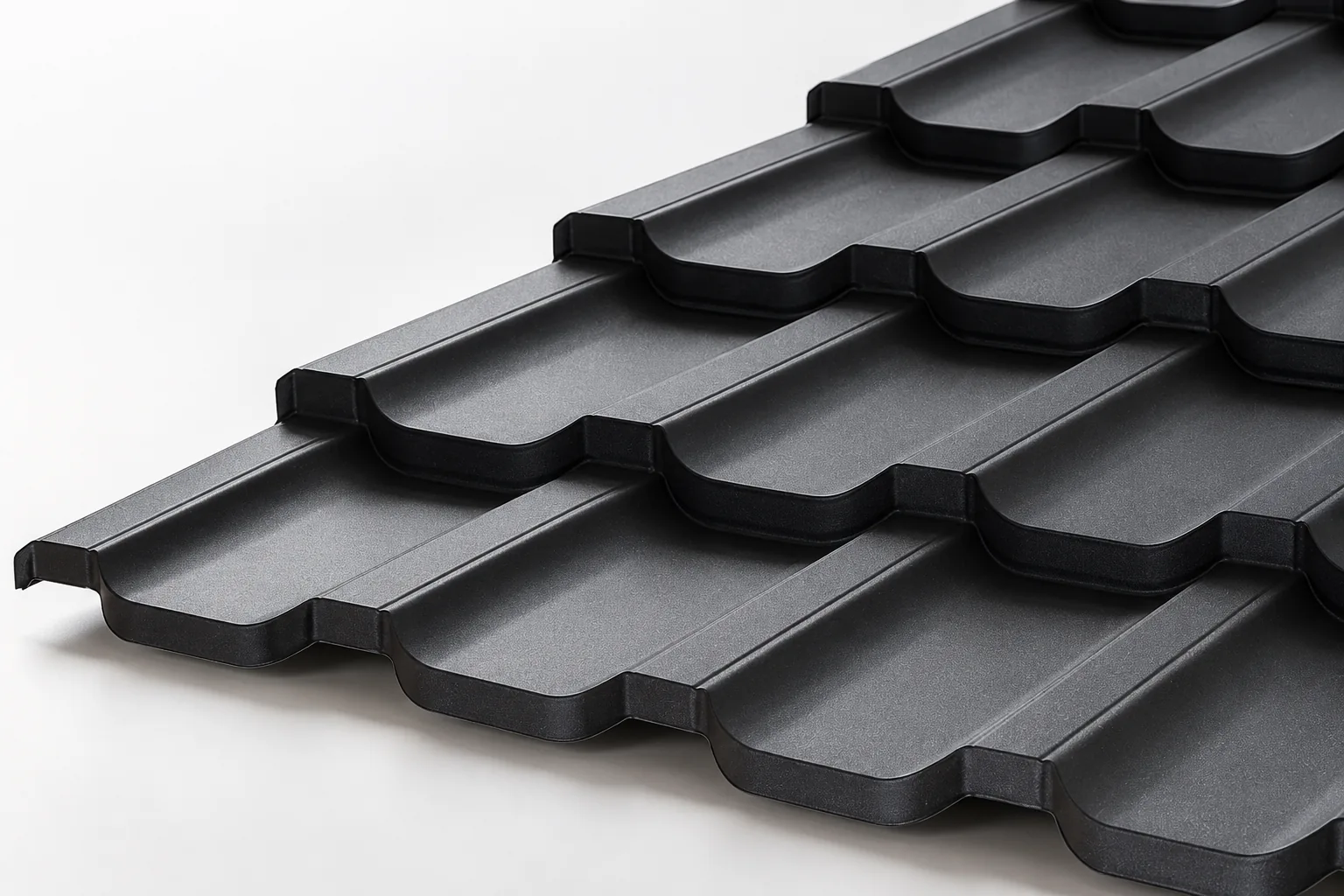
The steel core together with the profile geometry forms the mechanical part of the sheet. Its thickness and grade matter for the performance of the covering. The coating protects the surface but does not replace the required amount of steel. Load-bearing capacity therefore cannot be assessed by the appearance of the outer layer alone.
T18, T35 and tile-effect metal roofing may use similar families of protection despite their different shape. The choice of profile and coating are two related decisions. The first must match the geometry and loads, and the second the environmental conditions. Both should be described in the order.
What purpose does the metallic layer serve?
The metallic coating separates the steel from the environment and contributes to corrosion protection. Zinc and suitable alloys, among others, are used. Their composition and parameters are not identical. The term “metallic” is therefore not sufficient to compare two materials.
The documentation may state the type of coating and its surface mass. The way this value is declared must be checked, including the reference to the sheet sides. It should not be converted independently into paint thickness. These are different layers and different units of description.
What does the organic coating add?
The organic coating provides an additional barrier and gives the surface its colour and texture. It may comprise a primer and a top coat. The type of resin, the thickness and the entire production process influence the properties. Comparing a single parameter is not enough to identify a better product.
Resistance to corrosion, UV radiation, scratching and forming conditions all matter. Not every coating is intended for the same environment. Matt and gloss describe appearance, not full protection. Likewise, the colour name does not indicate the composition of the layer.
Why must the underside of the sheet also be checked?
On the inner side, the sheet also comes into contact with moisture and air. The reverse-side protection may differ from the face side. In an insulated building envelope, the layer arrangement and condensation matter. In an agricultural or industrial building, potentially aggressive vapours are added.
Equal resistance on both sides should not be assumed without documentation. If the covering will be visible from below, aesthetic requirements should also be agreed. Anti-condensation fleece serves a separate function and needs to dry out. It does not automatically change the sheet’s resistance to every environment.

What can the protective layer not repair?
The coating does not replace a correct overlap, fixing or chimney flashing. It will not stop water penetrating through a poorly made joint. Nor will it restore rigidity to a bent sheet. A roof requires the material to be compatible with the structure and careful installation.
Edge protection should not be treated as a promise that any scratch will disappear by itself. Damage must be assessed according to the instructions for the specific product. Sometimes a local touch-up is enough, and at other times the element must be replaced. The extent of the problem matters more than its name alone.
What can damage the protection before installation?
Sliding sheets over one another, sand between surfaces and incorrect lifting can cause scratches and bends. Moisture trapped in a pack creates different conditions from rain on a correctly laid roof. Transport and storage instructions must be observed.
For cutting, tools are used that do not damage the coating through high temperature. An angle grinder can also damage adjacent surfaces with sparks. Swarf is removed promptly. Its rust should not remain on the covering while waiting for rain.
How to read durability declarations and the warranty?
Corrosion resistance and colour durability have separate criteria. It is worth checking what the stated categories refer to and for which variant they apply. A test result is not a simple conversion into a number of years of use. The actual conditions on a building can vary greatly.
The warranty defines the scope and conditions of protection, not the unconditional service life of the roof. The requirements regarding environment, inspections and repairs must be read. The documents should be kept for the ordered material. A general marketing table may not describe all the conditions of a given variant.
How to preserve the protection during use?
Dirt and accumulated leaves trap moisture, so inspections and appropriate cleaning are needed. The cleaning method should be matched to the coating. Sharp tools and aggressive chemicals can remove more than just the dirt. After work on the roof, it is worth checking for new scratches and leftover waste.
A well-chosen protective layer makes sense when the user knows its purpose and limitations. To compare steel sheets, ask for the full protective build-up on both sides. Then set it against the conditions of the building. Such a description offers more than a general promise of an exceptionally resistant colour.
7 branches. Materials closer to your project.