Four checks when selecting a tile-effect metal roof covering
Tile-effect metal roofing
Begin by establishing whether the chosen roofing tile profile actually suits the roof geometry and the intended method of installation, rather than by comparing colours. Check its conformity with the design, the specification of the steel and workmanship, the suitability of the coating for the surrounding conditions, and the full cost of the finished roof including delivery. Any one of these points may rule out a seemingly attractive offer. Only once they have been set side by side is it worth deciding between similar variants, since the appearance of a sample alone will not reveal technical differences.
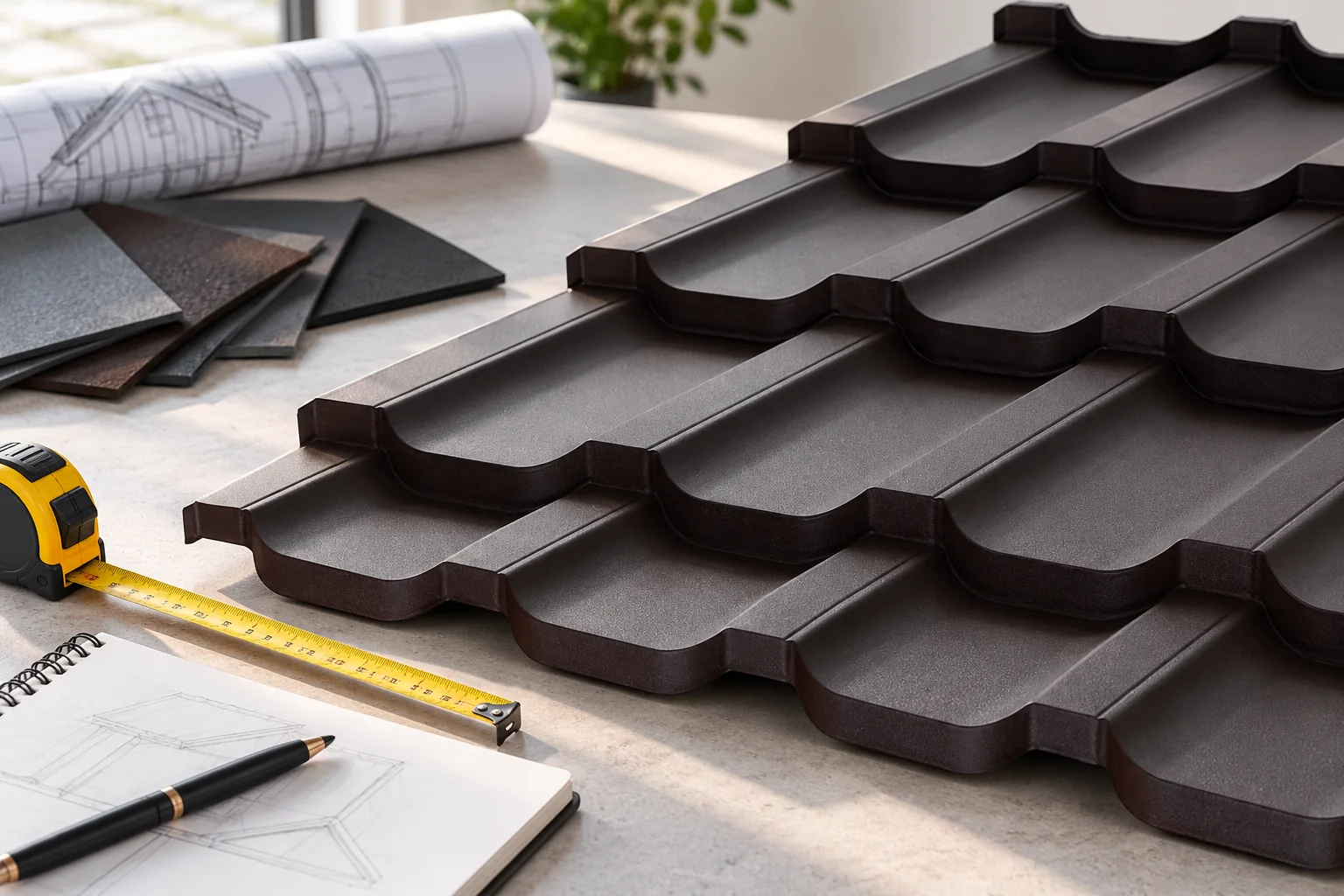
Prepare the data before you start comparing models
A dimensioned roof plan, the pitch angle and the layout of openings are needed to discuss the covering. For a renovation, an assessment of the structure and of the layers remaining beneath the sheet is also required. This information narrows the choice to materials that can actually perform on the given roof slope.
It is worth defining straight away how the loft will be used and what services are planned. Heated rooms require a different layer build-up from an open canopy. Panels, the chimney and equipment serviced from the roof affect the fixings and access. Adding them later may require alterations.
Only with such a set of data should you ask for several quote variants. Each should refer to the same plan and scope. Otherwise you will be comparing different tasks, even though the quote headings look similar.
1. Does the model suit the geometry and layout of the roof slopes?
Check the permitted pitch, the method of joining the elements and the required substructure. Tile-effect metal roofing has a defined profile module that the battens work with. Their spacing cannot be changed arbitrarily. The eaves, ridge and connections to flashings must also be resolved.
On a simple roof slope, it is worth considering sheets cut to size. With many roof valleys and corners, small modules may be convenient. This is not a ready-made ranking, however. The actual material layout, the number of offcuts and the possibility of using the cut-off pieces must be compared.
Ask about the overall and effective width, as well as the length limits of the sheet. Not every element can be safely transported and lifted onto the roof. The format should suit both the geometry and the organisation of the construction site. The installer’s convenience may affect the cost and the risk of damage.
2. Does the offer describe the steel and workmanship precisely?
The specification should include the core thickness, the steel grade and the metallic protection. The data must relate to the selected variant, not the entire product family. It is worth checking how the thickness is stated and which documents confirm it.
A higher profile changes the appearance and rigidity of the profile, but does not by itself determine the quality of the material. Similarly, a greater sheet weight may result from its dimensions. Comparison makes sense with the same unit and an accurate description. A product should not be judged solely by bending a sample in your hands.
The complete set also includes suitable fasteners and flashings. The screw must match the substrate and the required loads. The flashing should work with the geometry of the covering. Random accessories can negate the benefit of a well-made sheet.

3. Does the coating suit the building’s surroundings?
The coating is selected according to humidity, contaminants and possible salinity. In some buildings the internal side is also demanding. An ordinary house roof and a building envelope with aggressive vapours should not be assessed according to one simplified scheme.
Corrosion resistance and colour retention are different properties. They must be checked in the documentation for the specific coating. Matt and gloss describe the visual effect, not the full durability. A real sample should be viewed in daylight against the planned façade colour.
Also read the care and repair conditions. Not every surface can be cleaned with any chemical or painted with a random touch-up. The warranty should be analysed together with the scope of protection and the usage requirements. The number of years alone is not enough to compare quality.
4. How much does a finished roof and its delivery cost?
The price per m² of material is the start of the calculation. In the costs, include the ordered area, waste, flashings, fasteners and layers under the covering. Add labour, transport and unloading. Offers must be compared with the same stated tax and scope of work.
For modules, check whether the quote refers to a piece, the total area or the usable area. For sheets cut to size, verify the list of lengths. The schedule should also include elements at chimneys, windows and roof valleys. Missing these items can understate the apparent price.
The cheapest variant should be assessed in terms of where the saving comes from. Less material thanks to good layout is different from an omitted flashing. Also agree who is responsible for measurement and ordering. Correcting an incorrect length may require a new delivery.
How do you make the decision and confirm the order?
Compile the variants in four columns: compatibility with the roof, material, coating and full cost. Reject those whose application cannot be confirmed. Among the remaining, choose the solution that suits the appearance of the house and the way the work is carried out.
Record the exact profile, coating, colour, quantity and dimensions of the components in the order. Keep the technical documentation and the installation instructions. On delivery, compare the consignment with the specification and check the condition of the surfaces. This is the last straightforward opportunity to detect an error before the material goes onto the roof.
7 branches. Materials closer to your project.