A leaking roof: how to trace the cause and decide what to do next
Renovation and maintenance
First limit damage inside and have the roof inspected, rather than immediately looking for the culprit at the wet patch. Water may travel along the membrane or structure, and a hole visible above a stain is not always the source of the leak. It is worth establishing whether the problem occurs with every rain or only with rain from a particular wind direction, and distinguishing precipitation from water-vapour condensation. The check should cover valleys, chimney flashings, wall junctions and service penetrations. An effective repair removes the cause instead of covering an arbitrary section of the roof slope.
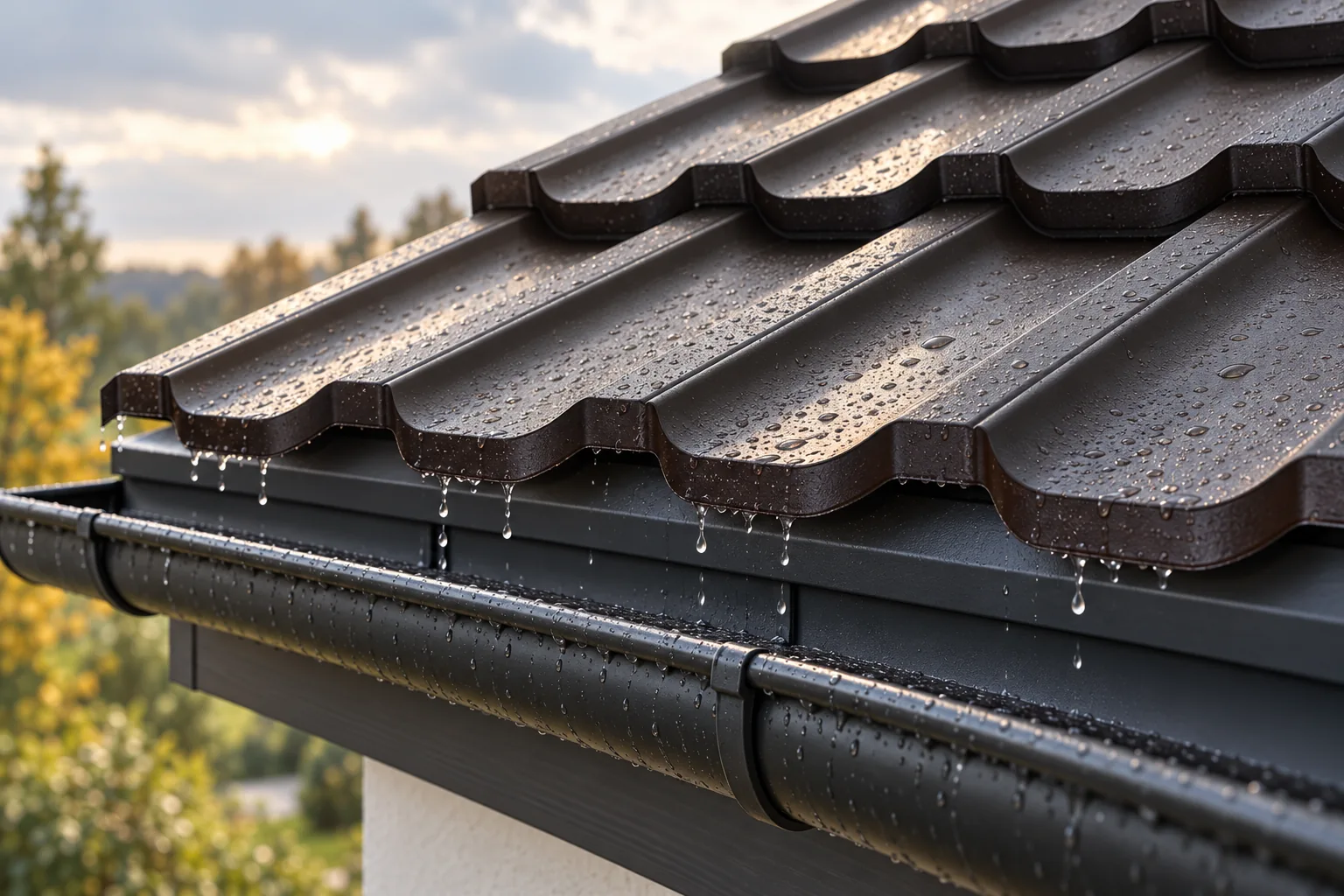
How should you react when you notice water?
Protect belongings and restrict access to the place where water is dripping from the ceiling. If the dampness affects the electrical installation, an electrician’s assessment is required. Do not touch wet cables or fittings. Photographs and a record of when the problem occurred will help with diagnosis later on.
Do not go onto a wet roof during rain or strong wind. Temporarily covering the roof slope requires safe access and fall protection. Commission it to a suitably prepared team. The aim of the first intervention is to limit further damage without creating a risk to people or additional damage to the covering.
Why can the stain be far from the damage?
Water may penetrate under the covering in the upper part of the roof slope and only emerge at another element. It travels along the underlay, timber or installations. The hole visible above the stain is therefore not always the only place requiring inspection.
Tell the roofer whether the problem occurs with every rain or only during rainfall with a specific wind direction. Thaw and lying snow are also important. Information about the conditions helps to identify the details to be checked. A photograph of a dry stain alone shows the effect but usually does not explain the cause.
Which places should be inspected first?
The inspection should cover roof valleys, chimney flashings, junctions at walls and service penetrations. The laps of the sheets and the fixings are also checked. Different elements and paths of water runoff meet at these places. Their performance depends on shape, position and the condition of the connections.
Do not overlook the eaves and drainage. Accumulated leaves can change the conditions of water runoff. Deformed flashings or an incorrectly executed detail can also direct water under the covering. The repair should result from inspecting the whole location, not merely from applying another layer of sealant to the visible joint.
How can you distinguish a leak from vapour condensation?
Moisture appearing on the underside of the steel sheet may come from condensation. In that case, the surface temperature, the interior humidity and the layer build-up of the roof need to be examined. The problem may intensify without any rainfall. Identifying the conditions under which it occurs is more important than automatically assuming the steel sheet is leaking.
Anti-condensation fleece has a limited capacity to retain water and must be able to dry out. It does not replace correct ventilation or the insulation of the heated building envelope. If the cause is humid air flowing in from the interior, that problem needs to be resolved. Sealing random gaps from the outside may only make drying more difficult.

When is repairing a detail sufficient?
A locally damaged flashing or an incorrect fastener may require repair of a limited section. First, however, the condition of the materials beneath the covering needs to be checked. Closing in wet insulation under a new section does not automatically restore the properties of the entire roof. The extent of drying out or replacement follows from the assessment of the damage.
Repairs use components that match the profile and coating. A similar colour does not mean the overlap shape is suitable. In the case of modular tile-effect metal roofing, dimensional compatibility is also important. If the problem stems from an incorrect slope, support or the entire detail, simply replacing a single piece may not be enough.
Which repairs often turn out to be superficial?
Randomly applying sealant to the surface may mask the symptom without restoring proper water runoff. Sealant has a defined scope of application and requirements for the substrate. It does not replace a flashing that is missing or incorrectly shaped. An incompatible material may also make later proper repair more difficult.
Without a diagnosis, all screws should not simply be tightened more firmly. Excessive pressure may damage the washers and deform the steel sheet. Likewise, drilling additional holes does not solve every leak. An assessment is needed of the type of fastener, its seating and the condition of the substrate to which it has been fixed.
How can you check the result and reduce the risk of recurrence?
After the repair, keep a description of the work carried out and photographs. Monitor the location under conditions similar to those that caused the leak. The inspection should also cover the drying out of the internal layers. The absence of a fresh stain alone does not always mean that all the moisture has already been removed.
Establish a plan for inspections, gutter cleaning and checking details. New installations on the roof should be fixed so as not to damage the protection already in place. Before the rainy season, check in particular the locations of previous faults. A well-documented cause helps prevent recurrence more effectively than a series of successive temporary seals.
7 branches. Materials closer to your project.