Modular metal roof tiles or sheets cut to length for each slope?
Tile-effect metal roofing
The choice between modular and cut-to-size metal roof tiles depends primarily on the roof geometry and transport conditions, not on the format alone. Check whether the roof is simple or has valleys and corners, what delivery options are available, and how the sheets are laid out. Compare two layouts for the same roof plan, taking into account the number of elements, offcuts and installation method. Remember that durability is determined by the material and the execution of details, not by sheet length. A full quote should cover accessories, flashings, waste, delivery and installation.
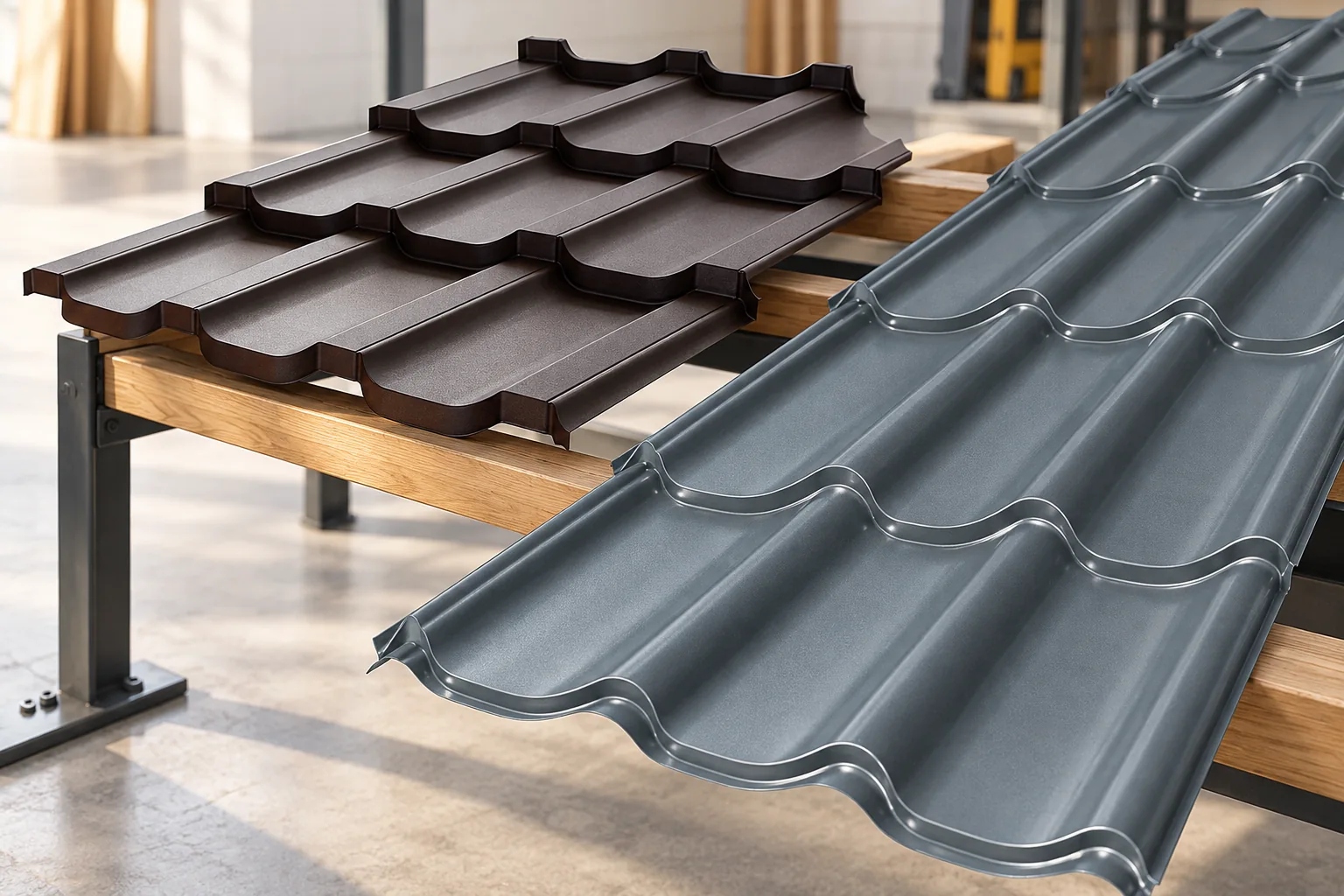
What do the two terms mean?
Modular tile-effect metal roofing is supplied in short elements of a fixed format. Their dimensions and the way they are joined depend on the model. It should not be assumed that modules of different systems have the same cover width or can be joined together.
Cut-to-size tile-effect metal roofing is ordered in lengths that result from the layout of the roof slope. Production and installation limits still apply. The overall length must not be confused with the effective cover length. The sheet width also includes the part needed for the overlap.
The order should specify the exact profile, colour and type of coating. For cut-to-size sheets, a list of lengths is added; for modules, their number and version. The required accessories should also be stated. This ensures that the term ’tile-effect metal roofing’ does not replace the full delivery specification.
On a straight roof, the sheet layout is what matters
On a regularly shaped roof slope, a long sheet can reduce the number of transverse joints. This makes it easier to plan continuous strips of covering. The prerequisite is correct measurement and the ability to deliver and bring the elements onto the roof without permanent deformation.
Modules are also suitable for a straight roof. Choosing them may result from difficult access, limited storage space or how the crew’s work is organised. The number of joints alone does not determine tightness. What matters is correct execution of the system overlap.
At roof valleys and corners, compare waste
On a complex roof, sheets require numerous diagonal cuts. Small modules can make it easier to fit the material to such areas. However, this does not automatically mean zero waste. A cut-off piece does not always fit on the opposite side of the slope.
It is best to compare two layouts prepared for the same roof plan. They should indicate the number of elements, the ordered area and how offcuts are accounted for. A general percentage allowance does not replace a layout drawing of valleys, dormers and diagonal edges.
Transport and handling have a real cost
A long sheet requires support during handling. Gripping it only by the ends can cause bending and damage to the profiles. Unloading, the number of people and the route for bringing the sheets onto the roof must be established in advance. Narrow access may limit the permissible delivery length.
Short modules are easier to divide into smaller batches, but they must still be protected from scratching and moisture. Packs should not be dragged over dirty ground. Storage rules are set out in the instructions, and the transport film is not a storage solution for an indefinite period.

Installation depends on the specific profile
Both solutions require a simple substructure, the correct starting point at the eaves and maintaining the geometry of the rows. The batten spacing results from the profile module. It should not be carried over from a previous roof to a new model just because it looks similar.
The laying direction, fixing points and connection of adjacent elements are specified in the instructions. The number of fasteners is also selected according to loads and roof zones. A smaller sheet does not exempt from calculations, and a long one does not allow fixings to be reduced arbitrarily.
Durability depends on more than format
The thickness and grade of steel, the metallic protection and the organic coating must be compared. Environmental conditions, the cutting method and subsequent maintenance are important. A weak coating does not become more resistant simply because the covering is in modular form.
Flashings, ventilation and the layers beneath the sheet metal affect the performance of the entire roof. Chimneys, roof valleys and service penetrations require particular attention. A well-chosen material can leak if a detail is poorly executed, regardless of sheet length.
How to compare prices fairly
Both quotes must assume the same material class, coating and scope of work. Check whether the price refers to the total area, the usable area or a single module. Accessories, flashings, waste, delivery and installation must be added to the covering value.
The price per square metre of the sheet alone may change the order of the quotes once cuts are taken into account. The cost of unloading and the additional work on long elements are also relevant. A comparison only makes sense when both quotes cover the entire same roof.
What will be easier for later repair?
Replacing a small module may reduce the area of work, but it depends on the layout of the overlaps and fixings. Removing a damaged element is sometimes linked to loosening the adjacent ones. With a long sheet, the repair may require more space and bringing the sheet onto the roof again.
It is worth keeping the name of the technical variant, the purchase documents and a colour sample. The availability of the same profile after years is not certain, and the coating may change shade. Base the final choice on geometry, logistics and the full quote, rather than on the format of the covering alone.
7 branches. Materials closer to your project.