How to assess the environmental impact of a metal roof
Choice of covering
A metal roof can be a sensible environmental choice, but only if you assess it across the whole life cycle rather than the material alone. Instead of relying on a general claim about steel recycling, check which stages the available environmental declaration covers, whether the data are comparable and whether they relate to equivalent roof solutions. Also consider waste reduction when ordering, the choice of coating and maintenance, as these decisions affect the actual impact. Compare products that serve the same function and intended service life.
What does the assessment cover beyond the material itself?
The covering is made from raw materials and requires energy, transport and installation. It is then used, maintained and eventually repaired or replaced. Each stage can affect the result. Therefore, the mere information that steel is recoverable does not close the environmental assessment.
It is also necessary to establish what is being compared. A kilogram of steel sheet and a kilogram of another material may serve a completely different function. It is more sensible to compare solutions covering the same area and meeting the same requirements. The period for which the roof is to retain this function is also important.
How does an environmental declaration EPD help?
An EPD presents data on the impact of a specific product or product group according to established rules. It allows verification of which stages were included, from which period the data originate and to which unit they refer. It is not a simple label indicating no harm to the environment.
Two declarations must first be checked for comparability. A different scope of stages or unit can change the meaning of the figures. The production result of one product alone should not be set against a fuller analysis of another. In case of doubt, the comparison should cover the entire planned roof, not a selected favourable indicator.
What does the possibility of recycling actually deliver?
After dismantling, the steel from the covering can be sent for processing and further material use. However, the actual effect depends on separation, collection and further handling. The assumption adopted in the environmental declaration is an analysis scenario. It does not constitute a guarantee of recovery for every batch from every construction site.
It is worth establishing the method of separating materials already during demolition planning. The roof may also contain insulation, membranes, sealants and other components. A sandwich panel is a composite product, so it should not be treated as a steel sheet alone. Each material requires an appropriate recovery route.
How can waste be reduced when ordering?
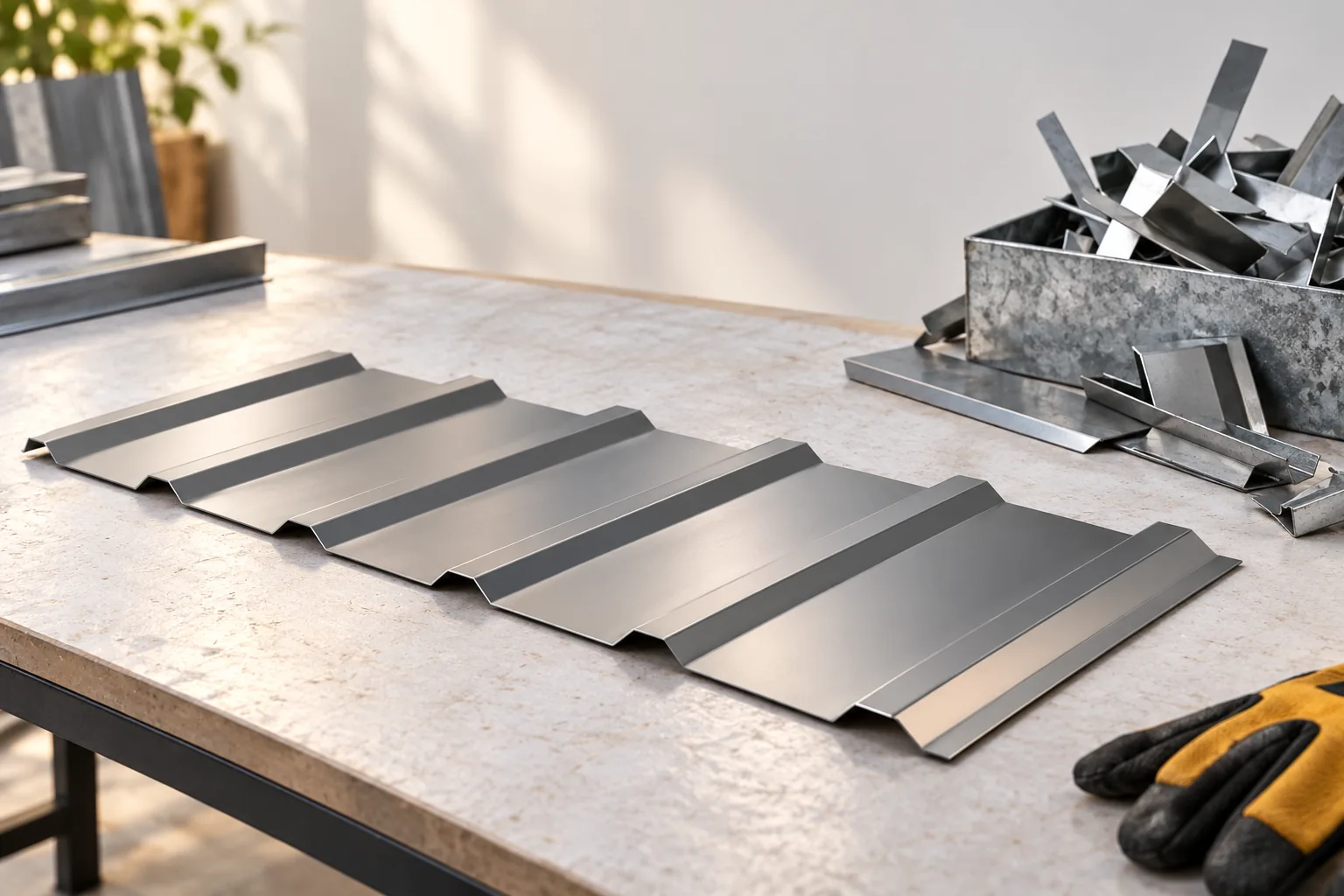
Accurate measurement and sheet layout help limit unnecessary offcuts. Cut tile-effect metal roofing can make good use of the format on a simple roof slope. Modular systems allow material to be planned differently on a roof with a complex shape. However, no format guarantees the smallest waste for every project in advance.
Ask for a comparison of the ordered area and the covered area. Also compare the places where offcuts will arise. Not every piece is suitable for use on the other side of the roof. The direction of the profile and the overlap matters. A smaller order is only an advantage if it still covers a complete, correct layout.

Why does maintenance affect the assessment of the choice?
Premature replacement means another purchase of material, transport and work. That is why choosing the coating for the environment and correct installation matter beyond costs as well. Damage during cutting, wet storage or left-over swarf can worsen the condition of the steel sheet. Limiting such errors allows the ordered product to be used better.
In use, inspections and appropriate cleaning are needed. A small repair carried out at the right moment can limit further damage if its cause has been removed. However, unlimited durability should not be assumed. Environmental conditions, documentation and the actual condition of the roof remain the basis for assessment.
Does energy efficiency result from the metal covering?
The steel sheet alone does not provide good thermal insulation. Energy use in the building is affected by the entire roof, its airtightness and its connections to other building components. Choosing PIR can help achieve a given thermal resistance at a smaller thickness than selected types of EPS. This does not automatically mean the lowest environmental impact in every system.
A comparison of insulation should take into account the same thermal function and technical requirements. Fire, moisture, acoustics and the expected service life are also important. A product with a favourable lambda value will not solve leaky connections. A well-executed detail is sometimes just as important as the parameter of the board itself.
What data should be requested before purchase?
Ask for an environmental declaration if one is available for the product under consideration. Check its scope and validity. Include a material plan, coating requirements and maintenance rules. It is also worth knowing the options for local repair and how dismantling is carried out after the end of use.
You do not need a promise that the material is “one hundred percent ecological”. You need comparable data and a solution that fulfils its function well. Metal roofing can be a reasonable choice when it uses as much material as needed, is correctly installed and maintained. However, the final conclusion must relate to the specific roof variant.
7 branches. Materials closer to your project.