What should you check before buying 100 mm second-grade wall panels?
Sandwich panels
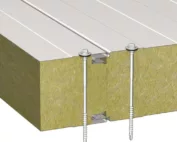
To check a 100 mm second-grade sandwich wall panel, first establish whether the specific batch meets the project requirements, not just the thickness. Inspect the locks along their full length, the condition of the facings and core, and the documents confirming the properties. Assess whether the defects are purely visual or affect the panel's construction. Compare the full specification, because PIR and mineral wool variants may have different insulation, weight and fire classification. Leave the suitability decision to the designer.
Does every 100 mm panel deliver the same performance?
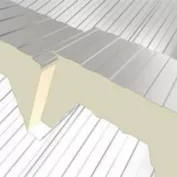
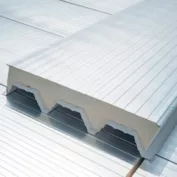
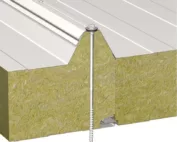
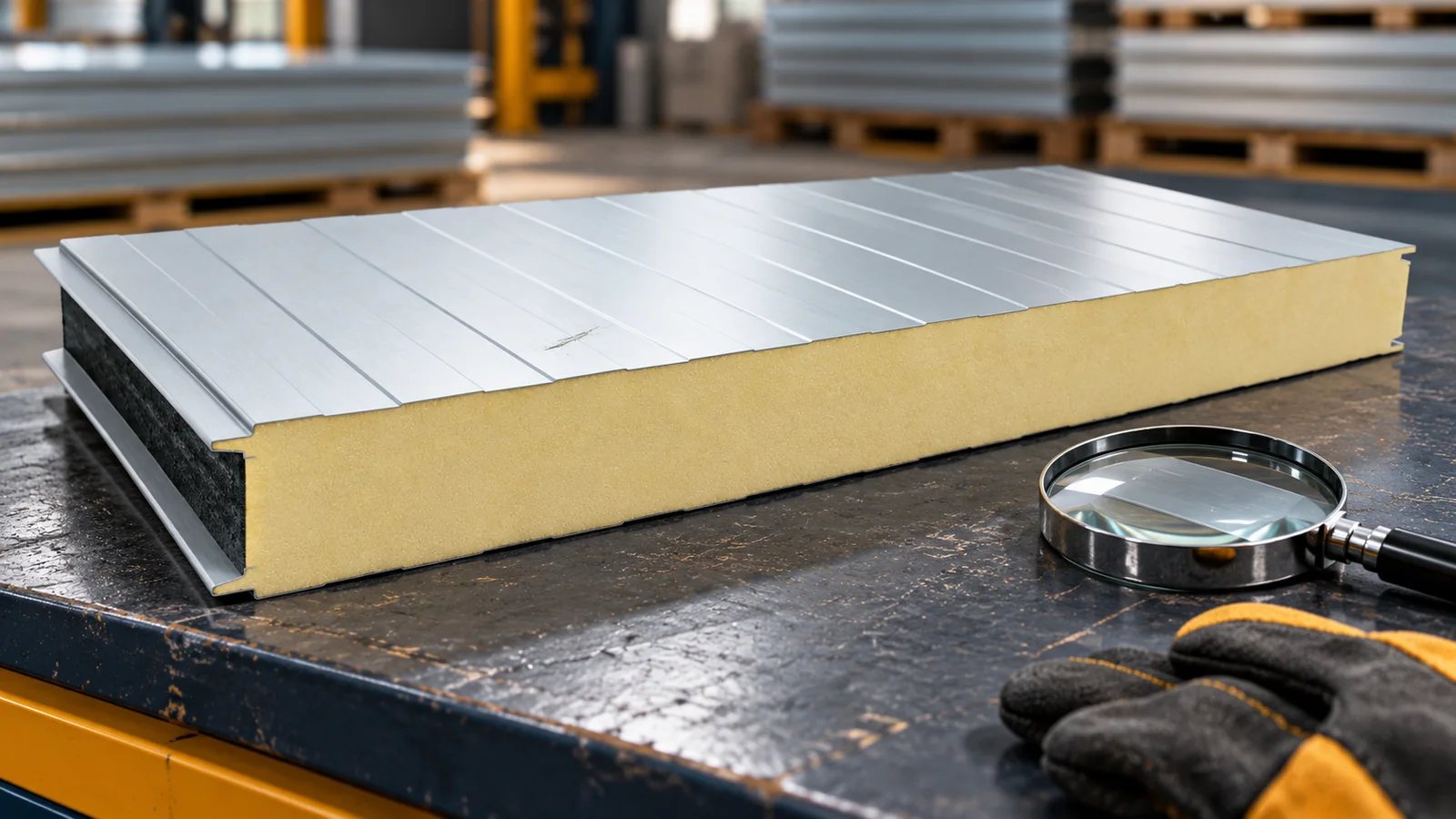
No. The PIR variant and the mineral wool variant may differ in thermal performance, weight and fire classification. They also differ in sheet thickness, cover width and joint geometry. The 100 mm designation is only one parameter. To substitute the material specified in the design, the entire specification must be compared, not just confirmation that the thickness matches.
For a discounted batch, the question of retained properties arises. The standard product data sheet does not automatically describe an item with a defect. Establish whether the deviation is purely visual or affects the panel construction. If a specific load-bearing capacity or EI class is required, the supplier should confirm the relevant scope of documentation. Parameters from a merely similar panel should not be transferred.
How should you inspect the facing so as not to overlook an important defect?
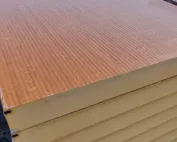
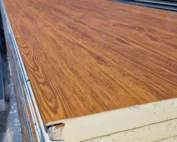
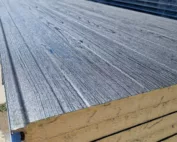
Check both sides in light that allows scratches and dents to be seen. The film may conceal the surface condition, so agree on the possibility of exposing it locally. Distinguish between a mark on the film, damage to the paint and damage reaching the steel. Each of these situations requires a different assessment. Also inspect the edges, where damage during handling is more likely.
Check whether the shade and profiling are uniform throughout the batch. A colour difference may be acceptable on an internal wall but difficult to conceal on a façade. For waviness, the cause and conformity with the permitted condition must be established. Do not assume that every irregularity is merely cosmetic. Clear separation of the sheet from the core may affect the performance of the composite element.
Why must the joint be inspected along its entire length?
A crushed edge may make it difficult to push the next panel into place. Damage is not always visible from the face of the pack. Inspect the joint along the element, particularly at lifting points and ends. Check the condition of the seals and the surfaces intended for contact. A trial assembly of matching pieces may help assess the geometry, but does not replace the parameter documentation.
Do not mix different systems just because they are both 100 mm. A similar shape does not mean dimensional compatibility. A concealed joint and a standard joint require different fixing solutions. If the repair were to involve cutting the edge and covering it with a flashing, a new connection must be designed. This is not a standard factory joint with all its properties preserved.

What should be checked in the core and the storage conditions?
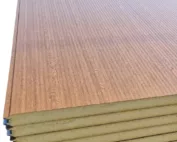
Inspect the accessible faces and areas of damage. Look for voids, delamination and signs of moisture. In panels with mineral wool, clarifying contact with water is particularly important. In PIR too, exposed edges and contact with the facing must be protected. The presence of a closed-cell core alone does not confirm that the entire damaged element is resistant to any wetting.
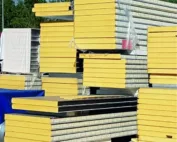
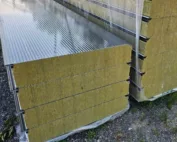
Ask about the duration and method of storage. The pack should have proper support and water drainage. Leaving the film on in the sun for a long time can make it difficult to remove. If the inspection does not resolve doubts, an assessment by the supplier or a specialist is needed. It is not worth buying a batch on the assumption that a wet or detached section will certainly return to its original condition on its own.
How do you calculate the usable area of a batch?
Break the walls down into modules and assign specific lengths to them. Mark the defects that must be avoided when cutting. Take into account openings, supports and end finishing. The nominal purchase area may be considerably larger than the area that can actually be used. Waste resulting from a damaged interlock can be harder to utilise than an ordinary short offcut.
For example, a panel 3 m long cut down to 2.8 m loses 0.2 m of length if the ends cannot be used. That is about 6.7% of its length. Further cut-downs and the cost of coating repair must be added to the calculation. Compare the price per useful metre of cladding including transport, flashings and labour. A discount off the list price does not by itself show the real saving.
How can you confirm the decision before payment?
Record the batch number, the number of pieces, the lengths and the type of accepted defects. Attach photos and the arrangements concerning documents and any repairs. Establish the conditions for acceptance and for reporting transport damage. This makes it clear which characteristics were known at the time of purchase. A general statement about second grade does not replace a precise description of the delivery.
Do not use it where the project requirements cannot be confirmed. Panels with certain visual defects may be suitable for less exposed cladding, but load-bearing capacity and tight connections are needed there too. A good purchase means material of known condition that suits the planned wall. A thickness of 100 mm and a low price are the beginning of the assessment, not its result.
7 branches. Materials closer to your project.