What thickness of PIR insulated wall panel should I choose?
Sandwich panels
The thickness of a PIR wall panel follows from the target thermal performance, the construction and the way the building is used. You do not choose it for a heated hall the same way as for an unheated warehouse. You need to compare the U-values of specific panels, the type of joint, the facings and the permissible spans. Details at the plinth and around openings also matter. The number of millimetres alone does not give a full answer. Establish the temperature and the heating regime. In a workshop used every day, heat loss through the walls matters differently than in a seasonal facility. An unheated warehouse may also need insulation, for example to limit temperature fluctuations. This does not mean, however, that the panel alone will provide the expected temperature there.
Will the wall permanently separate a warm interior?
Establish the temperature and heating mode. In a workshop used daily, heat loss through the walls matters differently than in a seasonal facility. An unheated warehouse may also need insulation, for example to limit temperature fluctuations. However, this does not mean that the panel alone will provide the expected temperature inside.
It is also worth describing the humidity and processes occurring inside in the enquiry. Washing with water, storing damp products or large temperature differences require attention at the joints. The required U-value should result from the design. Do not choose a thickness simply because it is most frequently ordered by other investors.
How to read the parameters of 100 and 120 mm panels
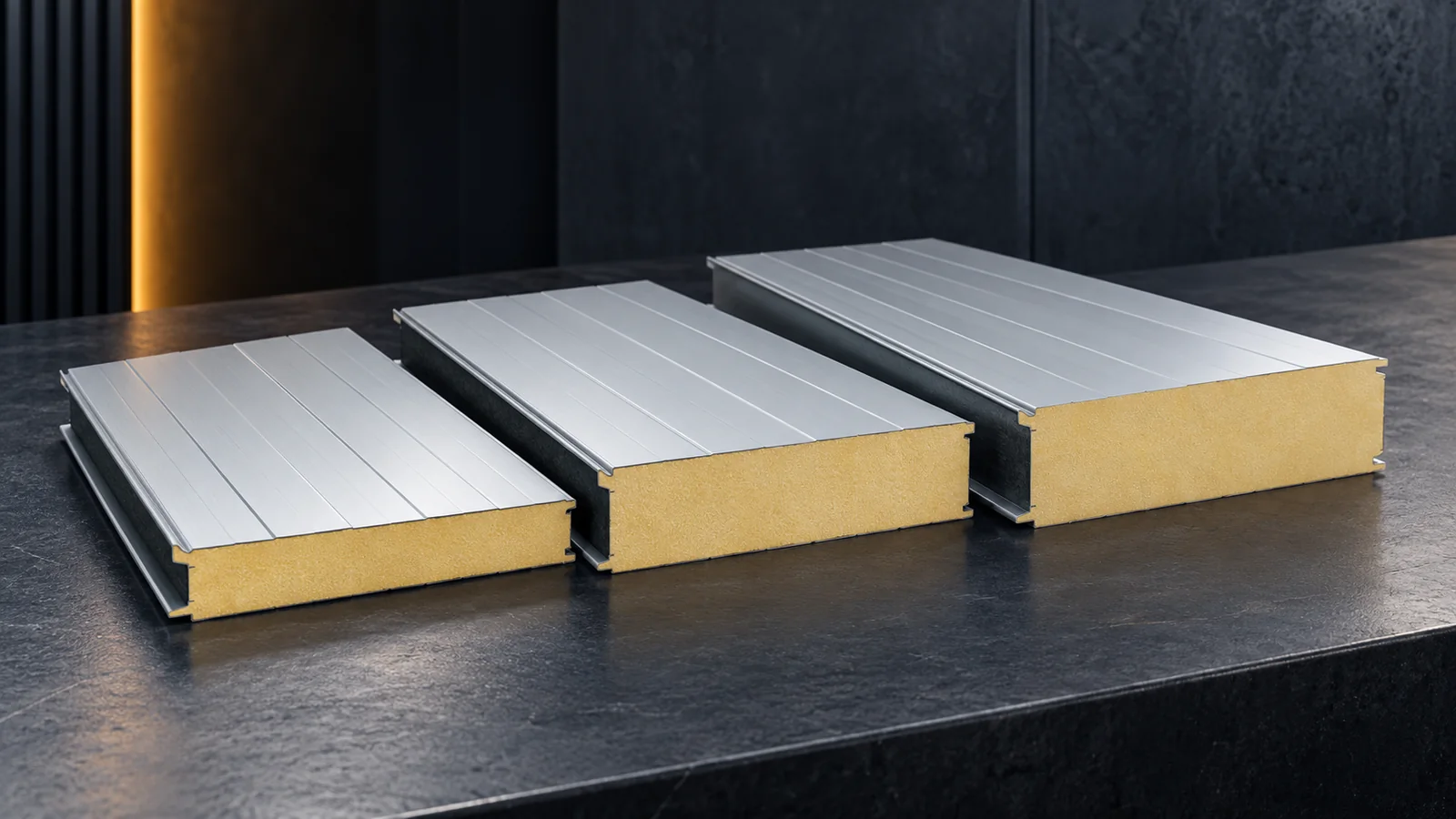
In an example data sheet for a 100 mm PIR insulated wall panel, Uc = 0.22 W/(m²·K) is given, and for 120 mm, 0.18. The weights with 0.5/0.5 mm facings are 12.3 and 13.1 kg/m² respectively. This shows that increasing the thickness can clearly improve the thermal parameter with a relatively small increase in the weight of this particular product.
However, this table must not be used for any panel. A different joint, core or calculation method may change the result. The examples serve to compare variants, not to impose one thickness on all halls. Also check exactly what Uc includes and what value the wall design requires.
Does hidden fixing change the selection?
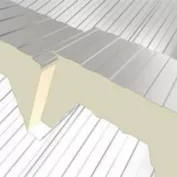
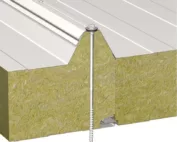
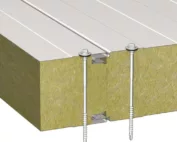
A concealed fastener allows a different façade appearance but requires suitable edge geometry. The joint of such a panel is not identical to the connection of the variant with a visible screw. This may affect the thermal parameters, the cover width and the installation rules.
Do not order a panel based only on thickness and colour and postpone the decision on fastening until the construction site. Check the connection loads, the vertical or horizontal arrangement and the permitted spans. If the design specifies a particular fire class, the panel orientation and fastening may be part of the classification conditions. The façade appearance must therefore be agreed with the technical requirements.

What is the significance of the spacing of columns and purlins?
The panel must carry the loads in its actual arrangement. The tables are selected according to the core thickness, both facings and the support scheme. The load-bearing capacity and the permissible deflection must be checked. A narrow support or too few fasteners may limit the solution regardless of the panel thickness.
It is worth deciding on the colour early. Dark claddings heat up more, and the temperature difference between the two sides causes additional effects. With long elements, the installation method also matters. Do not copy the support spacing from another hall. Wind, building height, surroundings and bay layout may all differ.
Where does the wall lose the benefit of a thicker core?
Most often, the connection to the foundation, the corners and the openings need to be checked carefully. Continuity of insulation does not end at the flat surface of the panel. Flashings and seals should drain water and restrict air flow. An incorrectly executed plinth can remain cold despite a good panel above.
At windows and gates, it is worth planning the support and the fixing of flashings. Do not cut large openings without checking the structure. The seal provided in the joint does not replace all other details. When the panel thickness changes, the fasteners, flashings and position of the joinery must be readjusted. This is part of the selection, not an installation detail.
How do you compare the cost-effectiveness of two thicknesses?
Compare the price of the entire enclosure and the expected thermal effect. Transport, scaffolding and part of the labour may be similar. The surcharge for the thicker variant is not always a large share of the full budget. On the other hand, do not buy thickness without a justified purpose and neglect more important repairs to details.
Attach the complete set of requirements and the wall drawings to the quote. Check whether the price refers to the covered area and whether it includes accessories. Ask for the documentation of the selected product. A good decision combines the right thickness with a correct joint, cladding and installation. Only then can the panel parameters translate into the performance of the entire wall.
Do not forget the cover width. Openings in the façade do not always reduce the ordered area by exactly their own square metreage. Sometimes they arise from cutting a full element, and the offcut cannot be used elsewhere. A cutting plan allows the cost of two variants to be compared more fairly than simply multiplying the wall area by the rate. It should take into account corners, joint orientation and installation direction. Changing the panel type at the purchasing stage may require these data to be checked again.
7 branches. Materials closer to your project.