Comparing sandwich panels by core, price and intended use
Sandwich panels
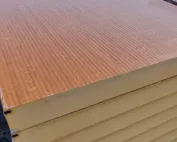
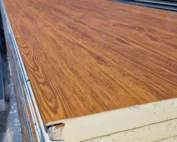
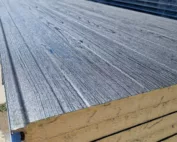
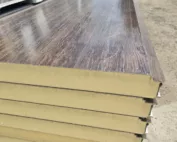
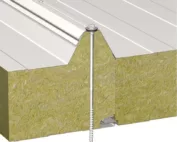
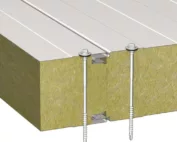
Compare insulated panels by the building task first, and only then by price. A wall, a roof and a cold store need different details. PIR helps to reduce insulation thickness, while mineral wool may better meet the fire requirements of a specific system. However, the result is determined by the parameters of the finished panel, its facings, the joint and the installation. The core name alone is not enough to choose a material. A wall panel forms the vertical envelope. Its facing can be smooth or lightly profiled. Solutions with visible and concealed fixing are available. The laying direction must be matched to the documentation and the structure. Vertical and horizontal are not merely two versions of the appearance of the same façade.
Wall or roof: where to start?
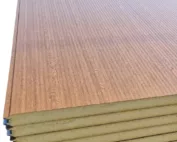
A wall panel forms the vertical envelope. Its facing can be smooth or lightly profiled. Solutions with visible and concealed fixing are available. The laying direction must be matched to the documentation and the structure. Vertical and horizontal are not merely two versions of the appearance of the same façade.
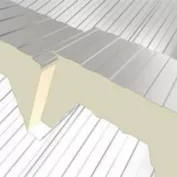
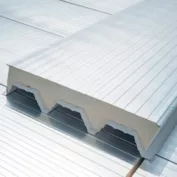
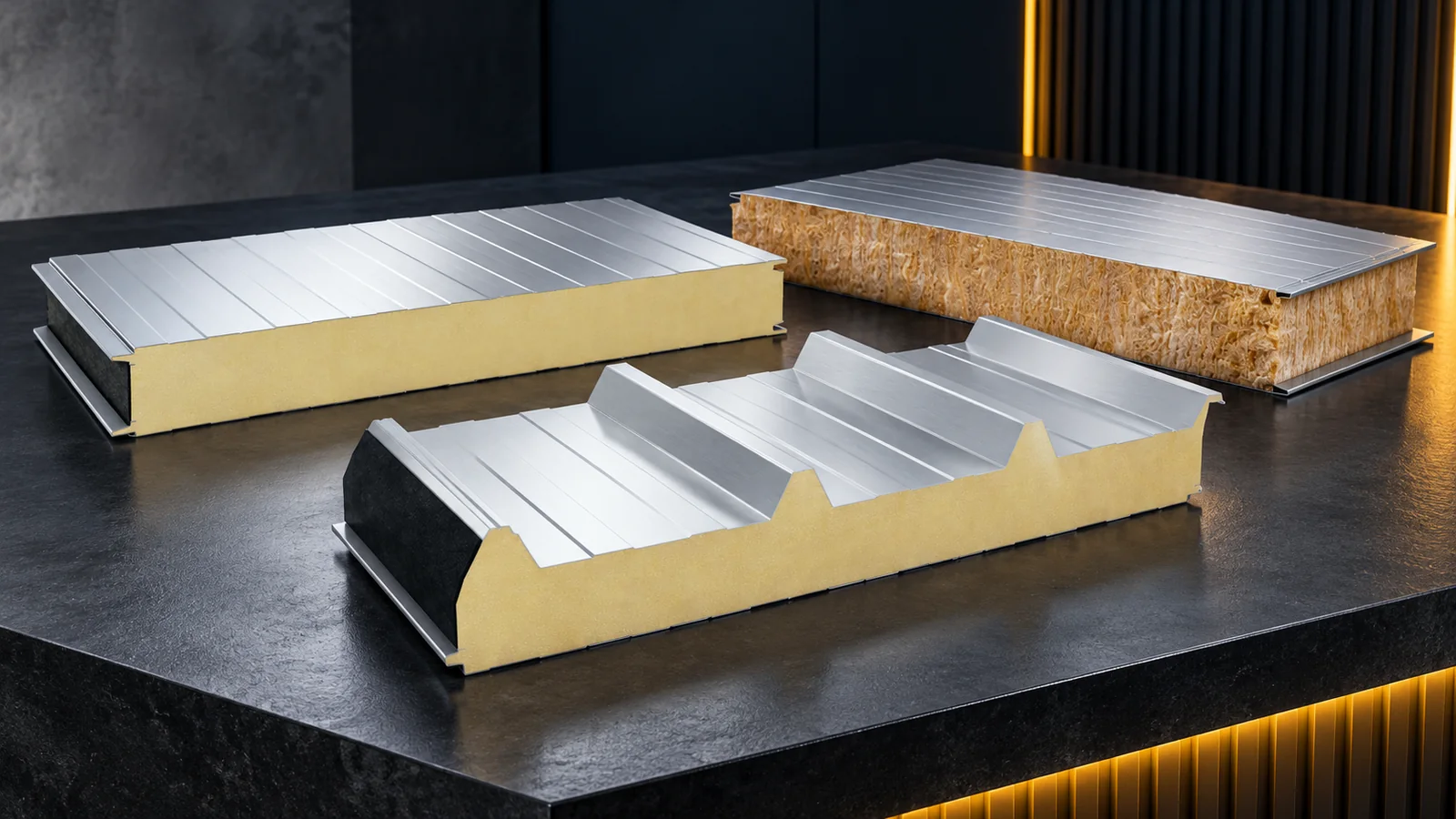
A roof panel has a higher trapezoidal profile on the outside and a sheet overlap over the adjacent element. It must drain water at the specified pitch and carry the roof loads. It is not replaced by a wall panel just because both cores have the same thickness. In a cold store, particular requirements for airtightness and temperature difference apply. Here too, the correct connection system is needed.
What does a PIR core offer, and what does mineral wool offer?
PIR provides high thermal insulation with a relatively small thickness. This allows the envelope dimension to be reduced if the other requirements are met. Mineral wool has different fire properties and may be required in a project for a specific separation. The decision requires comparing complete panels and their classifications.
In the example data sheets, a 100 mm PIR wall panel has Uc 0.22 W/(m²·K) and a mass of 12.3 kg/m². A 100 mm mineral wool panel has Uc 0.39 and a mass of 18.1 kg/m². Both mass values refer to 0.5/0.5 mm facings. This is a comparison of specific products of the same thickness, not of identical thermal insulation. It must not be used to derive the price or load-bearing capacity of any other panel.
How to check fire and acoustics?
Reaction to fire describes the product’s contribution to fire development. The fire resistance of a wall or roof concerns the behaviour of a specific assembly over a given time. The designations of these properties are not interchangeable. A PIR panel is not non-combustible, and the presence of mineral wool does not automatically give any wall the required EI class.
Read the scope of the classification: thickness, span, orientation, connections and support. Proceed similarly with acoustics. The airborne sound insulation index does not describe sound absorption within the room. A full metal facing does not become an absorbing element merely because of a mineral wool core. Gates, windows and leaks affect the result of the entire envelope. Select according to the required index and test conditions.

Why do the metal sheets and the joint matter?
The facings work together with the core and protect it from the environment. Therefore, the offer must compare the steel thickness on both sides, the type of protection and the coating. A damp agricultural interior, a workshop and a dry warehouse may require different solutions. The colour does not indicate which cleaning agents the surface is suitable for.
The joint affects installation, airtightness and connection parameters. A concealed fixing improves the uniformity of the façade, but does not remove the need for fixing calculations. Components from different families do not necessarily fit together. Also check the colour group. Darker claddings heat up more in the sun, which may limit the panel length or the permissible support arrangement.
How can you compare prices for different solutions fairly?
First establish the common performance requirements. Comparing only the same core thickness may favour a product with a different level of insulation. Comparing only a similar U-value may, however, conceal differences in fire performance, mass and the range of permissible spans. Prepare a short table of the properties required by the project.
Next, calculate the material using the actual modular lengths and widths. Add flashings, seals, fixings, transport and installation. Take the weight of the components into account when organising lifting. Do not treat the catalogue price of a decorative panel as the rate for an ordinary PIR wall panel. If the exact variant has no public price, a quote is needed. Default ranges do not replace offers with the same scope.
In the quote, keep the variant numbers and the quote date. This allows you to return to the arrangements after a change of drawing, colour or planned material quantity.
What data set should you send for a quote?
Describe the function of the building, the internal temperature and humidity, and the surroundings. Include wall and roof drawings with dimensions, openings, supports and laying direction. State the thermal, fire and acoustic requirements. Indicate the planned colour and the expected type of fixing. This allows the proposal to be checked against the design.
Before purchase, approve the specific variant and documents. Do not later change just the sheet thickness or joint type without assessing the consequences. The wall and roof panel should form a complete envelope with matched details. The most favourable choice is a set with the required parameters that can be correctly installed and maintained. The price per metre is one element of this decision.
7 branches. Materials closer to your project.