Mineral wool wall panels: what do the panels cost, and how much does the finished wall cost?
Insulated wall panels
The price per square metre of a panel with a mineral wool core is only part of the wall cost. Flashings, fasteners, sealants, transport and installation are added to the order. Panel lengths and the number of openings also make a difference. A comparison only makes sense once the core thickness, facings and required parameters have been established. Without such a specification, a lower rate may simply mean a different product. The final budget is best calculated for the entire façade. The quote is influenced by the quantity of material, the mineral wool thickness, both facings and the type of coating. Colour, profiling and the joint are important. The size of the production batch may also matter. A standard element from a larger order and a small delivery in a non-standard finish do not have to cost the same, even at an identical thickness.
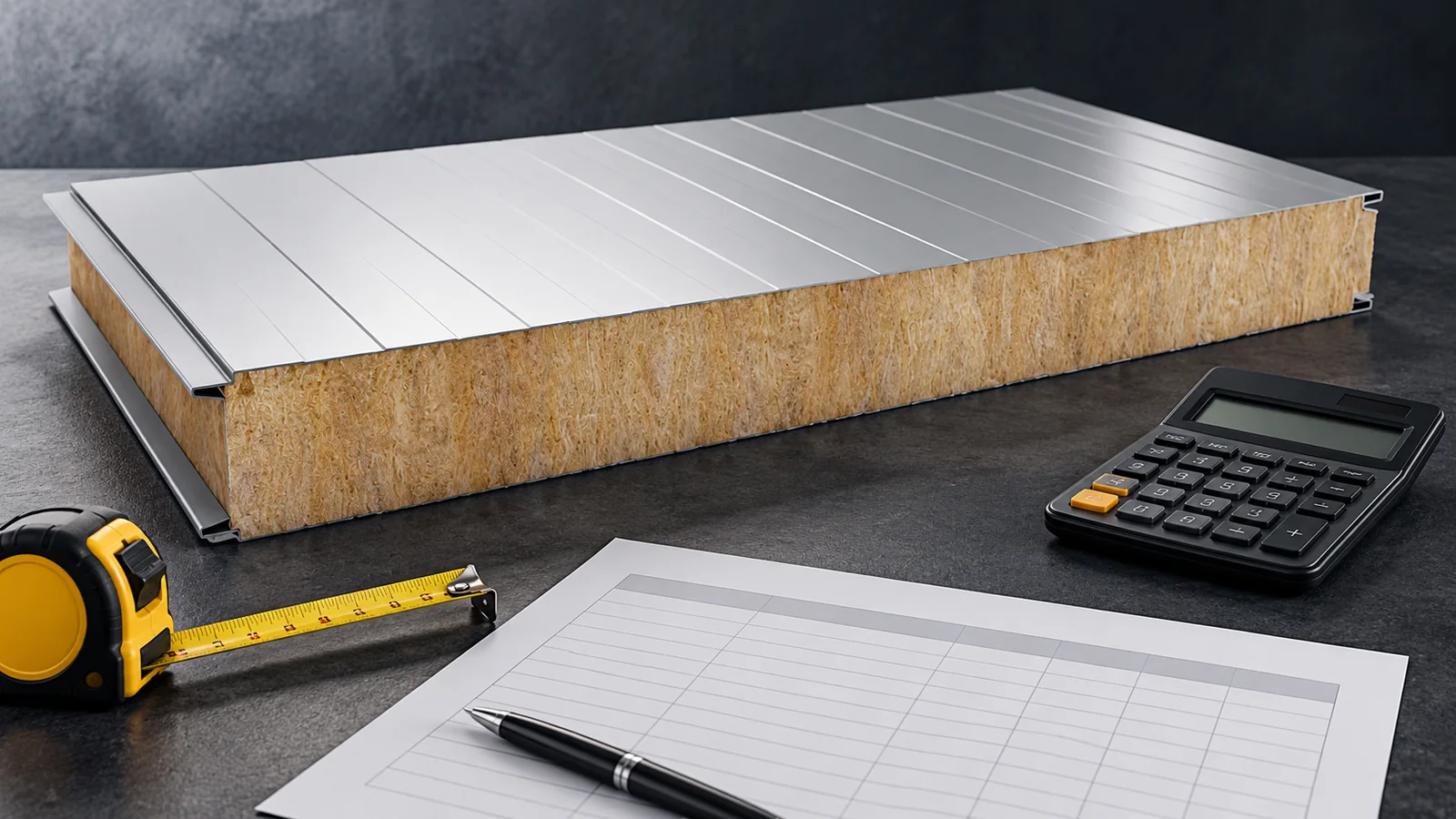
Why is there no single price for a panel with a mineral wool core?
The quote is affected by the quantity of material, the thickness of the mineral wool, both facings and the type of coating. Colour, profiling and the interlock also matter. The size of the production batch can also be significant. A standard component from a larger order and a small delivery in an unusual finish do not have to cost the same, even at identical thickness.
The price also depends on commercial terms and timing. A catalogue price list is not automatically the final price for every customer. A quote should have a date and a validity period. If you are comparing several offers, make sure they share a single net or gross basis. A difference resulting from tax can look like a discount, even though it has nothing to do with quality or delivery terms.
What area are you actually paying for?
Establish whether the order area was calculated using the cover width and the length of the elements. The overall width may include part of the interlock. Do not convert the price from one dimension to another on your own without confirming the sales rules. The quote should state the number of pieces, their lengths and the resulting billing area.
Openings in the wall do not always reduce the order by the full area of the window or gate. Some panels may need to be cut from a whole element. Offcuts are sometimes used elsewhere, but this has to be planned in advance. A panel layout gives a more accurate result than multiplying the building perimeter by the height and subtracting all openings. Include the corners and the façade division in the calculation as well.
What should be added to the cost of the panels themselves?
The budget should include base flashings, corner flashings, flashings at openings and at the junction with the roof. Add to this the fasteners and the required tapes and sealants. Some items are billed in metres, others in pieces or packs. The number of metres of flashing results from the shape of the wall, not from a single fixed ratio to the area.
Include the structure as well, if the quotes cover it. A cheaper panel may require different support. Check who provides unloading and lifting equipment. Long panels with mineral wool may require a suitable spreader beam or vacuum lifter. Record labour, cuts and detail finishing separately. Only the sum of these items describes the cost of the finished wall.

How to build a transparent calculation?
To estimate the cost of a finished wall, add the panels, accessories, logistics and labour. Suppose a finished wall of 100 m² requires 108 m² of panels. At an assumed €34.72 per m² excluding VAT, the panels alone cost €3749.76 before VAT. The unit price is for this calculation only; it is neither a market price nor a shop offer.
If the remaining items add €2036.76 before VAT, the example totals €5786.52 net. Dividing by the 100 m² of finished wall gives €57.87 net per m². The panel price alone therefore does not tell you what the cladding will cost. For an actual order, use a current quotation for each item and check the quantities against the panel layout.
Do accessories really change the budget?
One roll of tape may seem inexpensive, but wall cladding has many supports and joints. In the price list effective from 28 October 2026, a 30 m roll of 3 × 20 mm PES tape cost the equivalent of €4.17 net, and the 3 × 40 mm version €7.17 net, using the exchange rate on 14 November 2026. These are dated catalogue examples, not standing offers.
However, you do not choose tape by price per metre alone. It must have the right type and dimension for the given detail. Screws, seals and flashings work in the same way. Understating the number of these elements is not a saving if it leads to leaks. It is better to compare correctly calculated complete sets than two lists with a different scope of materials.
How to compare quotes before ordering?
List in one table the thickness, U-value, required fire class, both facings, coatings, colour and lengths. Add information about second-grade material if it occurs. Then compare the scope of flashings, transport, unloading and installation. Indicate the items excluded from the price. Every ambiguity should be clarified before work begins.
Also check whether the quote takes into account access to the building and the real working conditions. Installing long panels on a high wall differs from fitting a small partition at floor level. Do not assess profitability on the basis of a single amount per m² alone. A reliable quote shows what you will receive and what expenses remain on your side. This way the final cost does not come as a surprise after delivery.
7 branches. Materials closer to your project.