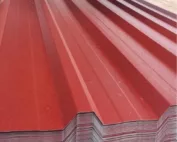
T18 or T35 trapezoidal sheet: which profile suits the job?
Sheets and roofs
The choice between T18 and T35 trapezoidal sheet depends on whether both profiles meet the requirements of the specific project. Compare sheet thickness, steel grade, cover width and support layout, and calculate the number of sheets, because a lower price per metre does not always give a proportionally cheaper covering after cutting. The designation indicates only the nominal profile height; it does not specify thickness, steel grade, support spacing or coating properties. Leave the load-bearing and deflection decision to the designer.
What can be read from the profile name alone?
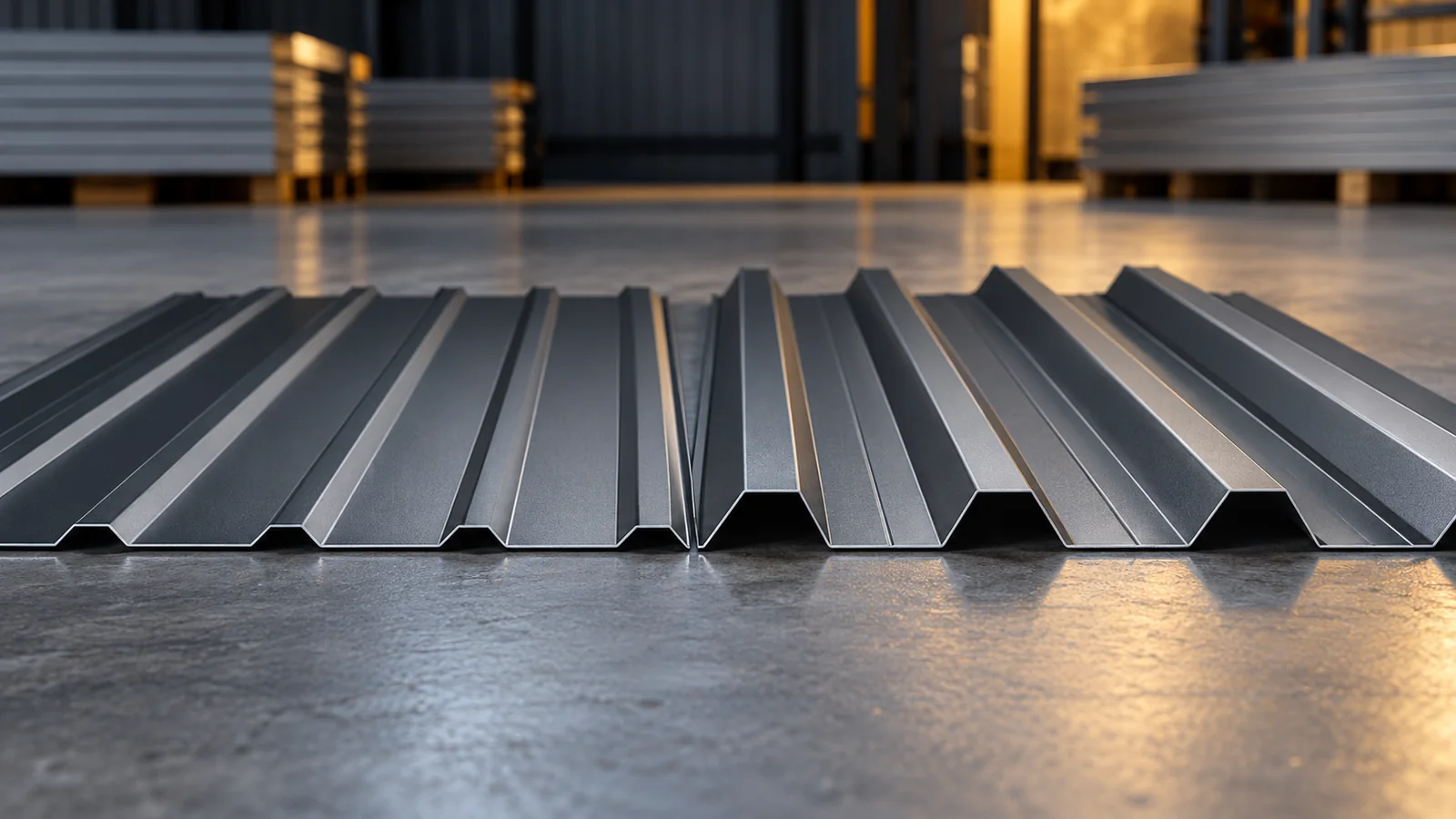
The designation indicates the family of nominal profile height. T18 has a shallower pattern, while T35 has more pronounced ribs. On the roof this changes the appearance and the shadow on the surface. It does not, however, define the thickness or grade of steel. Nor does it specify the support spacing, sheet length and coating properties.
The same general name may occur with different widths and edge shapes. That is why the full designations of specific products are compared. When buying additional material, the compatibility of the cross-section must be checked. It is not enough to measure the rib height and choose a similar colour. An incompatible edge may prevent the side lap from being made correctly.
What are the dimensions of two example models?
The following data relate to two specific cross-sections from one catalogue. They do not describe all T18 and T35 profiles available on the market.
| Parameter | Example T18 | Example T35 |
|---|---|---|
| Profile height | 18 mm | 35 mm |
| Rib pitch | 157 mm | 207 mm |
| Cover width | 1100 mm | 1035 mm |
| Example thicknesses | 0.50; 0.60; 0.70 mm | 0.50; 0.60; 0.70 mm |
Cover width is used for measurement. The overall sheet width is greater because part of the material engages in the overlap. When planning the purchase, allowances must also be made for cut-offs and any longitudinal joints.
When does a higher profile offer an advantage?
The profile height affects stiffness, but the result also depends on the flange widths and steel thickness. T35 may be required for a configuration where the selected T18 does not meet the conditions. This does not mean there is one permissible purlin spacing for every T35. The correct value comes from the tables and loads.
The designer checks load-bearing capacity and deflection. The number of spans, the bearing width and the profile orientation are significant. A table for one thickness does not justify using a thinner sheet. Fixings must also be taken into account. Even a stiff profile will not be adequately secured against wind if the connections to the substrate do not correspond to the assumed loads.
Can both profiles be used on a roof and a wall?
There are variants intended for roof coverings and for cladding. The finish side and the overlap configuration may differ. The function of the sheet must be specified before ordering. Roofing sheet should not automatically be turned over if this changes the required protection or the way water is drained.
On the roof, the minimum pitch and connection details are checked. On the wall, wind, support and tightness remain important. A taller profile may emphasise the technical appearance of the façade more strongly. A lower one is often easier to integrate into a finer surface subdivision. The aesthetic choice should follow confirmation of the technical conditions, not replace it.

How do you compare price and material consumption?
Assume identical thickness, coating and pricing basis. In the sample price list dated 28 October 2026, the 0.50 mm versions with 25 µm polyester cost €10.34 gross per m² of coverage for T18 and €11.31 for T35. These are catalogue prices for specific models, not a shop offer.
Then count the full strips on each roof slope. A different width may change the amount of cut-off at the edge. In one geometry a narrower profile may fill the area better, in another the opposite. Add flashings, fixings and logistics to the total. The percentage difference in the price per metre should not be treated as the ready difference in the cost of the entire roof.
Does the profile solve the problem of noise and condensation?
Changing from T18 to T35 alone does not replace an insulation and ventilation design. Both materials are thin metal coverings. Condensation on the underside depends on temperature and humidity, and the sound in the room depends on the entire building envelope. Deeper ribs do not guarantee a quieter or warmer loft.
An anti-condensation layer can temporarily retain moisture if it has conditions for drying out. It does not seal faulty laps and is not thermal insulation. Its usefulness must be assessed separately from the trapezoidal profile height. The coating is also selected for the environment, not for the profile name alone. The same T18 or T35 can be offered in very different surface protection variants.
Which variant should you choose for your own project?
If both meet the design requirements, compare the full cost, appearance and availability. T18 may be sufficient with proper support and loads. T35 may provide the required parameters in a different configuration. When the requirements go beyond these models, another profile must be considered instead of forcing one of the two to fit.
Before deciding, request the product data sheet, load tables and installation instructions. Determine the sheet lengths and delivery handling. The choice is justified when a specific model, coating and application conditions can be specified. A general statement that T35 is stronger is not enough to place a correct order.
7 branches. Materials closer to your project.