Hiring a roofer: which jobs belong in the scope of work?
Construction and installation
A roofer is responsible for the covering and details that help protect the building from water, and their work begins before the first sheet is screwed down. Before starting, it is worth checking that the roof matches the documentation and the instructions for the chosen covering, especially the pitch, diagonals, eaves line and plane of the battens. The contractor should report any discrepancies found, and in a renovation assess the available parts of the old roof; doubts about the load-bearing capacity of the truss require a structural engineer's assessment. The scope of the contract should clearly define the layers, flashings, ventilation and acceptance of works.
What should the roofer check before starting?
At the outset, the roof must be compared with the documentation and the installation instructions for the chosen covering. The pitch, diagonals, eaves line and the plane of the battens are important. The contractor should report any discrepancies found. It is not sensible to cover uneven battens in the hope that the steel sheet will level the surface.
For a renovation, an assessment of the accessible parts of the old roof is needed. A roofer can identify damaged covering and traces of leaks. However, doubts about the load-bearing capacity of the roof structure require assessment by a structural engineer. The contractor’s experience does not replace calculations for the elements that are to support the new system.
Which layers and elements do the works include?
The contract may cover the underlay, counter-battens, battens and covering. This is in addition to flashings for the ridge, eaves, roof valleys, chimneys and walls. Every detail must work with the direction of water runoff. A small error in such a place can undo the correct laying of a large area of sheets.
Do not assume that insulation, loft conversion and gutters are always part of the same contract. Individual stages may be carried out by different teams. The boundaries of the works and the manner of handing over the substrate must be agreed. Particularly important are the places where the covering, insulation and service penetrations meet.
What skills does working with sheet metal require?
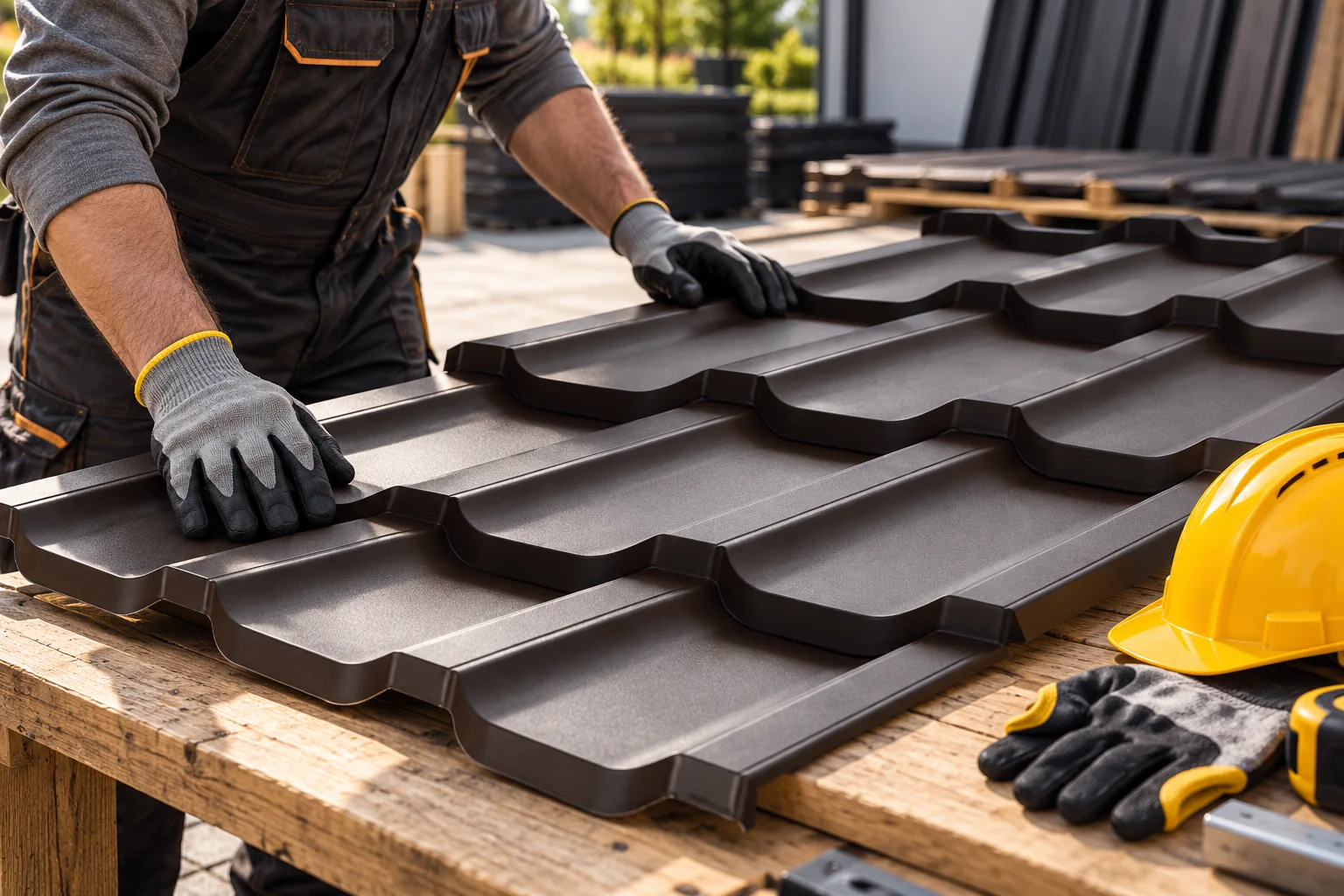
Cut tile-effect metal roofing requires precise measurement and safe handling of long sheets. With modules, the installation direction and the alignment of successive joints are important. T18 or T35 trapezoidal steel sheet has its own requirements for support and overlaps. Knowledge of one covering alone does not provide ready instructions for the others.
Proper handling of the material is also needed. Suitable cold-cutting tools are used for coated steel sheets. The instructions prohibit the use of an angle grinder, which damages the protective coating through heat and sparks. After cutting and drilling, the contractor should remove metal filings from the surface.

Why do flashings and ventilation require attention?
Flashings are not only there to cover an uneven edge. They drain water and protect areas exposed to wind-driven rain. They must have the correct shape, fixing and connection with other layers. Sealant should not be the only answer to a poorly prepared detail.
With a ventilated roof, an air inlet is needed at the eaves and an outlet at the upper part of the slope. The space between them must remain clear. Closing it with random foam can hinder moisture removal. The contractor should be able to show the air path before the structure is covered.
What should be agreed in the quote and schedule?
Separate the installation of the covering, flashings and additional elements. Indicate the number of chimneys, windows and service penetrations. Agree on material delivery, unloading and protection of the building during works. For a renovation, add dismantling and waste handling. A clear scope limits misunderstandings on the final bill.
Schedules should account for weather and substrate readiness. A quick start is of little value if the material has not arrived or the structure needs correction. For a larger roof, agree on the sequence of stages. This will allow acceptance of layers that will no longer be visible once the sheet metal is installed.
How can you recognise a well-prepared contractor?
Ask to see completed projects similar to your roof. Ask how the roof valleys, eaves and connections to chimneys will be resolved. A specific answer should refer to the design and the covering instructions. A declaration of many years of experience alone says little about the quality of the planned details.
A good sign is also readiness to document the works. Photos of the substructure and connections help with acceptance and later diagnostics. Pay attention to storage organisation and protection of coatings. The way sheets are handled often says more than an assurance of problem-free installation.
How should the handover of a finished roof be carried out?
Check the completeness of flashings, the patency of drainage and the condition of the coating. No swarf or installation waste should remain on the covering. Establish whether service access routes and the planned snow guards have been installed. Entrust acceptance of hard-to-reach places to a person prepared for safe work at height.
Keep the user manual, material documents and a record of the agreed scope. Ask for information on inspections and reporting defects. A well-executed roof still requires checks. The owner should know which activities are needed and how not to damage the covering during use.
7 branches. Materials closer to your project.