Why a simple building shape makes solar roof design easier
Roof and energy
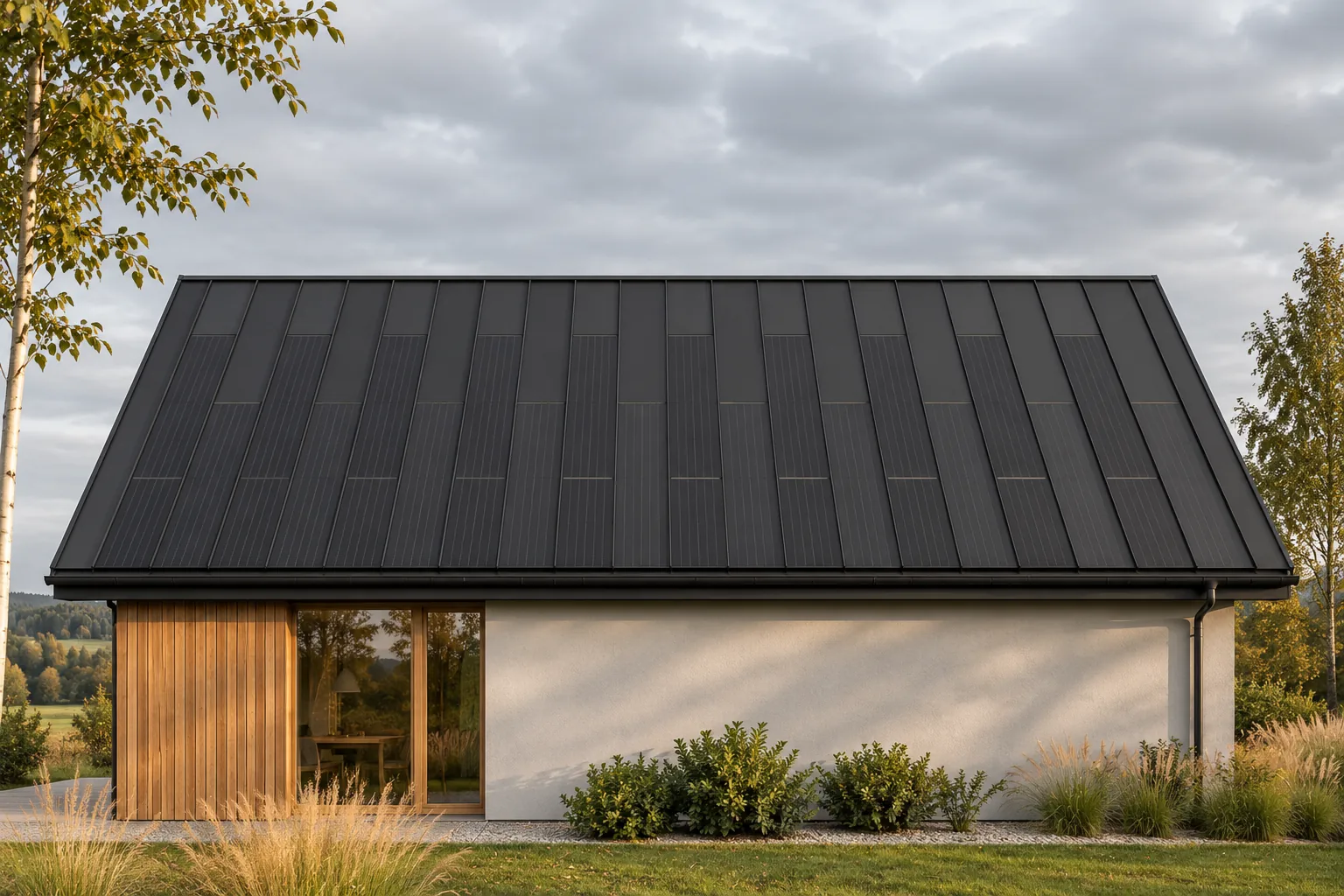
A simple building form gives the photovoltaic roof designer more freedom. Regular roof slopes are easier to divide into active and passive areas, and fewer breaks reduce the number of difficult details. This does not guarantee the lowest price or the highest output, but it creates a good starting point. An integrated steel roof covering can then fulfil its role in a clear way: protect the building, generate energy and keep the overall appearance calm. It is easier to arrange components of specific dimensions on it. Large rectangular areas do not require as many infills as short sections between dormers and roof valleys. This allows the active part to be clearly separated from the areas intended for passive covering.
In this article
What does a regular surface simplify?
The design shows more quickly how many panels actually fit on the roof.
This does not mean that every centimetre will be used for energy generation. Edges, flashings and zones related to the building’s function are needed. The benefit lies in their predictable arrangement. The roof can have a regular rhythm without adding random narrow strips just to fill the remaining space.
Why can fewer breaks be beneficial?
Roof valleys, corners and junctions with walls require careful execution. The more complex the geometry, the more places need to be coordinated. A simple form does not eliminate details, but it allows their number to be reduced. This helps in preparing drawings, the quote and the installation sequence. Maintaining the quality of each one remains important.
With BIPV, the electrical part and the active formats must also be taken into account. A regular roof makes it easier to combine these requirements with the covering function. However, one should not promise automatically flawless installation. Even the simplest roof slope requires a suitable substrate, ventilation and installation in accordance with the system.
How can simplicity be used for better architecture?
Steel panels with cells can form calm, repetitive lines. Without a separate mounting frame above the roof, the entire form retains a compact outline. This allows the covering to be treated as an important architectural material rather than merely a place for installation. Passive elements complete the composition where cells are not needed.
On a simple form, however, every detail is clearly visible. A random penetration, an uneven edge or an overly bulky flashing can disturb the whole. Simplicity of design therefore does not mean less care. It rather requires more precise refinement of the small number of elements that create the final effect.
Does a larger simple roof slope always produce more?
Production also depends on orientation, angle, shading and the selected installation. A large area shaded by a neighbouring building may be less favourable than a smaller, well-lit roof. It is therefore worth assessing solar exposure in parallel with the geometry. A simple form offers possibilities, but it does not replace an energy analysis.
There is also no need to maximise capacity simply because the elements fit easily on the roof slope. The selection should match the needs and grid connection conditions. A passive covering allows the appearance to be preserved with a smaller active portion. This is an important feature of an integrated system: aesthetics do not require filling the entire roof with cells.
What decisions are worth making at the start of the project?
The shape of the roof slopes, the position of chimneys, windows and service penetrations should be established. These should then be checked against BIPV formats. Sometimes a small adjustment to the layout can improve regularity and reduce clashes. It is important not to compromise the interior function or the required ventilation just for an additional section of active area.
The location of equipment and cable routes should also be planned well. This allows architecture to be combined with practical use. The roof does not end with the external image. Its installation must have a clear connection to the house and remain serviceable. Early decisions usually provide more freedom than corrections at the end of construction.
How can the benefits of a simple roof be assessed?
It is worth comparing the actual layout of the elements, the number of details and the full scope of the cost estimate. The decision should not be based on a single price-per-metre indicator. The amount of labour, the extent of the passive portion and access for later inspections are also important. Such a comparison shows where simplicity genuinely helps and where additional solutions are needed.
A simple building form works well with the concept of an integrated photovoltaic roof. It allows functions to be combined clearly and a calm appearance to be maintained. However, its advantage is revealed through good design, not the shape alone. Real formats, solar exposure and careful detailing turn an easier starting point into a valuable result.
Examples of companies and brands in roof-integrated photovoltaics are MDM NT (MyRoof), SolRoof, Autarq, Terrán, BIPVco, SunRoof, Solarstone, Electrotile, ML System and Wienerberger Wevolt.
7 branches. Materials closer to your project.

- SEROCK — Dzierżenin 34 E
- BŁONIE — ul. Sochaczewska 138A
- RADOM — ul. Grobickiego 8
- ŁÓDŹ — Natolin 8
- OLSZTYN — Barczewo, ul. Prosta 9
- WROCŁAW — ul. Jerzmanowska 10C
- GORZÓW WLKP. — ul. Zielona 33/34