XPS vapour diffusion resistance: what does the μ factor mean?
XPS insulation
In XPS documentation, alongside the lambda value and strength, you can find the diffusion resistance coefficient μ. It describes how the material behaves with regard to water vapour penetration by diffusion. This is a different property from water absorption by immersion. Extruded polystyrene has a specific diffusion resistance, and in the finished building element the thickness of the layer also matters. Understanding these data helps to assess the thermal and moisture behaviour of the system without oversimplifications about “breathing” or completely sealed walls. The μ value shows how great a diffusion resistance the material has compared with a stationary layer of air of the same thickness. It is a dimensionless quantity. A higher value means greater resistance to vapour diffusion.
In this article
The μ coefficient is a comparison with air
For XPS, it should be read from the documentation for the specific product. It is not worth assuming a single figure for the whole group of materials, because the data may differ between variants.
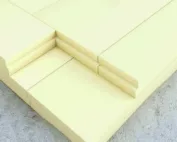
Extruded polystyrene may have a fixed value or a range linked to the board variant in its data sheet. The table description and notes must be checked. XPS cannot be assessed on the basis of surface appearance alone. The colour and the shape of the rebated edge do not indicate the vapour diffusion resistance. The correct data are needed especially when the layer build-up requires an analysis of the risk of moisture accumulation.
Thickness allows sd to be calculated
For a homogeneous layer, the air-equivalent diffusion thickness sd is calculated as the product of μ and the thickness d expressed in metres. For example, with μ = 150 and d = 0.10 m, the result is sd = 15 m. This is an example calculation, not a parameter of any given XPS. For a real project, the data corresponding to the specific product and the calculation conditions must be used.
Extruded polystyrene of greater thickness creates a greater vapour diffusion resistance if μ remains the same. Increasing the thermal insulation can therefore change not only the thermal resistance but also the moisture behaviour of the layer. XPS is assessed together with the materials on both sides. The sd value alone does not yet indicate whether the build-up will be correct. Temperature and humidity conditions and the course of all relevant layers are needed.
Diffusion does not describe leakage or draughts
Vapour can move through a material by diffusion, but moisture also reaches the building component by other paths. A leaking joint can let air through, and damaged waterproofing can let water through. The μ parameter of the XPS board does not describe these phenomena. They must be resolved separately, because even a material with high vapour diffusion resistance does not automatically seal gaps between elements.
Extruded polystyrene in board form creates a layer with joints and edges. XPS with a rebated edge makes thermal fitting easier, but is not in itself, for that reason alone, a ready-made vapour control layer. If the design requires a continuous layer regulating vapour flow or air tightness, it must be provided in accordance with the appropriate solution. Its effectiveness is also determined by the joints and installation penetrations.
Water absorption remains a separate property
The low water absorption of XPS means favourable behaviour in specific tests involving contact with water. Diffusion resistance describes a different mechanism. The values WL(T), WD(V) and μ are not interchangeable names for a single parameter. Each of them is read together with its method and unit. In this way it is possible to understand why a document contains several different pieces of information relating to moisture.
Extruded polystyrene combines properties useful in the ground-level area and in selected roof assemblies. Their use requires an assessment of the specific building component. XPS with low water absorption can still affect the ability of adjacent layers to dry out. It is therefore worth considering both normal service conditions and construction moisture. Sealing in a wet substrate requires a different assessment from installation on a prepared, dry surface.
The position of the insulation changes the thermal conditions
Insulation on the outer side of a wall and insulation from the inside produce a different temperature distribution. XPS should not be transferred between these assemblies without checking the consequences. With internal thermal insulation, the condition of the existing building component and the possibility of moisture accumulation are of particular importance. The analysis covers the entire cross-section and the service conditions of the room, not only the properties of the board itself.
Ventilation is equally important. XPS does not remove the vapour produced in the home, and diffusion through the walls does not replace effective air exchange. In practice, it is worth controlling the sources of moisture and the way it is removed. The material parameters help to design the building envelope, but they do not exempt you from using the building correctly. These are two complementary areas that affect the conditions inside.
How to use the data when choosing
The manufacturers of XPS include, among others, HOCH, Synthos and Finnfoam. In the documents, you should look for μ or appropriately marked diffusion data for the selected variant. The term styrodur used colloquially does not indicate these properties. If the project specifies a particular requirement, it should be included in the specification. The material selection can then be checked before delivery, instead of being assessed only after the building envelope has been completed.
Extruded polystyrene is useful thanks to the combination of several properties, but each describes a different task. XPS limits heat flow, has specific water-related properties and offers resistance to water vapour diffusion. Distinguishing these functions makes sensible design easier. Instead of looking for one “best” coefficient, it is worth selecting a complete set of parameters to suit the layer build-up and the conditions in which the building will be used.
7 branches. Materials closer to your project.