Comparing PIR and XPS in a technical specification
PIR insulation
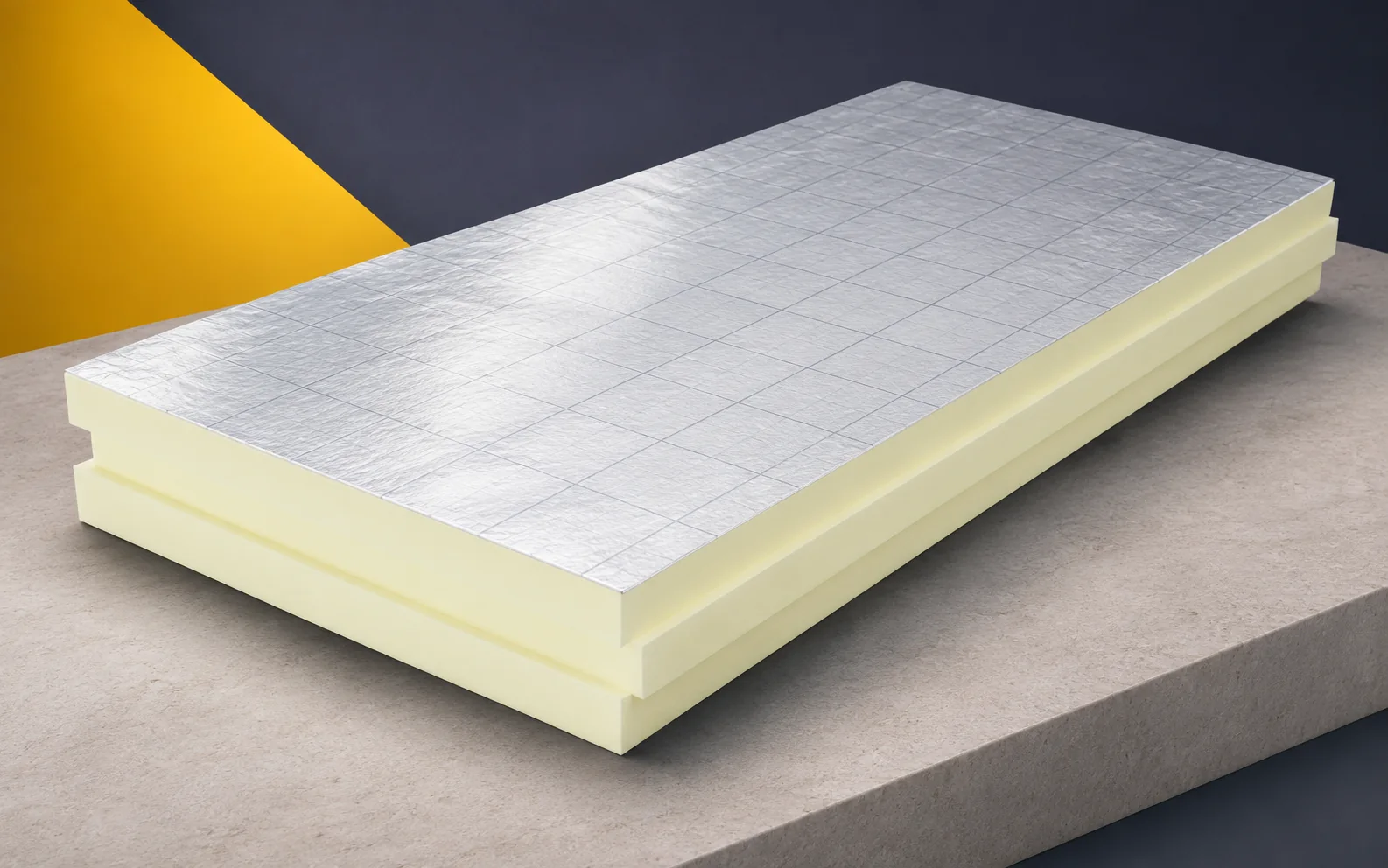
In the specification of a PIR-for-XPS substitute, it is not enough to compare lambda and thickness. A common set of requirements for the given location is needed. PIR boards can provide a favourable thermal resistance, but equivalence also covers moisture, mechanical and installation conditions. Polyurethane foam and extruded polystyrene are different plastics. Comparing their lambda does not exhaust the description of the materials. Lower conductivity does not automatically mean better water resistance, greater load-bearing capacity or a more favourable reaction to fire. Each of these properties is assessed separately. For a thermal objective, specify the required property of the layer or of the entire building element.
In this article
The advantage of PIR lies above all in the space it saves
Next, select thicknesses for the specific products. Polyurethane boards and XPS should not be compared on the basis of general values assigned to groups. In the specification, it is worth retaining the identification of documents. This makes it easier to assess whether the proposed variant actually meets the assumption, and does not merely repeat a favourable figure that appears in a different variant of the material.
Contact with water matters more than the appearance of the core itself
The place of installation must be assigned to a specific product, not to an abbreviated name. XPS covers products intended for perimeter insulation and inverted roofs, but not every XPS board has a confirmed scope of this kind. For PIR too, the scope stated for the given product applies. Therefore, in the specification and on the drawings, the product documentation for the given application must be indicated; a similar appearance of the board alone is not sufficient to approve the installation location.
Record the conditions of contact with water as an application requirement, not as a general claim of resistance. What matters is the position of the product in the building element and the anticipated exposure. Polyurethane insulation cannot be regarded as equivalent to XPS on the basis of the rigidity and appearance of the core alone. The documents must correspond to the specific task. If they do not confirm the required scope, thermal equivalence is not sufficient to approve the substitution.
CS and creep do not describe the same situation
When comparing strength, ask about both short-term testing and long-term requirements. The CC designation, if present, relates to creep under specified conditions. The difference between the parameters is significant for sustained load. The thickness and rigidity of the load-distributing layers remain equally important.
For mechanical requirements, separate the short-term compression test result from the assessment of long-term deformation. Polyurethane foam and XPS require the relevant data to be read for the specific variant. The specification should make clear what loads are envisaged and how they are distributed. A single strength column can conceal different meanings of the parameters. The comparison must preserve consistency of test method and reference conditions.
Facing and fixing limit the scope for substitution
Before purchasing a replacement batch, also compare the cover dimensions and the edge profile. Even a small difference can change the layout of the boards. This matters on a large surface and with multi-layer thermal insulation. The substitution should include updating the cutting plan and the necessary accessories.
The description of the replacement should cover compatibility with adjacent materials. This applies to adhesives, membranes, separating layers and fastening. If the product has a different surface, these connections must be checked again. They should not be regarded as matters left to the arbitrary decision of the crew. The correct detail is part of the design solution. Changing it can affect functions that the table of basic insulation parameters does not show.
The most common situations where the choice is justified
Dividing into zones with different requirements allows different insulants to be used in one building: the material under the roof waterproofing does not have to be the same as that envisaged in the ground. Such a selection is justified when each section meets the requirements assigned to its location. In that case, the coordination of drawings must cover the detail of the connection between different systems in order to assess the continuity and feasibility of the solution.
Requirements should be assigned to designated zones if the building does not have uniform conditions. PIR boards may be justified in one part and a suitable XPS in another. In such a layout, the transition between materials must be shown. This allows the continuity and feasibility of the solution to be assessed. A general statement permitting both insulants throughout the entire building would be too broad if all required applications have not been confirmed.
Compare systems with the same function
When ordering, prepare a short specification instead of a general enquiry about the price of PIR or XPS. State the application, the area and the required thermal effect. Also establish whether you have a thickness restriction. The seller can then relate the offer to the actual task rather than to the cheapest available variant.
In the substitution assessment procedure, retain the same criteria that were used for the original selection. Polyurethane insulation should not be rejected or accepted solely on account of the name of the plastic. Compare the function, the documents and the execution consequences. If the proposal changes the height, update the relevant details. The final entry should allow the supplier and the contractor to identify exactly the approved product and its location.
Recording the decision in the documentation
The alternative variant has the same thickness but a different facing and a different CC parameter. Such a product requires a renewed comparison with the requirements. Compliance with one symbol does not prove equivalence. In the specification, it is worth indicating which parameters are decisive for this location.
Equivalence is an assessment for a specific application. It does not mean a general statement that PIR and XPS are interchangeable in every assembly. Prepare a table of the required characteristics and link it to the cross-section. Also identify the documents and installation conditions. Such a record enables an objective assessment of the offer. PIR boards can demonstrate a significant thickness advantage in it, but the other requirements retain their own importance and do not disappear once a good thermal result has been achieved.
7 branches. Materials closer to your project.