XPS water absorption: immersion versus diffusion
XPS insulation
Resistance to moisture is one of the most frequently cited advantages of XPS. However, several water-related parameters can be found in documents. Two important designations are WL(T) and WD(V). They are not interchangeable notations for one and the same property. Extruded polystyrene is tested both under long-term immersion and under exposure associated with diffusion. Only by distinguishing between these methods is it possible to compare boards and select them for the conditions in which they will perform. WL(T) refers to water absorption under long-term total immersion. The parameter is stated according to a specific test method. It facilitates assessment of how XPS behaves under such exposure, but it does not describe all possible moisture situations.
In this article
What the immersion test checks
The result should be read together with the symbol, the unit and any notes concerning the board variant. A number on its own, without the name of the test, is incomplete information.
Extruded polystyrene limits water absorption thanks to its cellular structure. The declared value describes the limit or level envisaged for the product, not a promise of a complete absence of water in every situation. XPS with low water absorption remains a favourable material for specific applications in contact with the ground. However, the other requirements arising from the design and the expected duration of exposure must also be checked.
Diffusion describes different conditions
WD(V) relates to water absorption in the long-term diffusion test. The effect of water vapour under varying conditions is not the same as immersion alone. The result for XPS may therefore have a different numerical value and depend on the thickness. This does not automatically indicate a contradiction in the data sheet. These are two different ways of assessing the behaviour of the material, needed under different design conditions.
Extruded polystyrene intended for an inverted roof or other demanding systems should have properties suited to the application. When comparing XPS, WD(V) must be compared with WD(V) and WL(T) with WL(T). Mixing these values can lead to an incorrect ranking. Likewise, declared parameters must be distinguished from the average results of a single test series cited in the marketing description.
Why thickness and surface area matter
Within one XPS family, the table may assign different data to individual thicknesses. The best parameter from a selected entry should not be transferred to the entire range. The surface variant may also matter. A smooth board and a board that has been treated should be assessed according to their own documentation. Before purchase, it is worth checking the full product designation, not just the common series name.
Extruded polystyrene is supplied in many formats and finishes. In the documentation, the variant actually ordered for the construction project must be identified. XPS with a given water absorption may be useful in one zone, but a design for another zone requires additional data. If the required parameter has not been declared, it must not be assumed to be zero. Confirmation must be obtained or a suitable material selected.
Low water absorption supports insulation performance
Water-related properties are important because moisture conditions affect the performance of the thermal layer. XPS selected for the ground-level area is intended to help maintain predictable performance in an environment different from a dry interior. A high proportion of closed cells is a practical advantage here. It allows applications to be considered in which a favourable thermal conductivity alone would not be a sufficient criterion.
Extruded polystyrene still requires selection for the specific assembly. Pressurised water, periodic dampness and water flow on the roof are different situations. XPS must be assessed together with the waterproofing, drainage and protective layers. This approach allows the low water absorption to be used without extending its significance to the tightness of the entire building. A material parameter does not describe a leak through an incorrectly executed detail.
A board joint is not tested in the same way as a specimen
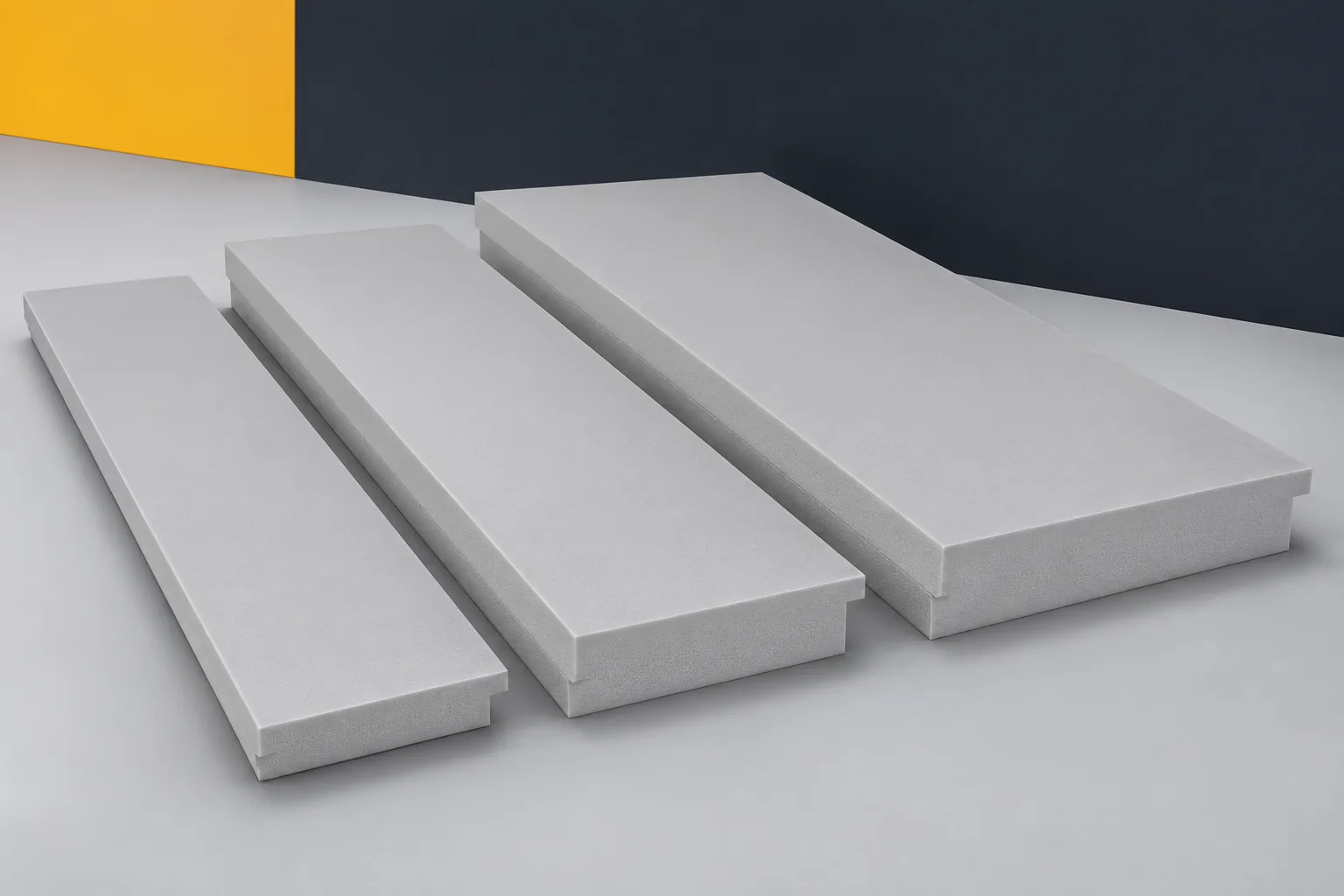
The water absorption documentation refers to the product, while joints, corners and penetrations also occur in the building envelope. Water can migrate between XPS boards even when the material itself absorbs little of it. The rebated edge helps to form the connection of the thermal layer, but does not automatically make it watertight. Where waterproofing is required, it must be executed in accordance with the design.
It is also worth distinguishing water absorption from resistance to water pressure and from the risk of buoyancy. XPS can be light and have low water absorption and yet require suitable protection in a given system. Thickness and the method of fixing are selected according to the actual conditions. When backfilling a foundation or covering a terrace, all these decisions should already have been made, because later access is limited.
A simple way to compare documents
Manufacturers of XPS include HOCH, Synthos and Austrotherm, among others. In a comparison of offers, it is worth creating separate entries for thickness, WL(T), WD(V) and the required mechanical properties. The colloquial word styrodur does not replace any of these parameters. If a document gives only a general statement about moisture resistance, more precise data on the specific grade are needed.
Extruded polystyrene is valued for its low water absorption, but a reliable choice is based on the meaning of the individual designations. XPS compared according to the same method gives a clearer picture than a set of random figures. It is worth keeping the documents for the selected material and checking that the delivery matches. This ensures that the thermal layer corresponds to the conditions assumed by the designer, and not merely to a brief description in the offer.
7 branches. Materials closer to your project.