Specifying Thermano Deck: properties that depend on board thickness
PIR insulation
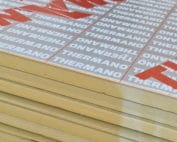
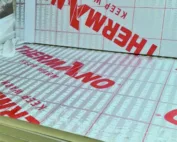
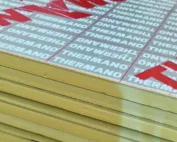
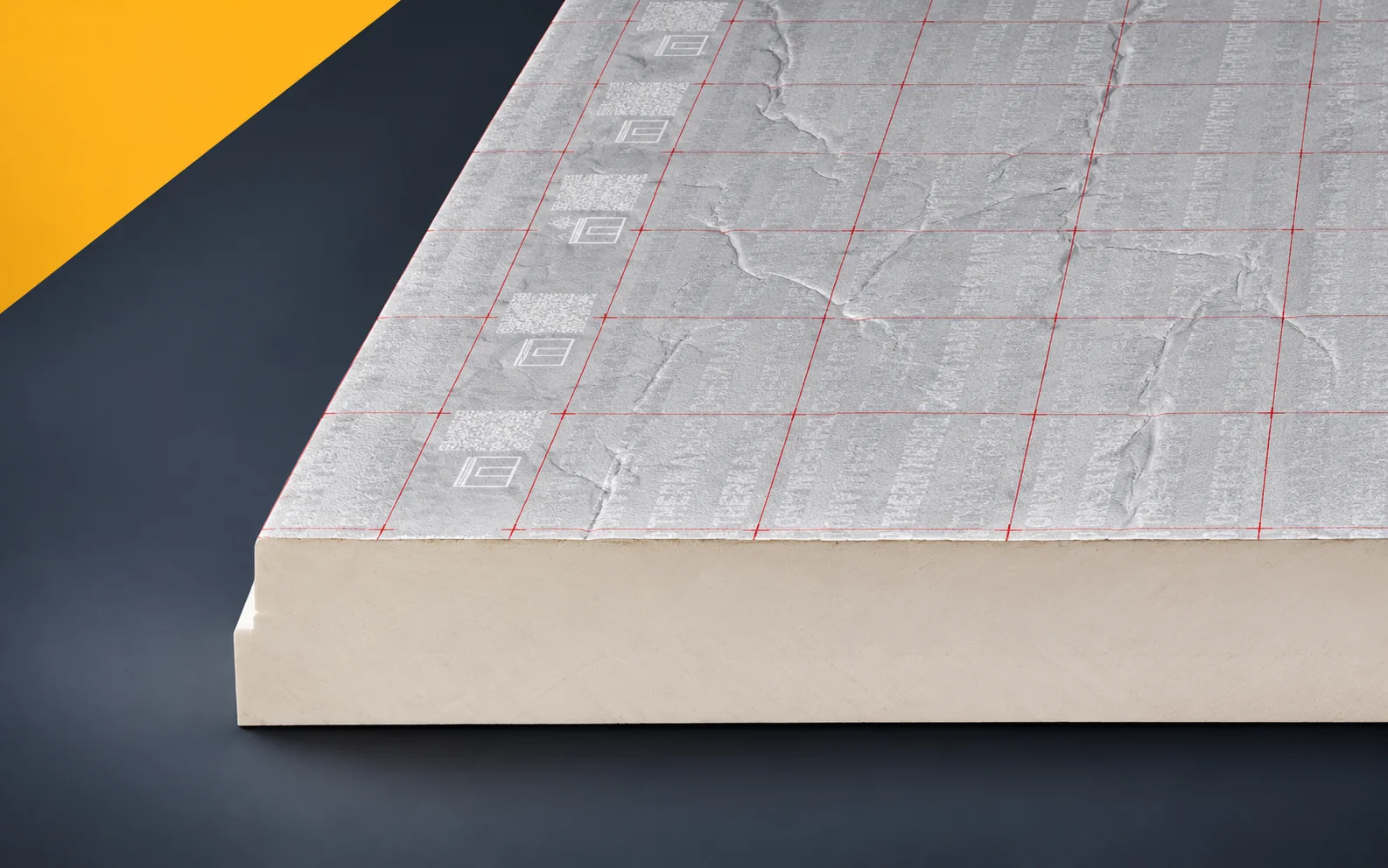
Thermano Deck does not have a single set of parameters for all thicknesses. Both lambda and the declared mechanical properties change. The specification should therefore refer to a specific board, and not to the most favourable figures from different rows of the table. Thermano Deck has a PIR core and a multilayer gas-tight facing containing aluminium on both sides. The product is intended, among other things, for classic flat roofs. In the specification for the application described as PIR boards, clearly indicate the large area of a flat roof based on trapezoidal sheet metal and finished with parapets. Thermano Deck must be selected together with the vapour control layer, the substrate and the method of executing the waterproofing, and the adopted variant must be clearly marked in the documentation.
In this article
Identification and intended use of the product
A shortened record of the name alone is not sufficient, because the name of a roofing product does not in itself define how all the layers are to be connected. The functional assumptions are intended to make it possible to obtain a repeatable roof cross-section before the work is divided into successive sections. In the design documentation, state the type of substrate, the arrangement of the protective layers and the selected method of fixing the thermal insulation, together with a reference to the relevant cross-section.
The basis for a correct comparison
In thermal calculations for Thermano Deck, two lambda values are used: 0.023 W/(m·K) for thicknesses of 30–90 mm and 0.022 W/(m·K) for 100–200 mm. The selected thickness must indicate the correct one of these values, not a single value common to the entire range.
When comparing polyurethane boards in calculations, describe separately the comparison of 90 mm and 100 mm boards lying on either side of the threshold of the declared lambda. For the selected Deck thickness, the correct lambda of 0.023 or 0.022 W/(m·K) must be retained so that each value can be linked to the correct version of the calculation. The parameter must remain linked to the declared range, since using a single value for both variants will distort the assessment of the difference in their thermal resistance. Verification of the design should make it possible to calculate the change in insulation performance without omitting the ranges listed in the product data sheet. In the calculations, retain the RD values of the selected thicknesses and the influence of the fasteners and adjacent layers on the roof result, so that a later change of material can be traced.
Interpretation of the mechanical and fire properties
Thermano Deck has a declared compressive stress at 10% deformation of at least 150 kPa for thicknesses of 30–160 mm and 120 kPa for 170–200 mm. Do not transfer the result from the thinner variant to the thicker one, nor treat it as the load-bearing capacity of the roof. The reaction to fire of the product is class E.
In the table of mechanical and fire requirements, distinguish the 160 mm and 170 mm variants, for which the declared level of compressive resistance changes. The CS value must be read for the specific thickness range of the Thermano Deck board, so that the product document does not replace the required assessment of the application. Evidence for one case cannot be extended arbitrarily, because a thicker Thermano Deck board does not necessarily have a higher CS value than a thinner one. The product and application documents must make it possible to maintain the mechanical requirements even when the thickness is increased for thermal reasons. When approving the material, compile the set of declarations for the specific thickness and the method of transferring loads from the planned equipment with the actual configuration of the roof build-up.
Changing the thickness of Thermano Deck from 160 to 170 mm requires checking the mechanical table. It is not merely a correction of the quantity of insulation in the thermal calculation. The current data indicate different CS values for these ranges. If the design provides for localised loads, the conditions adopted for the layer must be checked again. Such a check should be part of the material change procedure, even when the product name remains the same.
Separation of the functions of the sealing layers
The substrate under Thermano Deck must be dry and level, with an appropriate vapour control layer. On trapezoidal sheet metal, the longer side of the boards is laid perpendicular to the ribs.
The analysis of moisture conditions should cover the joint of the vapour control layer at the point where the work stage changes on a large industrial roof. An unclosed perimeter of thermal insulation must be protected against water and the flow of humid air in accordance with the thermal and moisture conditions adopted for the roof build-up. The description “polyurethane foam” does not close the analysis, because the silver surface of Thermano Deck does not replace the continuity of a separate vapour control layer. The adopted layers and their joints must allow installation to be carried out so that completed sections do not take in water from the still open part. In the specification, explain the tightness of the temporary termination, the dryness of the substrate and the condition of the material after a break in the works, as well as the boundaries of responsibility of the individual layers.
Geometry and detailing of the connections
When ordering Thermano Deck, distinguish between the BASIC, TOP and MASTER edge options. A standard board measures 1200 × 2400 mm overall.
In the working drawing, describe precisely the arrangement of the boards with their longer side perpendicular to the ribs of the trapezoidal metal sheet substrate. The distribution of rows should result from the coverage of the ordered TOP or MASTER edge, and the method of checking should be shown on the working drawing. This cannot be left solely to the installer’s decision, since the difference between the external dimension and the coverage grows with each successive row. The adopted geometry should allow the roof to be laid out according to the selected groove and produce a predictable completion of the field. The designed polyurethane insulation requires specifying how to check the direction of the ribs, the actual coverage of the ordered boards and the support of the cut pieces at the parapet during acceptance.
Conditions for purchasing and checking a substitute product
The Thermano Deck order should contain three pieces of information: the type of substrate, the edge variant and the planned covering. If the roof is to be used for PV, the method of mounting the installation is also required — without it, the selection of boards is not complete.
When checking the item ‘polyurethane insulation’ in the bill of quantities, analyse the requirement for boards together with the work around drains, parapets and installation bases. The offers being compared must cover the same work at drains, parapets and installations, and the agreed criteria must remain clear when assessing a substitute. Agreement on a single characteristic is not enough, since the cost of details may remain similar despite a small change in the price of material in the main field. The material procedure should allow comparison of offers with the same scope of protection, fixing and finishing of the covering. In the conformity report, enter the number of boards in the selected groove, the quantity of auxiliary materials and the responsibility for the flashings, so that the decision is not based solely on the commercial description.
7 branches. Materials closer to your project.