XPS thermal conductivity: declared values and design values
XPS insulation
Lambda appears in almost every thermal insulation offer. In the case of XPS, it usually refers to the declared thermal conductivity, designated λD. A lower value means a lower ability of the material to conduct heat under specified reference conditions. However, extruded polystyrene should be assessed together with the thickness and the conditions of application. A single figure from the headline of an offer does not yet answer the question of how a finished floor, wall or roof will perform. The declared lambda describes a property of the product determined according to the rules applying to a given group of materials. It allows XPS to be compared on a common basis. It should be read from the documentation for the specific variant, not from a general description of all of the manufacturer’s boards.
In this article
What the declared value means
In the table, it is also worth checking the thickness to which a given figure is assigned. Within a single family, several values may occur.
Extruded polystyrene is sometimes offered with the slogan “lambda from”, which indicates the best result of a selected part of the range. This does not mean that every format and every thickness has an identical characteristic. When ordering XPS, a value corresponding to the actual board is needed. This ensures that a comparison of two offers does not mix the parameters of a thin and a thick product, nor of different grades of the material.
The design value corresponds to the application
The conditions in the building component may differ from the reference conditions used for the declaration. The calculation takes into account the requirements of the relevant method and the influence of service conditions where this is necessary. Therefore, the design value is not simply any number added by the contractor. It should have a basis in the adopted rules and material data.
XPS used in contact with the ground may be subject to different conditions than insulation in a dry layer of a building. Extruded polystyrene should be selected together with an assessment of moisture and temperature. There is no single multiplier that can be applied to every board and building component without verification. In practice, it is worth asking what lambda value was adopted in the calculation and for what reason. This explains the difference between the declaration and the design.
Thickness turns lambda into thermal resistance
The thermal resistance of a homogeneous layer can be calculated as R = d/λ. The thickness d must be given in metres. For an example board with a thickness of 0.10 m and an adopted lambda value of 0.034 W/(m·K), the result of the calculation is approximately 2.94 m²K/W. This is a mathematical example, not a declaration of any XPS. The relevant declared thermal resistance is read from the documentation of the selected product.
Extruded polystyrene of greater thickness can provide higher thermal resistance despite a slightly higher lambda value. That is why a ranking of coefficients alone does not determine the effectiveness of the layer. XPS is compared at the required thermal resistance or at the same thickness, depending on the purpose. Such a comparison also helps to assess the amount of space required within the building component. It is more useful than choosing the lowest number without context.
Board R-value versus the U-value of the whole building element
The heat transfer coefficient U relates to the building component and results from the adopted calculation model. The thermal resistance of the XPS is only one of its components. The other layers, the joints and the boundary conditions matter. A floor on the ground requires its geometry and its contact with the substrate to be taken into account. It cannot be described solely by inverting the thermal resistance of a single board.
Similarly, in an inverted roof the specific nature of water flow between the layers is added. Extruded polystyrene has concrete advantages there, but the calculation must correspond to the system. XPS with a very good lambda will not eliminate an uninsulated thermal bridge at the edge. That is why the benefit of better material insulation should be combined with the continuity of the entire layer. Both measures matter for the result in the finished building.
How to compare offers without mistakes
First, the required thickness or thermal resistance must be determined, and then the products that meet the remaining conditions must be compared. XPS can differ in water absorption, mechanical properties and finish. The lowest lambda does not determine suitability under a loaded floor. A useful comparison covers the features actually needed in the project, and not just one highlighted parameter.
Well-known XPS manufacturers include Austrotherm, Synthos and swisspor. In their documentation, you need to look up the data for the specific variant. The colloquial term styrodur does not indicate the level of insulation performance. It is also worth distinguishing between the price of a pack, a square metre and a volume. If the thicknesses differ, comparing the surface price alone can lead to apparent savings at the expense of the required thermal resistance.
What to check during execution
The calculated effect requires the use of XPS with matching parameters and thickness. Any accidental substitution of the product should be checked before installation. Precise joints and connections to adjacent thermal insulation are also important. Extruded polystyrene comes in the form of rigid boards, which makes it easier to maintain the intended geometry. This advantage only helps if the substrate and details have been properly prepared.
Acceptance should confirm the continuity of the XPS and that the delivery matches the design. It is worth keeping the board markings and the document with the parameters. This makes it clear which value was adopted and which material was actually installed. Lambda is an important starting point, but only the combination of product properties, thickness, calculation method and the quality of the completed building envelope provides the full answer.
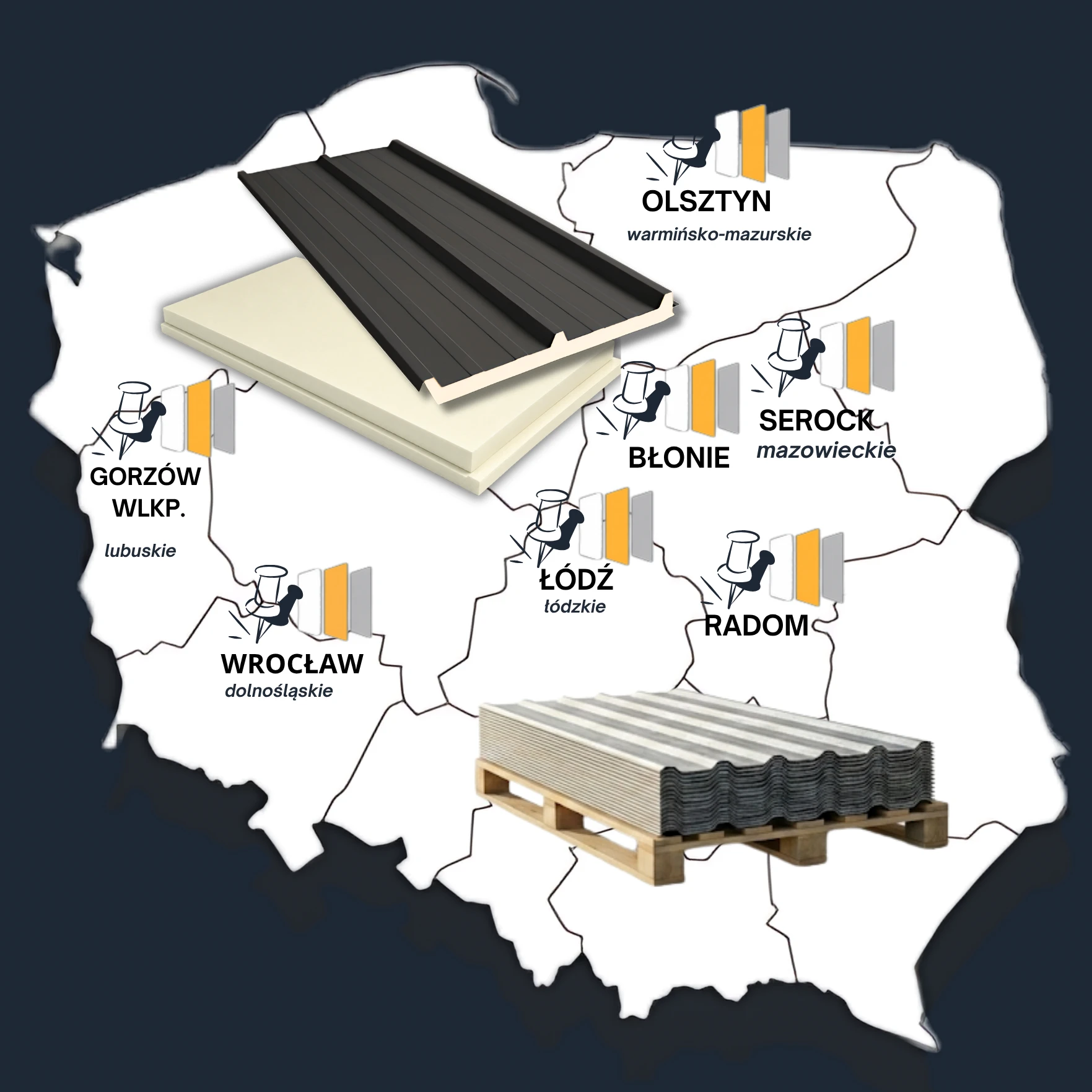
7 branches. Materials closer to your project.