PIR procurement specifications: defining material equivalence
PIR insulation
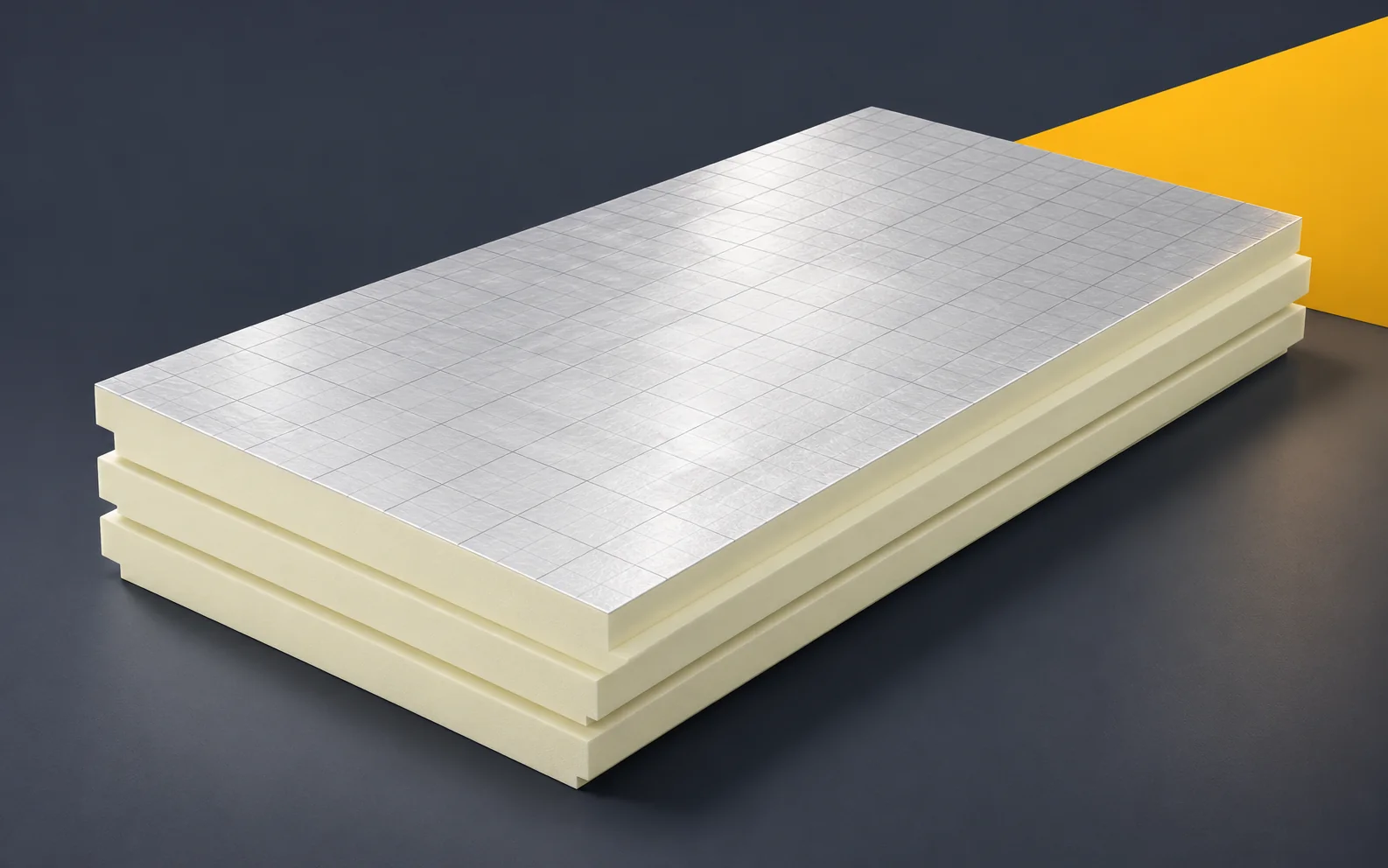
An equivalent PIR board should perform all the required functions, not merely have a similar lambda value. The enquiry should describe the facing, the edges, the mechanical properties and the application. This allows the proposed substitution to be checked before delivery and installation. PIR boards can look similar yet have different facings, strength and intended use. Before purchase, a current technical data sheet, a declaration of performance and installation instructions are needed. The documentation should relate to the variant available on the given market. Parameters from the data sheet of a different version cannot fill gaps in the offer. The data sheet of a similar product may contain different dimensions, facing or classification.
In this article
The document describes the correct variant
The number and date of the version make later checking easier. However, the specification should not be based solely on the name of the document. The characteristics needed for the function that the board is to perform in the designed assembly should be stated.
Comparable scope of offers
The starting point is the function that the PIR board is to fulfil in the building element, not the thickness or lambda alone. Therefore, the specification should define a common basis for comparison: the complete building element together with the method of fixing. Only against this background can it be demonstrated that an offer with the same thickness does not provide equal thermal resistance, and that the same lambda does not determine whether the facing is compatible with the adhesive. Such a provision in the specification makes it possible to reject a proposal that meets a single parameter but changes the layer arrangement or the fixing.
Equal board thickness is not a sufficient definition of equivalence. Equivalence requires a common reference point for the entire solution. This may be the expected thermal result while observing height restrictions and mechanical conditions. If the replacement changes other layers, these must be included in the comparison. The price of the board alone should not be assessed separately. Such a provision helps to demonstrate whether a proposal actually preserves the designed function of the building element.
Format and organisation of delivery
The format of the PIR board is entered in the detailed design together with the laying method and the coverage area. A large format reduces the number of elements to be laid, whereas a small one makes handling easier in narrow spaces and work on a subdivided surface. In the specification, it is therefore worth stating the format together with the required laying method and the coverage area, so that the contractor can plan the organisation of the works and the client can compare offers in the same arrangement.
Changing the element size can affect the cutting plan and the number of joints. The format affects the number of contacts, the cutting plan and the relationship with the support. It is worth specifying which dimensional changes are permissible without adjusting the design. The coverage area should be stated unambiguously. If the edge profile changes the usable dimension, this must be taken into account in the quantity. This allows deliveries to be compared according to the actual scope of execution, and not merely the gross area on the pallet.
Cutting plan and edge connections
In the specification, the cutting plan and the edge profile should be described together, because a straight edge, a lap and a tongue-and-groove joint each require proper matching of adjacent elements. The cutting plan allows full boards to be used in repetitive locations and reduces waste. The edge profile should be clearly named in the schedule so that variants are not confused at the stage of drawing coordination and parameter selection.
A drawing of the corner helps avoid confusing a straight edge with a lap or a tongue-and-groove joint. A drawing of the edge cross-section is often clearer than a short designation alone. It should correspond to the variant offered. It is also worth indicating how the board is finished at the cut edge near the perimeter. If a change of profile affects the sealing or the arrangement of the joints, it requires assessment. The specification should prevent a situation in which the delivered board is thermally suitable but forces an unagreed joining technology.
Materials at the interface between layers
In a PIR purchase specification, the boundary between the board and adjacent materials requires a separate record, because this is precisely where most ambiguities arise when assessing equivalence. The tape must work with the facing, the adhesive with the substrate, and the fastening with the structure. Therefore, acceptance of a substitute should cover the compatibility of accessories at the interface between layers, and not only the parameters of the board itself.
It should not be limited to a table of the core’s properties alone. Material acceptance should cover the interfaces with the surroundings. Adhesive, tape and fastening must work together with the new board and the existing substrate. It is worth recording who presents the confirmation of conformity. One cannot assume that an unchanged core means an unchanged surface. This ensures that the assessment of the substitute covers the properties that actually affect installation and the durability of the entire system.
Cost of use and subsequent maintenance
When defining equivalence in the PIR purchase specification, the cost of complete insulation should be related to the entire solution, not solely to the purchase of boards. Substrate preparation, labour, cutting, supplementary components and protection of the works all matter. It is worth establishing the documents handed over at final acceptance so that the substitute can be settled within the same scope.
They make it possible to link design, delivery and actual execution in a single set of information. At final acceptance, a description of the changes made and identification of the materials used are needed. It should make it possible to reconstruct the actual cross-section. Photographs of works that will be covered up should be linked to their location on the plan. Such a set is useful during later renovation and inspection. Equivalence approved at the purchase stage should remain legible also after the project is completed.
Example of a material quantity check
The quantity take-off can begin with a comparison of modules and then move on to the cutting layout. For an example area of 150 m² and a nominal format of 1200 × 600 mm, the result rounded up to whole elements is a minimum of 209 pieces; the 2400 × 1200 mm format gives a minimum of 53 pieces. These are purely geometric quantities. Milling changes the coverage, and cuts and losses depend on the drawing, so neither number yet constitutes an order. The final schedule should contain the exact designation of the PIR boards, their intended use and the laying method, with accessories for joints in separate items. Sealing foam and factory-made insulation board have different tasks, although both are sometimes described by the general word “polyurethane”.
7 branches. Materials closer to your project.