When do fixings affect the corrected Uc value?
EPS and thermal insulation
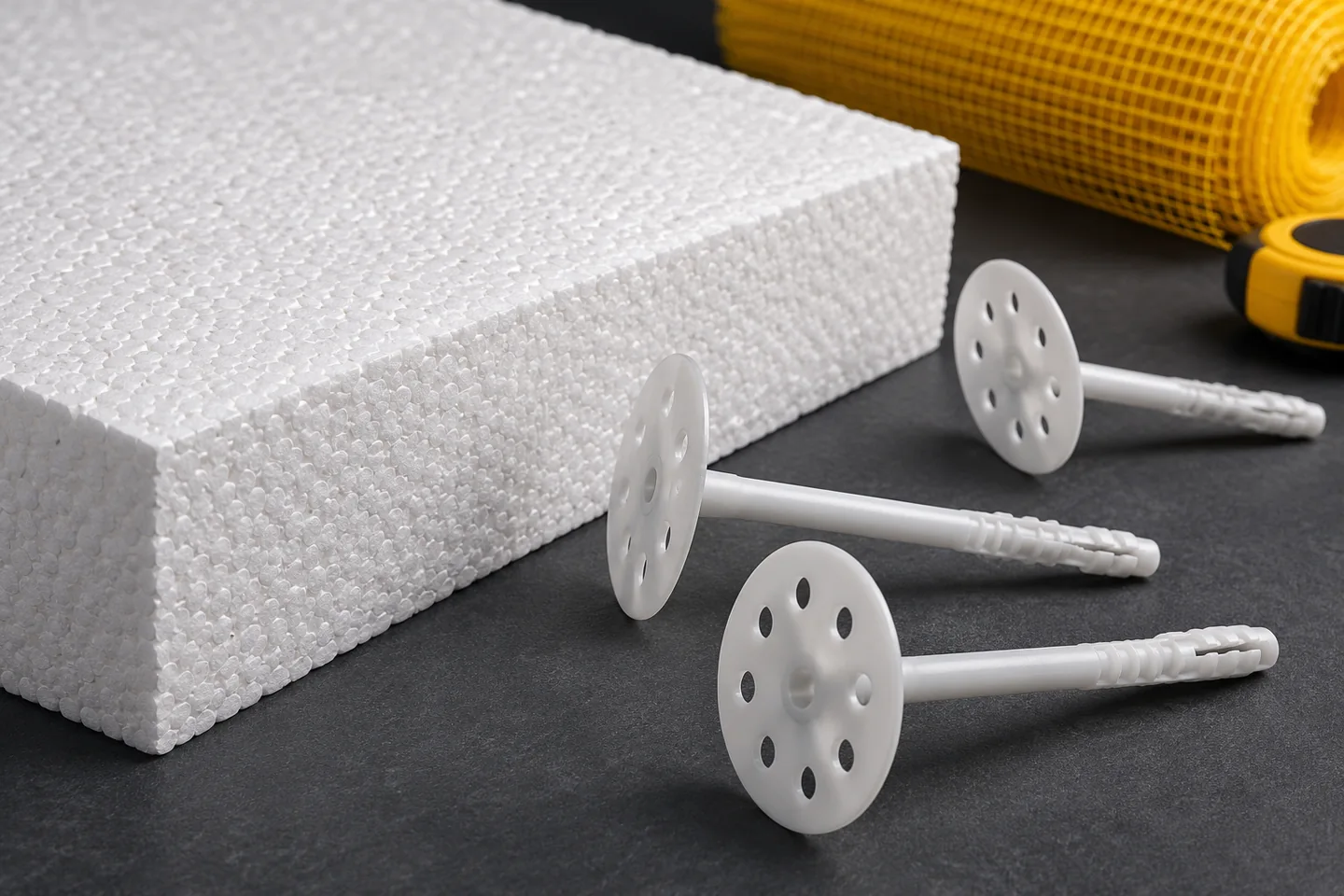
Fasteners passing through EPS can increase heat flow through an insulated wall. Their effect depends on the construction, the installation method and their number. Therefore, the U-value for the layers alone is not always the final Uc result. Thermal data for the fixings and a layout plan are needed. Saving on the number of fasteners is not a way to improve insulation performance. A fixing creates a local disturbance in the homogeneous insulation layer. Heat can flow differently around it than through the EPS field alone. The effect of a single element may be small, but there are many of them on a façade. The better insulated the undisturbed wall is, the greater the relative share a given addition from fixings can have.
In this article
Why does a small fastener matter?
This effect should not be assessed solely by the washer diameter. The materials of the shank and sleeve, the geometry and the installation method all matter. The thickness and lambda of the insulation may also be significant. Two similarly looking fasteners do not have to produce the same correction. A value adopted for one installation variant does not always describe another variant of the same product.
What does the point thermal transmittance χ mean?
The symbol χ describes the point thermal transmittance of the fixing and has the unit W/K. The data should come from the relevant documentation or calculations. It is necessary to check which solution the given values relate to. In particular, the thickness range and the installation method are important. Merely finding the lowest number in the table does not provide a basis for using it in every project.
χ is not the lambda of EPS and is not added directly to the resistance R. In the relevant simplification, the influence of repeated fixings per square metre can be expressed by ΔU = n × χ. The symbol n denotes the number of fixings per 1 m². Such use requires the conditions of the method to be met. Unusual density or other elements may require a more detailed model.
What does an example correction look like?
Assume the U-value of the wall without the influence of fixings is 0.180 W/(m²·K). For this example only, assume six fixings per square metre and χ = 0.002 W/K. We obtain ΔU = 6 × 0.002 = 0.012 W/(m²·K). Disregarding other corrections, Uc will be 0.192 W/(m²·K). This is an increase of approximately 6.7% relative to the initial result.
The number six is not an installation recommendation here. Likewise, the assumed χ does not describe every plastic fixing. The example shows only the method of calculation. In a real project, a safe fixing for the system, the substrate and the wind is selected first. Its thermal influence is then assessed. This order should not be reversed and the fixings reduced merely to obtain a lower Uc.
Does countersinking the washer always eliminate the thermal bridge?
Installation with a recess and a suitable cap can limit the thermal effect in the intended solution. This does not mean the thermal bridge disappears in every configuration. Data are needed for the specific fastener and the method of seating. Deepening the hole on your own or replacing components with a random offcut does not guarantee that the mechanical and thermal parameters are maintained.
The fixing must work together with the EPS and the reinforced layer. Seating that is too deep or incorrect can damage the board and change the way forces are transferred. A plate mounted unevenly can also make finishing more difficult. A thermal improvement only makes sense together with correct execution of the entire detail. The requirements of the system manufacturer and of the fastener manufacturer should be consistent with each other.
How can different thermal bridges be kept apart?
Fasteners create point thermal bridges, whereas the junction of a wall with a balcony or roof is often treated as a linear thermal bridge. The latter is described by the coefficient ψ in W/(m·K) and the length of the junction. All these values should not be added to the wall U-value without verification. The balance requires consistent units and the correct reference to area.
Double counting must also be avoided. If the result for a given building component already accounts for the fixings, they are not added again. The report should clearly indicate what U, Uc and the separate components from junctions include. This makes the result clear also when comparing two projects. The same number without a description of the assumptions can mean a different scope of calculation.
What should be prepared for the final assessment?
Data on the layers, the specific type of fastener, the installation method and the layout plan are needed. It is worth checking whether the documentation covers the selected EPS thickness and the substrate. If the material or the fixing is changed, the result must be verified. This also applies to switching to a board with a different lambda. The thermal documentation and the fixing design should refer to the same version of the façade.
The manufacturers of polystyrene include Arsanit, Austrotherm, Paneltech and Termo Organika, among others. The appropriate board is part of the ETICS, and the fixings have their own requirements. A correctly calculated Uc allows the effect of the completed system to be assessed more accurately than lambda alone. However, it does not replace checking the load-bearing capacity, the adhesion and the quality of installation on site.
7 branches. Materials closer to your project.