Converting white EPS thickness to graphite EPS at equal thermal resistance
EPS and thermal insulation
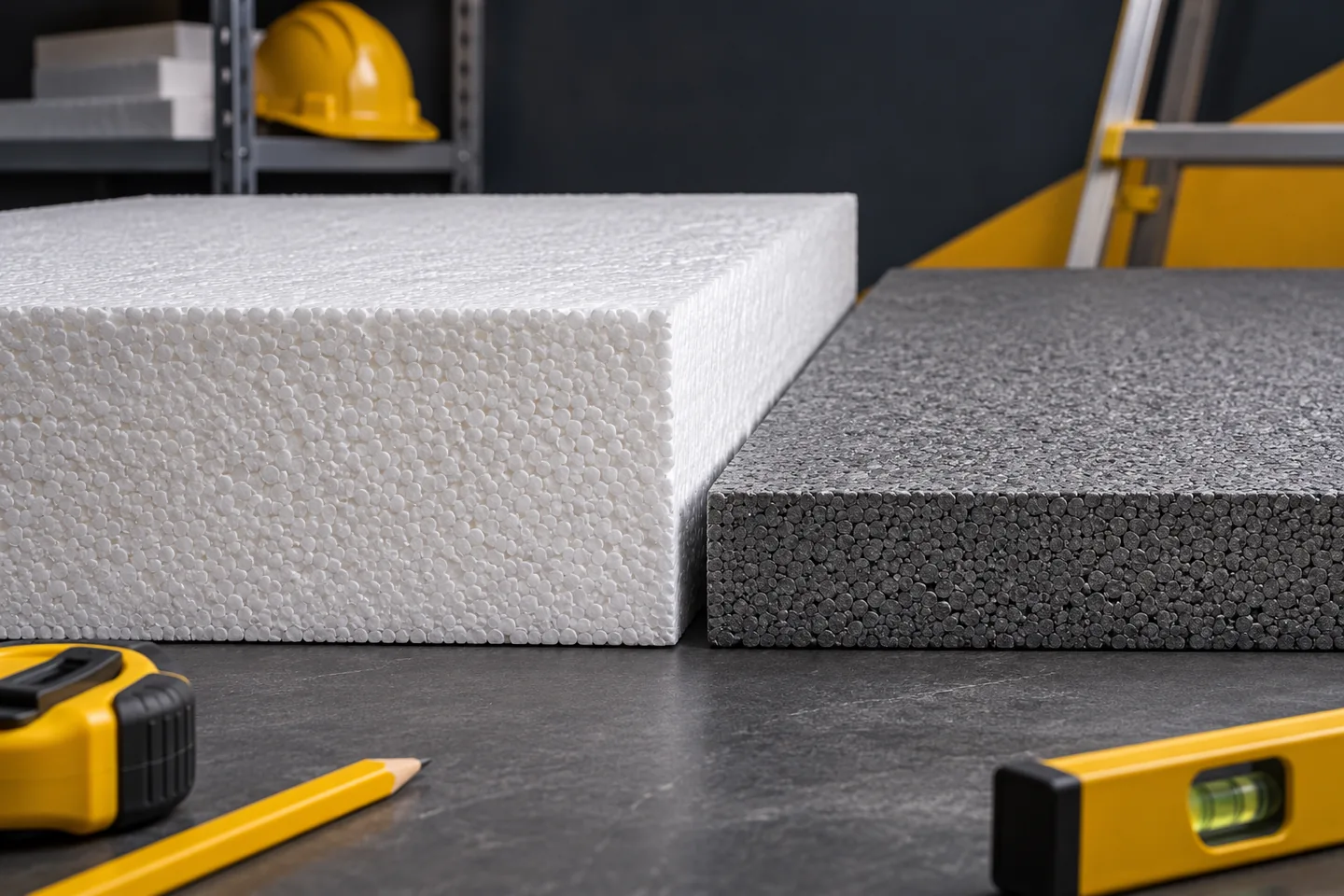
White and graphite EPS can be compared by thermal resistance, not by thickness alone. At equal R, the board with the lower lambda value can be thinner. The conversion is simple, but it does not settle all the conditions of a substitution. You still have to check the application, the mechanical parameters, the available dimensions and the requirements of the system and of the installation. The colour of the EPS helps to identify the type, but it does not give the exact insulating performance. White boards have different lambda values, just as graphite ones do. For a comparison you need the values for the specific products. You should not attribute to the whole group a single figure heard in a shop. The declaration and the technical data sheet allow you to establish which variant is actually being compared.
In this article
First, read the lambda value of both boards
In the calculation, data adopted on the same basis and appropriate for the application must be compared. A declared value is one thing, and a possible design value taking operating conditions into account is another. If the design requires adjustment, it must be carried out consistently. A difference in the way data are read can create an apparent advantage that does not exist in the finished building envelope.
Use the ratio of thickness to lambda value
For a homogeneous layer, R = d/λ. For two variants to have the same thermal resistance, d white/λ white = d graphite/λ graphite must hold. Hence the thickness of the new board is d new = d old × λ new/λ old. Thicknesses must be expressed in the same unit. It is safest to calculate in metres and only then convert the result to centimetres.
Assume 20 cm of white EPS with λ = 0.040 W/(m·K). Its thermal resistance is 0.20/0.040 = 5.0 m²K/W. The graphite variant with λ = 0.032 requires a thickness of 0.16 m to achieve the same result. We obtain 16 cm, i.e. 20% less. This is a specific example, not a fixed difference between every white and every grey EPS.
What changes with a different pair of products?
If the white EPS has λ = 0.036 and the graphite one being compared has λ = 0.032, then the equivalent of 20 cm is approximately 17.8 cm. The space saving is smaller than in the previous example. With λ = 0.031 instead of 0.040, we would obtain 15.5 cm. Each pair requires its own calculation. There is no single rule that three or four centimetres are always subtracted.
The result of the calculation must be compared with the available thicknesses. If 17.8 cm is not offered, one should not round down without rechecking the thermal resistance. In this example, an 18 cm board has a slightly higher R than required for equivalence. This also affects ordering and the fitting of details. In the documentation, it is worth recording both the calculated value and the selected commercial dimension.
Equal thermal resistance does not mean full interchangeability
Two boards can have the same R but a different intended use and different mechanical properties. On a façade, the ETICS requirements must be checked, including the relevant TR and the other characteristics. Under a floor, compressive behaviour and performance under permanent load are what matter. At a foundation, water conditions are added to the picture. A thermal substitution is not automatically a technical substitution for every location in a building.
Nor should properties be assessed on the basis of density alone. This parameter can be helpful in a specific check, but it does not replace the declared lambda, TR or creep data. The choice should be based on the complete set of required characteristics. If the variant with the better lambda does not meet the other conditions, the formula result alone does not justify its use.
Check what the thinner layer changes in the detail
A smaller thickness affects the depth of the reveals, how far the window sills project and the length of the fixings. It can help where space is limited, but the connections must be adapted to the new arrangement. It is worth checking the junctions with the plinth, the roof and the foundation insulation. An equal resistance of the wall field does not mean an identical thermal bridge at each of these locations.
Graphite boards require protection from adverse sunlight in accordance with the manufacturer’s instructions. This applies to storage and installation. They should not be left without suitable protection merely because they will soon be covered with a reinforcing layer. The site conditions are part of the correct application of the material. A good lambda does not eliminate the effects of deformation or incorrect bonding.
How can the cost of both solutions be compared?
The price per cubic metre does not yet correspond to the price of a layer with the same R. For 1 m², the volumetric price must be multiplied by the chosen thickness in metres. Then offcuts and the remaining system components are taken into account. A thinner material may change the length of the fasteners or the scope of the flashings. However, savings that the design does not actually allow to be achieved should not be attributed to it.
Well-known EPS manufacturers include Termo Organika, Austrotherm, Arsanit and Paneltech. When comparing their boards, it is best to set out R, the application and the cost of the complete layer. The final decision should preserve the system’s compatibility and the thermal performance of the building envelope. The ratio d/λ provides a clear basis for the calculation, and the documentation determines whether the substitution is appropriate for a given construction project.
7 branches. Materials closer to your project.