Specifying Recticel Powerdeck F: board and roof assembly properties
PIR insulation
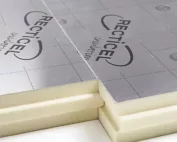
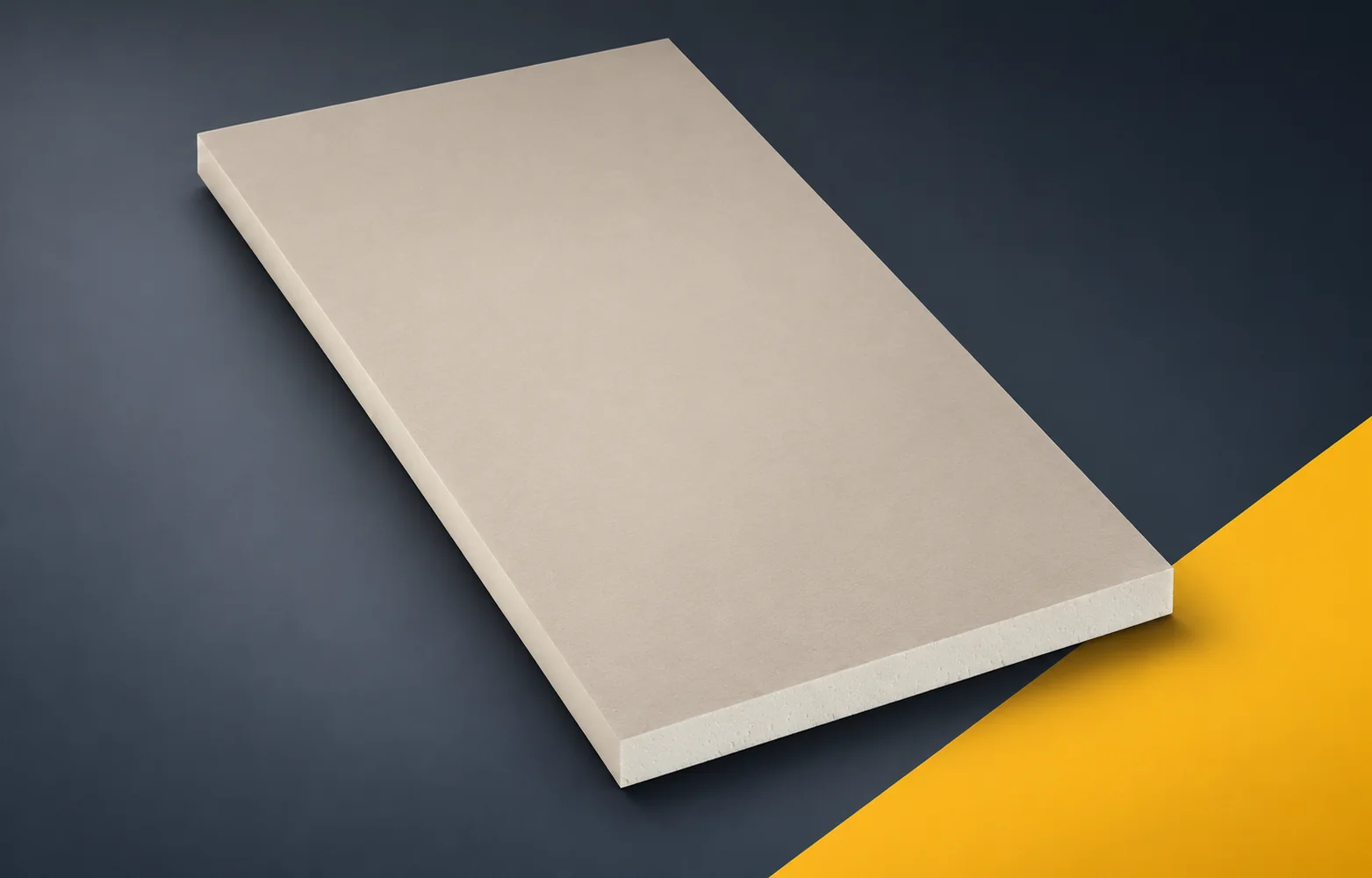
The description of Recticel Powerdeck F should specify the facing, thickness and method of application. The PIR category alone is too broad. The board parameters must be compared with the roof system documentation, particularly when selecting the adhesive and assessing the required fire performance. Recticel Powerdeck F has a PIR core faced on both sides with mineralised glass fleece. The product is intended for flat roofs with a suitably selected covering. In the application specification described as PIR boards, clearly identify the mineralised glass fleece of Powerdeck F as the surface that bonds to the covering. The Powerdeck F facing must be matched to the materials in contact in the adopted roof system, and the adopted variant must be clearly identified in the documentation.
In this article
Scope of data in the specification
A shortened record of the name alone is not sufficient, because a similar colour of the PIR core does not determine the compatibility of the surface with the selected membrane. The functional assumptions should allow the choice of product to be based on the requirements of the specific roof system. In the design documentation, state the type of facing, the adopted covering and the documentation of their mutual compatibility, together with a reference to the relevant cross-section.
Lambda, thickness and thermal resistance
For the Powerdeck F build-up calculation, use the declared lambda of 0.026 W/(m·K) and use it to determine the thermal resistance of the layer at the design thickness; link the result to this board, not to the general PIR category.
When comparing polyurethane boards in calculations, describe the calculation of the Powerdeck F layer separately using the declared lambda of 0.026 W/(m·K). The thickness of Powerdeck F must be calculated with its own lambda of 0.026 W/(m·K) so that each value can be linked to the correct version of the calculation. The parameter must remain linked to the declared range, since using a lambda of 0.022 from another product would lead to an incorrect result for this board. Design verification should make it possible to determine the thickness resulting from the Powerdeck F parameters rather than from the general PIR name. In the calculations, retain the design thermal resistance, the available layer height and the calculation of the full roof section so that a later material change can be traced.
Product parameters versus assessment of the system
The CS(10/Y)120 declaration applies to Powerdeck F, whereas reaction to fire E is given for thicknesses from 40 mm; B-s2,d0 relates to the specific end use, so the classification must be linked to the actual substrate and fixing.
In the table of mechanical and fire requirements, distinguish the CS120 declaration and the conditions of class E given for Powerdeck F from 40 mm. The end-use classification must be linked to the actual substrate and fixing of Powerdeck F so that the product document does not replace the required assessment of the application. Evidence for one case cannot be extended without limit, because a change of covering or fixing may go beyond the scope of the previously assessed assembly. The product and application documents should make it possible to retain the requirements of the entire roof when considering mechanics and fire behaviour. When approving the material, combine the board thickness, the complete set of layers and the documentation corresponding to the actual method of fixing them with the actual assembly configuration.
For Powerdeck F, the designer should link the facing to a specific method of joining the layers. The information about the mineralised fleece is important for this selection. In the thermal table, the lambda value of 0.026 must be retained, including when comparing alternatives. The reaction-to-fire conditions and the final classification must be stated separately. The specification should not permit arbitrary substitution of the adhesive or coating without checking the entire system.
Separation of the functions of the sealing layers
The selection of a bonded or self-adhesive membrane and of the fastening system for Powerdeck F requires confirmation of compatibility with the mineralised fleece; the name of a polyurethane or bituminous adhesive alone does not determine suitability within the system.
The analysis of moisture conditions should cover the connection with a bonded or self-adhesive membrane in a clearly defined set of materials. When bonding, the compatibility of the membrane and the bonding material with the mineralised fleece must be confirmed in accordance with the thermal and moisture conditions adopted for the building envelope. The description “polyurethane foam” does not close the analysis, because the general chemical name of the adhesive does not replace confirmation of the compatibility of the specific product. The adopted layers and their connections must allow the joining method to be selected together with the surface preparation and the execution conditions. In the specification, explain the system instructions, the requirements for the substrate and the method of inspecting the connection before the details are covered, as well as the limits of responsibility of the individual layers.
Geometry and detailing of the joints
Indicate the Powerdeck F edge variant — straight or milled for overlapping — on the execution drawing and link it to the ordered thickness. Confirm the format and availability for the specific variant before determining the cutting plan and the number of boards.
In the working drawing, precisely describe the variant of straight edges or the overlap specified for the ordered Powerdeck F version. The side geometry of Powerdeck F must be agreed before determining the cutting plan and the number of boards ordered, and the method of verification must be shown on the working drawing. This cannot be left solely to the installer’s decision, since a change of format or side profile affects the cuts and the actual surface coverage. The adopted geometry should make it possible to agree the delivery geometry before determining the number of boards and the direction of successive rows. The designed polyurethane insulation requires specifying how to verify the format on the order, the method of bringing the elements together and the support at the end of the field during acceptance.
Documentation of as-built compliance
The Powerdeck F order covers the board thickness and the design of the joints; the quotation must also include the preparation of the substrate, the required layers and details, otherwise the price of the board does not reflect the finished system.
When checking the item “polyurethane insulation” in the bill of quantities, analyse the cost of preparing the substrate and of connecting the insulation to the selected waterproofing system. The quotation should include the preparation of the substrate and all materials needed to install the covering, and the agreed criteria must remain clear when assessing a substitute. The conformity of a single characteristic is not enough, since a favourable board price does not automatically include priming, bonding and the execution of flashings. The material procedure should make it possible to compile the expenses leading to a finished, tight covering with specified requirements. In the conformity report, enter the bill of quantities for the boards, the bonding materials, the works on the substrate and the details around the perimeter of the covering, so that the decision is not based solely on the commercial description.
7 branches. Materials closer to your project.