Removing moss from tile-effect metal roofing without damaging the coating
Renovation and maintenance
Begin by establishing which coating covers the metal roof tiles and what condition it is in, since this determines the permissible cleaning method. Check whether the green deposit is moss, algae or another biological growth, and where it concentrates — in depressions, around flashings or in shade, where the roof slope dries more slowly. Inspect the water drainage and remove loose leaves and twigs before washing. When choosing a method and product, follow the coating instructions; leave design decisions to the designer.
Why does the deposit appear only on part of the roof?
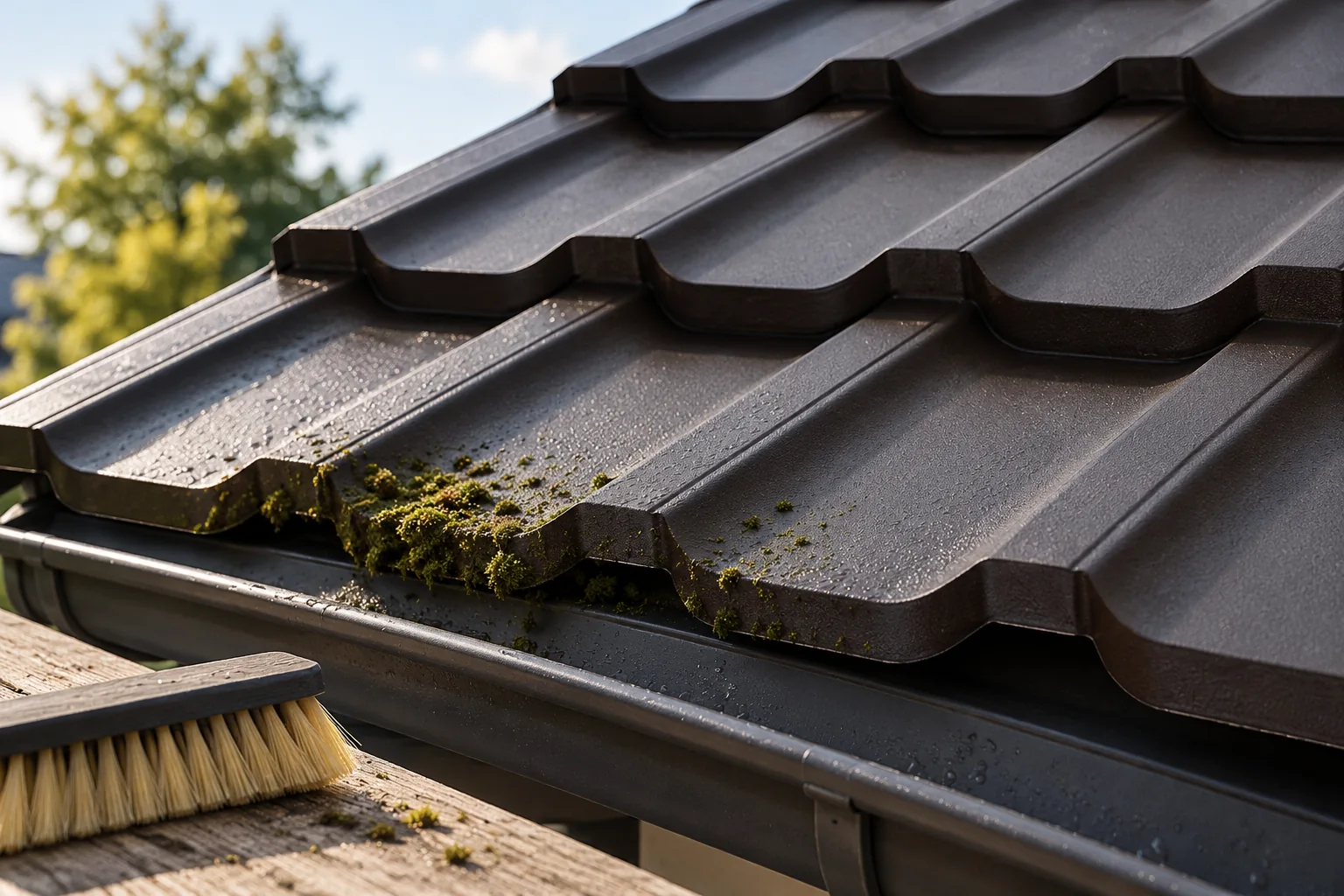
A shaded section of the roof slope dries more slowly than a sun-exposed surface. Leaves, dust and nearby trees also matter. Contaminants create conditions that favour moisture retention. That is why the deposit often concentrates in recesses, around flashings or near accumulated organic debris.
Not every green deposit is moss. It may also be algae and other biological soiling. It is not worth choosing an aggressive product solely by the colour of the stain. First establish what coating you are dealing with and check its condition. Peeling or rust spots require different treatment than a light deposit.
Where should you start preparing for cleaning?
Assess the roof from a safe position and take photos. Check whether the gutters and roof valleys are clear. Before washing, remove loose leaves and twigs by a method that does not scratch the coating. Do not drag hard contaminants across the slope. They can act as an abrasive under a brush or boot.
Also prepare a way to collect the dirty water and cleaning residues. The product should not be used without reading the instructions. Weather conditions, concentration and contact time are important. Protect plants and façade elements in line with the product actually used, without improvising a chemical mixture.
Is water and a soft brush enough?
For a light deposit, this method may be sufficient. Work gently, following the direction of the profile and water runoff. Do not try to scrape off the deposit with a metal scraper. The thin protective layer should remain on the sheet. Deep scratches may require repair even when the roof looks brighter after cleaning.
A strongly adhering deposit may require a product approved for the given coating. A test on a small area helps assess the surface reaction. Do not combine different products for a stronger effect. If the coating instructions do not describe such cleaning, the procedure should be confirmed before applying chemicals to the entire slope.

When does a pressure washer become a problem?
A strong jet can force water under the laps or damage a weakened coating. Flashings and the areas around seals need particularly careful treatment. There is no single safe setting for all equipment and all coverings. The nozzle, the distance and the direction of the jet also matter.
If pressure washing is permitted, follow the conditions in the instructions for the given material. Do not direct water from below under the joints. While washing, do not test tightness by deliberately flooding the seams. A roof is designed for a defined run-off of precipitation, not for every possible test with a pressurised jet.
What should be checked after removing the deposit?
After washing, the condition of the coating is easier to see. Inspect the edges, the places where branches were and the areas around fixings. Repair minor damage in accordance with the recommendations for the material. Do not paint over a damp substrate or remnants of growth. Paint on a poorly prepared surface can quickly lose adhesion.
Check the gutters and roof valleys again. Detached fragments of deposit can collect precisely there. Pay attention to places that stay wet longer than the rest of the roof surface. The cause may be a blockage or local deformation. Removing the green layer alone will not solve the problem of improper drainage.
How can re-growth of dirt be limited?
Remove leaves before they form a wet layer. Monitor branches close to the roof and carry out the necessary garden work in line with local conditions. Do not place materials that retain water on the covering. With any intervention on the roof, it is worth removing the resulting swarf and installation remnants straight away.
Regular inspections help you respond to initial deposit before it adheres firmly to the surface. They do not, however, promise a complete absence of soiling in a shaded setting. The choice of coating and care matter, but they do not change the position of the building. The cleaning plan should take account of the actual conditions at the roof surface.
When should the work be entrusted to specialists?
A steep roof, no safe access and extensive growth argue in favour of commissioning cleaning to a prepared team. Wet sheet metal is particularly demanding to move on. Merely resting a ladder does not provide protection against falling. It is not worth judging the difficulty of the work solely by the size of the soiled area.
Before commissioning, ask about the method, the agent and the principles for protecting the coating. Also agree on an inspection after drying and the removal of waste from the drainage. A well-executed service leaves a clean surface without new scratches. If the coating is already damaged, a separate renovation plan may be needed instead of more intensive washing.
7 branches. Materials closer to your project.