Modular tile-effect sheets: advantages and installation planning
Tile-effect metal roofing
Modular metal roof tiles are not a universal solution — their suitability depends on the specific roof and how it is installed. Before buying, check the module’s coverage area after overlaps, the requirements for the substrate and ventilation, and the full cost for the given roof slope. Smaller sheets make transport and work planning easier, but they do not remove the need for careful preparation of flashings and checking the geometry of the first row. The comparison should be based on an actual layout, not on one common module size.
What does modular format really mean?
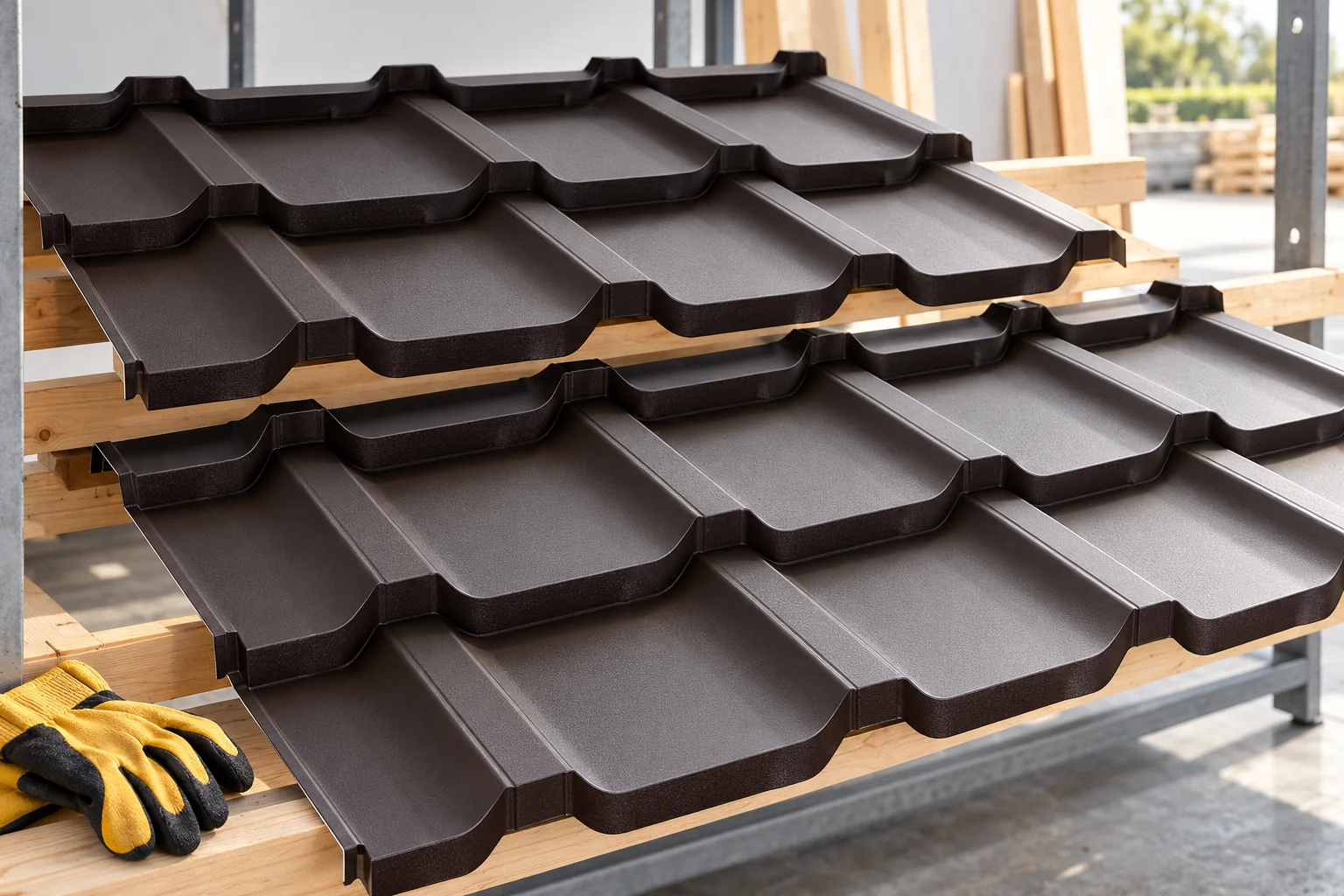
A modular sheet has fixed dimensions and a defined covering area once the laps are made. It may contain one or more rows of the pattern along the slope. The number of these rows is not the same as the number of corrugations across the width. The exact proportions must be read from the drawing of the selected model.
There is no single common module size for all tile-effect metal roofing. Products may have different widths, lengths and edge solutions. When ordering material, the information ’tile-effect metal roofing’ alone is not sufficient. Precise identification of the profile, coating and colour is required.
Where are smaller sheets particularly convenient?
Modules can be more easily distributed between work stages and material delivery points. This matters on a site with limited access and with complex geometry. A shorter element is also transported differently from a long sheet cut to size. The rules for handling and storage must still be observed.
On a roof with valleys, it is worth analysing the cutting layout for both formats. Modules may facilitate material utilisation, but they do not guarantee the absence of waste. The direction of the pattern and the overlap limits the use of certain offcuts. The comparison should be based on an actual plan, not a fixed percentage added to the area.
How do you check whether the product suits the roof?
From the documentation, read the minimum pitch, the required support and the fixing rules. Conditions may vary between models. The batten spacing should not be selected solely on the basis of the installer’s habits. The areas around the eaves and the points where the slope geometry changes are particularly important.
In a renovated house, the structure and condition of the layers beneath the covering should also be checked. The low weight of tile-effect metal roofing does not confirm the soundness of the old roof truss. If the attic is heated, a complete insulation and moisture control system is required. The modular format does not change the role of these layers.
What should be prepared before the first row?
The substrate should be level and in accordance with the product requirements. The dimensions of the roof slopes, the eaves lines and the locations of penetrations must be checked. It is worth preparing the flashings in advance so that their installation does not later require dismantling the laid modules. The sequence of work should follow the instructions for the specific system.
The first elements determine the layout of the entire covering. An alignment error can accumulate with each successive row. Therefore, checking the geometry at the start is more important than quickly fastening a large number of sheets. Serious deviations should not be corrected by forcibly stretching the overlaps.

How to maintain watertightness and surface protection?
Fasteners are selected according to the covering model, the substrate and the load conditions. The manner of seating is important for sealing. A connection that is too loose or excessively tightened may not perform correctly. The number and arrangement of fastenings should not be based on a single universal rule.
Suitable tools are used for cutting the sheet metal without overheating the coating. Swarf is removed continuously. Valleys, the chimney and service penetrations are also important, because the module overlaps alone do not solve all details. Following the instructions is more important than the belief that a small sheet is always easy to install.
How to compare prices and the number of modules needed?
First determine the usable area of one element. The overall dimensions also include the parts that form the overlaps. Multiplying the number of pieces by an unsuitable area can overstate the expected coverage. The order should be based on the layout of the elements on the specific roof slopes.
In the quote, separate the modules, flashings, fastenings, delivery and labour. Compare the coatings and sheet thickness, not just the colour. Also check the scope of the warranty and the maintenance requirements. Only such a set allows you to assess whether the benefit of the format corresponds to the difference in the full cost of the roof.
What is worth keeping after the work is completed?
At acceptance, collect the product documents, the roof drawing and photos of important details. Establish the rules for inspections and cleaning. The coating requires protection also during subsequent installation work. When installing photovoltaics, the fastenings, loads and tightness of the penetrations must be checked again.
The modular format can facilitate the organisation of future repairs, but the method of replacement depends on the system connections. Not every element can be removed without disturbing adjacent ones. Retained material identification will help select the correct replacement. The convenience of modules is greatest when accompanied by good preparation and precise execution.
7 branches. Materials closer to your project.