How to size and choose gutters for a metal roof
Guttering and flashings
Gutters for a metal roof should be selected primarily by the amount of water drained, the roof geometry and the arrangement of outlets, not by the building's total area alone. It is worth establishing the water path right down to the point where it is received at ground level. Prepare a roof plan with eaves dimensions, roof pitch angles and the positions of valleys, and mark the possible routes for downpipes. Check that the chosen system includes all necessary components, including unusual corners and transitions. Remember that a single gutter run may collect water from different parts of the roof, so the total area is not enough to determine the size of each section.
What data is needed for selection?
Prepare a roof plan with eaves dimensions, roof pitch angles and the position of roof valleys. Mark the places where downpipes can be routed. A single gutter can collect water from different parts of the roof. Therefore, the total building area is not sufficient to determine the size of each section.
The selection should take into account the capacity of the specific system and the design conditions. Distances to outlets and areas of concentrated runoff are important. A downpipe hidden behind a corner may look good, but its position must match the drainage layout. First the water flow is determined, then the appearance is refined.
When should steel guttering be considered?
Steel gutters can be colour-matched to the roofing and its flashings. When choosing, check the type of surface protection and its suitability for the given environment. The name of a shade says nothing about the coating construction. In more demanding environmental conditions, it is worth comparing documentation and application limitations.
For durability, cutting, connections and the repair of minor damage also matter. Swarf left after work can rust on the surface. The coating should not be treated as protection against every installation error. The complete set should include matching brackets, connectors, outlets and end caps.
What should be checked with a PVC system?
For plastic gutters, it is particularly important to follow the connection method specified by the manufacturer. Components change dimensions with temperature. Installation must account for their movement and the required position in the connectors. A connection intended to allow sliding should not be blocked.
Choosing PVC is not just about the price of a simple section. Check the availability of corners, outlets and parts needed for an unusual façade. Also assess the appearance of the pipes against the wall. A correctly selected system should match both the technical conditions and the plan for routing the installation on the building.
How do you choose the gutter cross-section and position?
Round and square profiles can be matched to different house styles. However, there is no rule that one shape always drains more water. Specific dimensions, outlet layout and system data must be compared. A similar width designation does not guarantee the same capacity.
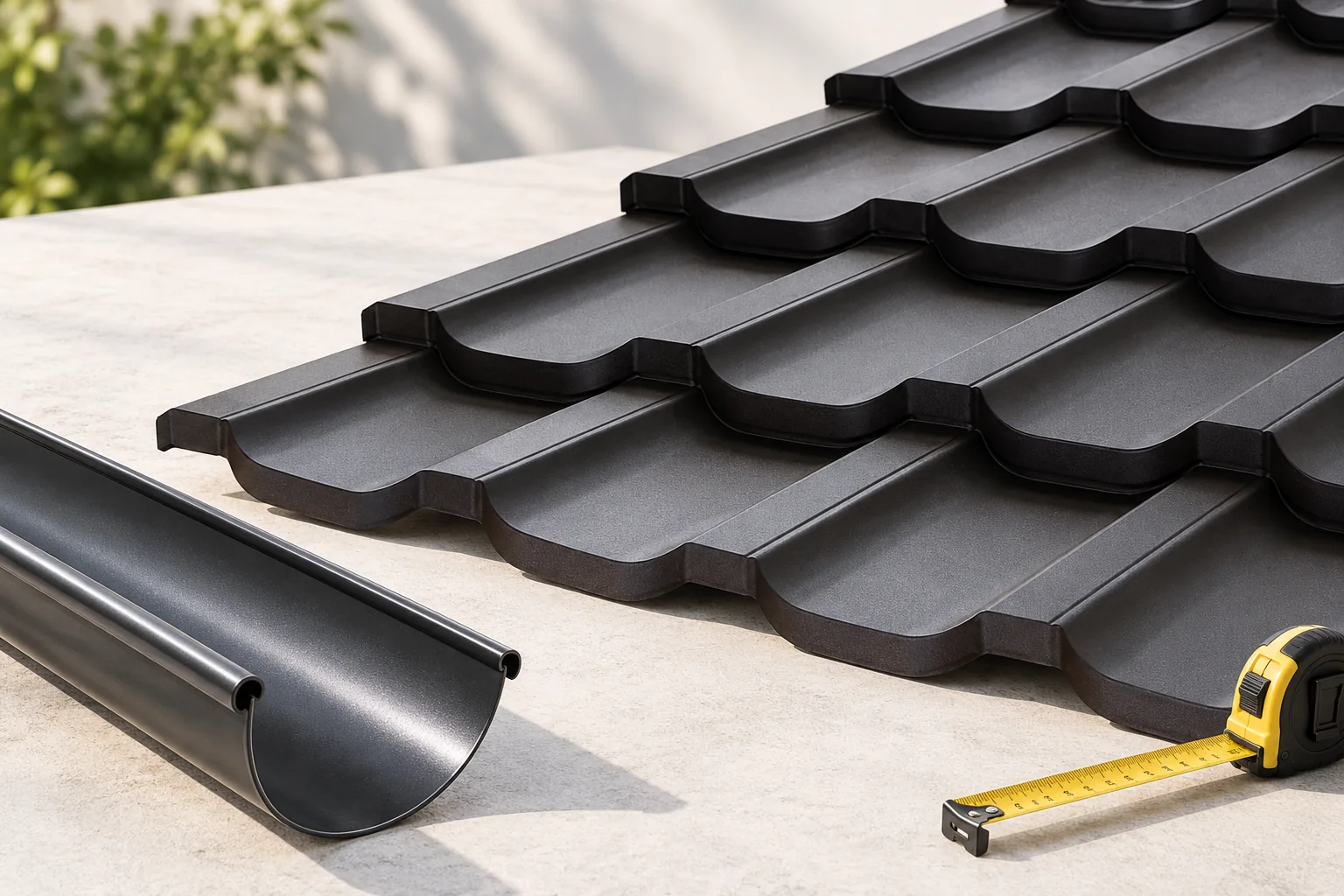
The position of the gutter is coordinated with the termination of the roofing and the eaves flashing. Water must also reach it at points of increased runoff. At the same time, the ventilation under the sheet metal must not be accidentally closed off. The detail must be matched to the tile-effect metal roofing (Dachpfannenblech) or to the specific T18 or T35 profile.

Why is it not worth mixing random components?
The gutter, connector, seal and bracket form a cooperating set. Similarity of shape is not enough for parts from different systems to work correctly. Differences in tolerances, fastening and thermal behaviour can cause difficulties during assembly. Sometimes they only become apparent when the weather changes.
The range should include all parts needed for the route shown. It is worth checking especially unusual corners and transitions at the cornices. Before installation, the method of fixing the brackets must also be determined. Their spacing is not selected according to a single rule for every material and roof layout.
Where should the water from the downpipes go?
Drainage does not end at the lower bend of the pipe. The point of water discharge and the possibility of inspecting this section must be determined. Directing the stream to a random point near the building can cause dampness in the surroundings. The solution should suit the site development plan and the existing installation.
If rainwater harvesting is planned, the position of the equipment must be coordinated with the pipe route. Not every accessory fits every cross-section. In the concealed variant, access for cleaning and assessing tightness is important. Merely hiding the pipe in the structure does not reduce its servicing needs.
How can you compare cost and subsequent maintenance?
Compare the complete set: gutters, pipes, brackets, clamps, outlets, connectors and installation. Additionally include flashings and any concealment. On a roof with many corners, the cost of accessories can significantly change the result. The price per metre of gutter is only one item in the comparison.
Also determine a safe method for cleaning and inspecting the outlets. A house among trees will require attention regardless of the material chosen. Signs of water overflow, stains and deformation should be clarified quickly. A well-chosen system is one whose performance, installation and access for maintenance suit the specific roof.
7 branches. Materials closer to your project.