How to choose metal fence pickets? Dimensions, gaps and installation
Metal fences
Metal pickets allow you to choose the height, gaps and rhythm of the fence without giving up lightweight, profiled elements. Before purchase, however, you need to calculate the clear width of the bays and plan the support. The number of metres of fence alone does not determine the number of pickets. What matters is the profile width, the spacing, the type of finish and whether the layout is single-sided or double-sided. Posts and foundations must correspond to the load of the entire fence. Width determines the rhythm of the bay, and height determines the course of its top line. Profile depth describes the pressing that increases the rigidity of thin sheet metal. This is a different dimension from material thickness. A picket a dozen or so millimetres deep is not a solid steel element of that thickness.
How to read picket dimensions?
The width determines the rhythm of the bay, while the height determines the line of its top edge. The profile depth describes the pressing that increases the rigidity of the thin sheet. This is a different dimension from the material thickness. A picket with a depth of several millimetres is not a solid steel element of that thickness.
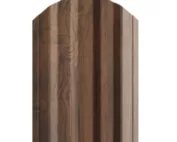
An example product is 115 mm wide, 18 mm deep and made of 0.50 mm thick steel. Shallower and wider profiles also exist. They should not be swapped without re-measuring. The height available in production does not on its own determine the permissible distance between posts. A long element must have support suited to its properties and to the wind conditions.
How to count pickets in one bay?
Each bay is calculated most accurately on its own. Measure the clear span between its boundaries. Assume the picket width and the number of pieces, then check the resulting gaps. If the gaps are to be equal at the sides as well, there remain two edge gaps and the gaps between successive pickets.
Example: a clear span of 2000 mm, fourteen pickets of 115 mm and fifteen equal gaps. The pickets occupy 1610 mm. 390 mm remain, i.e. 26 mm per gap. This is a calculation for the assumed layout, not a recommended gap for every property. With different edge gaps, these must be calculated separately. Only after drawing all the bays should the material be totalled.
How do gaps affect privacy and wind?
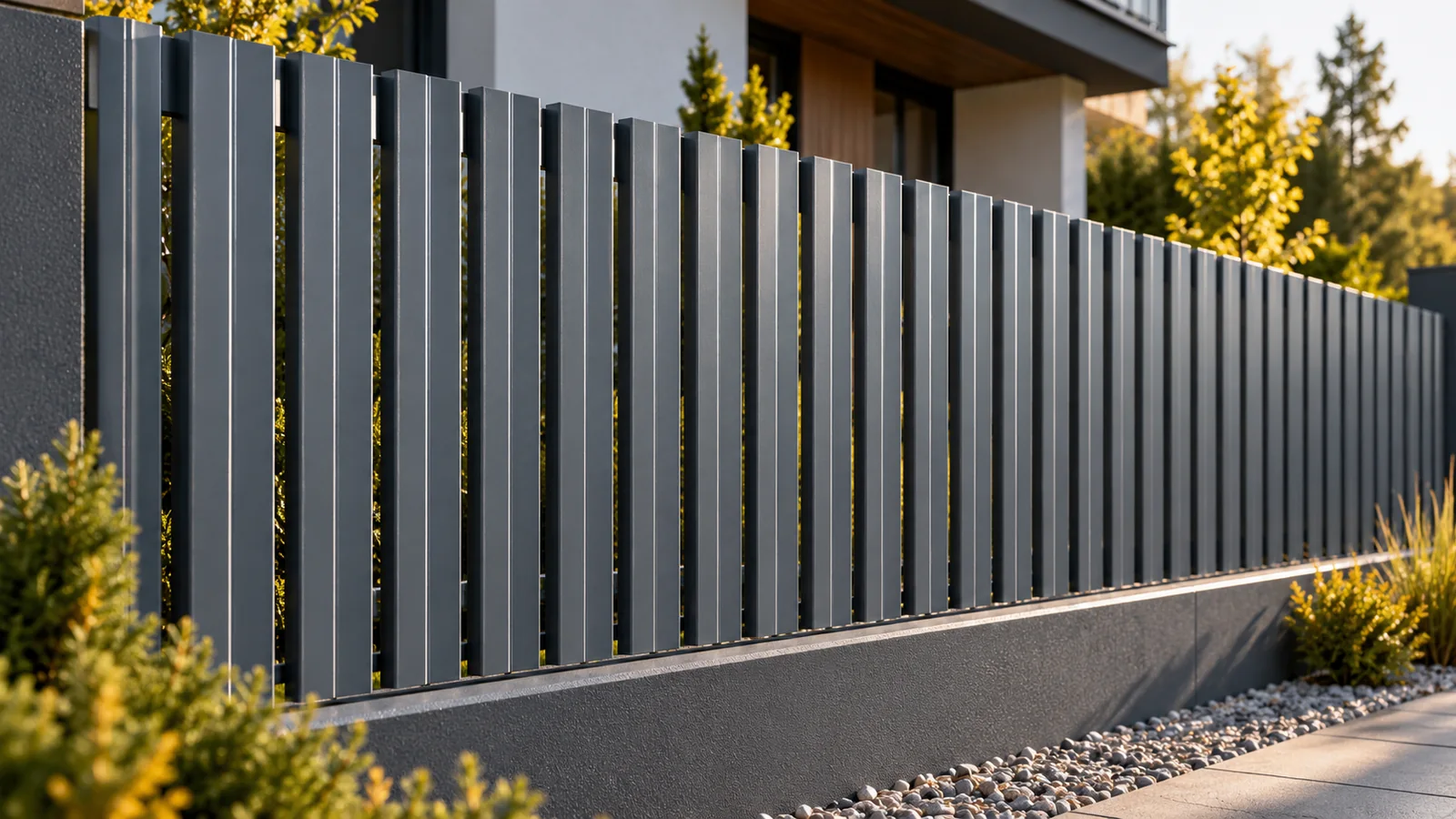
Small gaps give greater screening but restrict airflow. A fence with dense infill can place a greater load on the posts and foundations. An existing lightweight structure should therefore not be filled with an almost airtight wall without assessing its strength. Open, windy areas require particular attention.
A double-sided layout with offset pickets can restrict visibility at a certain angle. However, it uses more material and requires a fixing plan. It does not guarantee full opacity from every side. Before ordering, it is worth assembling a small section from samples or viewing a real bay. A drawing viewed straight on does not show the oblique view.

Which profile and finish to choose?
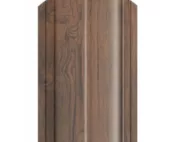
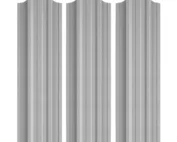
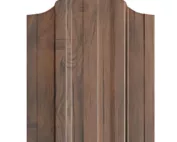
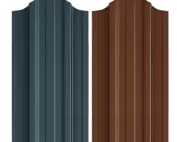
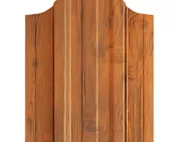
A straight finish gives a calm line. Rounded or slanted finishes change the rhythm of the fence. The availability of such a finish depends on the model. Not every profile can be cut on site without changing its appearance and edge protection. If the top is to form an arch or steps, prepare a schedule of lengths before production.
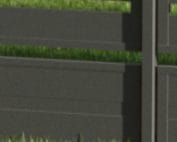
Pickets can be installed vertically or horizontally, provided the system allows it. Changing the direction, however, alters the method of support and the loads. An element suitable in a short vertical arrangement does not necessarily perform well as a long horizontal run. The rails, fixing spacing and end pieces must be matched. The two orientations should not be treated as interchangeable without checking the documentation.
What should be checked on the coating and fixings?
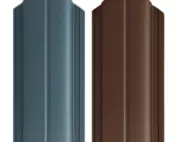
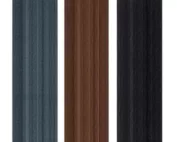
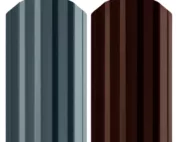
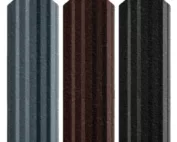
Before purchase, examine both sides of the sample. A picket that is decorative on one side may look different from the property side. With the double-sided version, the colour and texture must also be confirmed. The same shade number does not guarantee identical gloss across different parts of the fence.
The fasteners must match the rail material and the picket system. They should not cause unnecessary deformation of the thin sheet. The quantity and positions of the fixings are determined by the design, not by a random pattern from another profile. During work, the coating must be protected from scratching. Drill swarf must be removed so that it does not remain on the finished surface.
How do I order a complete set?
Record the dimensions and the number of bays, the pickets broken down by length, and the chosen rhythm of gaps. Count the posts, rails, fixings and end pieces separately. Treat the gate and the pedestrian gate as separate structural elements. Their widths, weight and fittings do not follow automatically from the calculation of simple bays.
Check whether the delivery includes all parts and how they will be packed. After installation, allow for periodic washing and inspection for damage. Metal does not require the same care as wood, but this does not mean no inspections are needed. Dirt, damaged coating and trapped moisture can also worsen its condition. A well-chosen fence combines ease of maintenance with a properly designed structure.
On sloping ground, determine whether the bays will be stepped or follow the slope. This changes the lengths of the elements and the appearance of the gap at ground level. This should not be resolved only by randomly shifting the pickets during installation. At the gate, the space required for its movement must also be maintained.
7 branches. Materials closer to your project.